
The best trailer light kits use weatherproof LED technology wired through a 4-pin or 7-pin connector to deliver brake lights, turn signals, running lights, and reverse illumination — with top-rated options from True MODS, MaxxHaul, and Cyfie available on Amazon for $18 to $85 depending on trailer type and feature set.
There's a specific kind of dread that hits you about 40 miles into a road trip when you realize you never tested your trailer lights before leaving the driveway. Not a dramatic realization — more of a slow-creeping suspicion, the kind that starts as a vague background anxiety and builds until you're watching semis give your trailer an unusually wide berth and you start to wonder if that's normal or if something is very, very off.
Trailer lights are one of those deceptively boring topics that turn urgent the moment something goes wrong.
They're also — and this part gets skipped in most buying guides — genuinely interesting once you understand what each light is actually doing and why the wiring matters as much as the hardware. A blinking brake light isn't just legally required. It's the thing standing between your trailer and the car behind you doing 70 on the highway. That framing changes how seriously you take the $35 light kit.
I've wired up enough trailers — boat trailers, utility trailers, the ancient rusted horse trailer my neighbor asked me to "just look at quickly" (three hours later) — to have developed some real opinions here. This guide is those opinions, organized.
Key Takeaways
- 4-pin flat connectors are the standard for most small utility and recreational trailers — they handle brake, turn, tail, and ground
- 7-pin round connectors are required for trailers with electric brakes, reverse lights, or auxiliary power (most larger RVs and campers)
- LED light kits outlast incandescent versions significantly and draw less power from the tow vehicle — worth the modest price difference
- Weatherproofing rating matters more than most buyers realize — cheap kits corrode within two seasons in wet climates
- Top-rated kits on Amazon range from $18 (basic 4-pin utility) to $85+ (full LED RV kits with all functions)
Why Trailer Lights Matter More Than You Think They Do
The legal argument is easy. In every U.S. state and most countries, operational trailer lights are required by law — full stop. Get caught towing without them and you're looking at equipment violation fines that make even the cheap light kits seem expensive in retrospect.
But the real argument isn't legal. It's physical.
A towed trailer — especially a long one — extends well behind your vehicle's natural footprint. Other drivers can see your car fine. They cannot necessarily see your trailer's rear edge at night, in rain, in fog, or in the chaotic visual mess of highway traffic at dusk when ambient light is just bright enough to make headlights useless and just dark enough that nothing is fully visible. Your trailer's lights are the only communication channel between your rig and everyone behind you.
Brake light fails. The driver behind you gets less reaction time. At speed, the math on that isn't comfortable.
Turn signal fails. Lane changes become a surprise for whoever is next to you.
Running lights fail. Your trailer essentially disappears at night. Rear-end risk goes up dramatically.
None of this is theoretical. The NHTSA reports that trailer-related crashes — many involving lighting failures or visibility issues — contribute to thousands of accidents annually. That number is underreported, incidentally, because "trailer lighting failure" often gets logged as a generic rear-end collision rather than a lighting-specific cause.
Types of Trailer Light Kits (What the Labels Actually Mean)
4-Pin Flat Connector Kits
The most common configuration for small to mid-size trailers — boat trailers, utility trailers, small cargo trailers, and pop-up campers. Four functions: left turn/brake, right turn/brake, tail/running lights, and ground. Simple, reliable, widely compatible.
If your trailer doesn't have electric brakes and doesn't need reverse lights or aux power — this is your connector.
5-Pin and 6-Pin Connector Kits
Less common but occasionally found on trailers with a single battery charging circuit or basic electric brake wiring. Not universal enough to be the first recommendation for most buyers, but worth knowing they exist if you're retrofitting an older trailer.
7-Pin Round Connector Kits
Required for anything with electric brakes. Also handles reverse lights and aux power — which means trailers with their own battery systems (most travel trailers and fifth wheels), campers, and anything large enough to need powered brake actuation rather than surge brakes.
If you're unsure whether your trailer needs a 7-pin, check whether it has electric brakes. If yes, 7-pin. If your trailer has a refrigerator, interior lighting, or any powered components that run from the tow vehicle, 7-pin.
LED vs. Incandescent
The answer here is LED, almost unconditionally. Incandescent trailer lights were standard for decades, and they still work — but they run hotter, they're more vulnerable to vibration failure (filament breakage), and they burn out faster, especially in the wet conditions that trailers spend a lot of time in.
LED trailer lights draw less power, last longer (5-10x typical lifespan depending on brand quality), and are now price-competitive with incandescent equivalents. The $4 price difference between an incandescent kit and its LED counterpart pays back within a single season for most trailers.
Installation: What the Instructions Don't Tell You
Quick answer: Connect each wire to its corresponding function lead using the color code (brown = tail, yellow = left brake/turn, green = right brake/turn, white = ground), secure all connections with waterproof crimp connectors or heat-shrink solder connectors, and test before mounting lights permanently.
What the Manual Skips
The ground wire is the source of 80% of all trailer lighting problems.
This is not an exaggeration. Intermittent lights, dim running lights, brake lights that activate erratically, turn signals that behave strangely — the vast majority trace back to a ground connection that's corroded, loose, or connected to a painted surface rather than bare metal.
Your ground wire (white, typically) needs to connect to bare metal on the trailer frame — not to a bolt that threads into painted steel, not to a bracket that might have surface rust under the paint, not to anything that creates resistance between the wire and the actual metal. Scrape bare metal, connect directly, and use a star washer if possible to bite through any surface oxidation.
Do that one thing correctly, and most trailer lighting problems never happen.
Connector Protection
Marine-grade dielectric grease packed into the connector housing before mating reduces corrosion significantly. This takes about 45 seconds and extends the connector life dramatically. Most kits don't include it. Buy it separately — a tube costs $4 and lasts for years.
Wire Routing
Route all wiring away from moving suspension components, exhaust pipes (obvious but worth saying), and sharp metal edges. The trailer flex that happens when going over bumps and around corners can abrade unprotected wire insulation in exactly the locations where it contacts metal surfaces. A problem that develops slowly and then announces itself with a short circuit at the worst possible moment.
Use loom (split conduit) or rubber grommets wherever wires pass through holes in the trailer frame. Takes 20 minutes. Worth every second.
Maintenance: What "Regular Checks" Actually Means in Practice
The advice to "check your trailer lights before each trip" is repeated so often it becomes background noise — something people nod at and then don't do. Here's a more realistic version.
Before every trip: Have someone stand behind the trailer while you cycle the brake pedal, hazard switch, and reverse. Full cycle, 30 seconds. Do this every time. This accounts for roughly 40% of light failures that occur during storage between trips — corrosion, rodent damage to stored trailers, and connector contamination.
Each season: Disconnect all connectors, inspect the pins for green corrosion, clean with electrical contact cleaner, and repack with dielectric grease. Check wire insulation along the full length where visible. This takes about 20 minutes and catches problems before they become roadside emergencies.
After submersion (boat trailers): Inspect the connector housing for water intrusion after every launch. Salt water is particularly aggressive — rinse the connector and trailer frame with fresh water if you're in a saltwater environment.
Legal Requirements: What You Need to Know (and What Varies)
In the United States, Federal Motor Vehicle Safety Standard 108 governs trailer lighting requirements — requiring tail lamps, stop lamps, turn signals, reflectors, and clearance lamps on trailers over certain widths. Each state can add to these requirements, which is why checking your state's DMV guidelines for the specific trailer type you operate is worth the 10 minutes.
In the UK, trailer lighting requirements fall under The Road Vehicles Lighting Regulations 1989 (updated multiple times since) — red rear lights, brake lights, direction indicators, and reflectors are mandatory for road use.
Canada follows federal requirements under CMVSS 108 (mirroring US standards largely) with provincial variations.
The consistent thread across all jurisdictions: brake lights, turn signals, and tail lights are universally required. Reverse lights and clearance lights have size-based thresholds. Check your specific trailer dimensions against your jurisdiction's requirements if you're at the edge of those thresholds.
Final Thoughts
Trailer lights are the kind of purchase that feels unimportant right up until the moment they matter — which is usually at night, in the rain, on a highway, with traffic behind you.
The good news is that quality here is not expensive. The difference between an $18 budget kit and the $40 Hopkins kit that will outlast your trailer isn't dramatic in dollar terms. In reliability terms — in the number of trips where something fails at an inconvenient moment — it's significant.
Buy LED. Get the Hopkins or Curt kit for the standard 4-pin application, or the Hopkins 7-pin for anything that needs electric brakes or auxiliary power. Install the ground correctly (bare metal, every time). Pack the connector with dielectric grease. Test before every trip.
That's the whole job.
Need help? We've done the research for you and found the Best Trailer Light Kit on Amazon. Every day, we read hundreds of reviews and try the highest-rated products we have on our list.
Best Trailer Light Kit
The Best
Product information
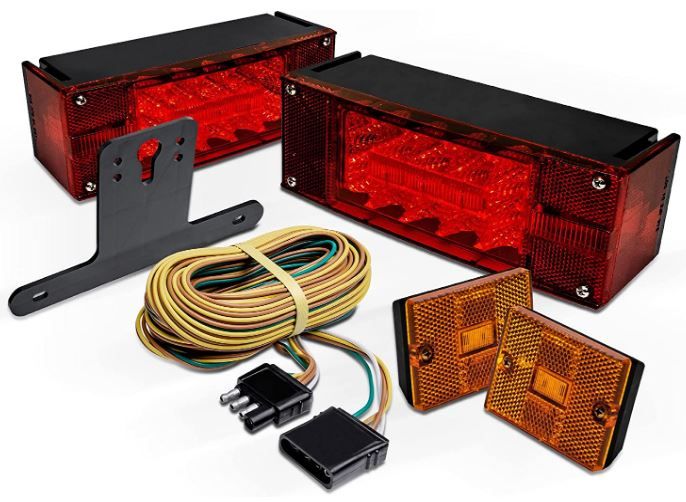
When it comes to visibility and safety, more is better. With a total of 36 powerful LEDs, an internal chrome reflector to maximize light output, and high-visibility reflective lenses, these trailer lights don't settle for less.
Built with epoxy-encased electronics and a sonically sealed body to prevent water intrusion, our lights have earned their DOT certification and IP67 rating.
Our lights combine turn signals, brake lights, tail lights, a license plate light, front and rear side marker lights, and reflectors into one kit, to conform to the trailer lighting requirements of DOT FMVSS-108 for trailers over 80" wide.
Looking for wiring to finish your installation? It's included. How about a license plate bracket? Also included. Wiring clips, terminals? Yup, included. A trailer to put the lights on? OK, so we included almost everything you need.
We also included a few features to make your life a bit easier. Like two separate wiring exit points on the back of the light, so you can adjust the installation to fit your needs.

A great trailer lighting kit that can replace and improve your old setup.

Some customers reported missing and damaged parts. Not waterproof. The wiring should be longer.
Our Thoughts - We picked this kit as the best because it's the best. It provides a solid set of lights.

Very Good
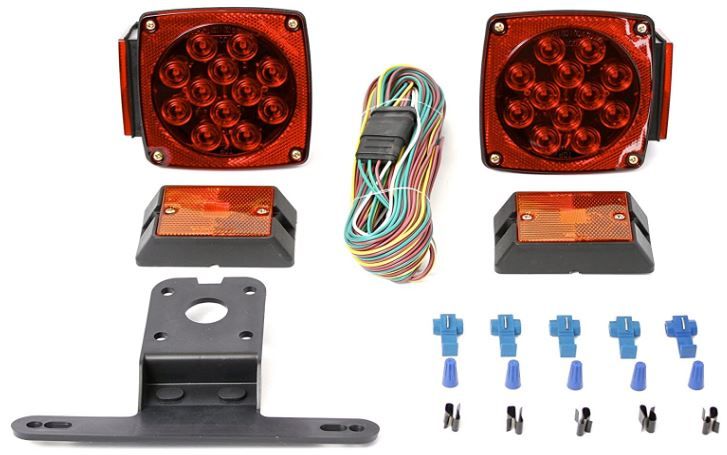
Product information
This trailer lighting kit is a comprehensive solution for all your trailer lighting needs. It includes stop, tail, and turn signal lights, along with two amber clearance lights for enhanced visibility. A wiring harness is also part of the package, ensuring a seamless installation process. This product falls under the category of Lighting and Electrical, offering a robust solution for trailers' lighting requirements.
The kit features high-visibility LED taillights, which are known to outlast standard incandescent lights. This ensures long-lasting performance, reducing the need for frequent replacements. The side lenses in this kit come with a standard bulb, providing sufficient illumination. Additionally, the kit complies with DOT standards, making it a reliable choice for your trailer.
Built with durability in mind, the kit's housing is corrosion-resistant, ensuring it can withstand harsh conditions. This makes it suitable for trailers less than 80 inches wide. To ensure easy installation, the kit includes a 23-foot wiring harness with UV-coated jackets, protecting the wires from potential damage caused by exposure to sunlight. With this kit, you get a combination of durability, compliance with standards, and high visibility.

The lights are good, bright, and efficient at an affordable price.

Some customers reported that the cables are substandard and too short for longer trailers. The lights are not waterproof. The amber side lights are not LEDs.
Our Thoughts - This is a fairly good trailer light kit for the money. A few niggly issues, mainly caused by the packaging and sipping, make it regular.

Good Value
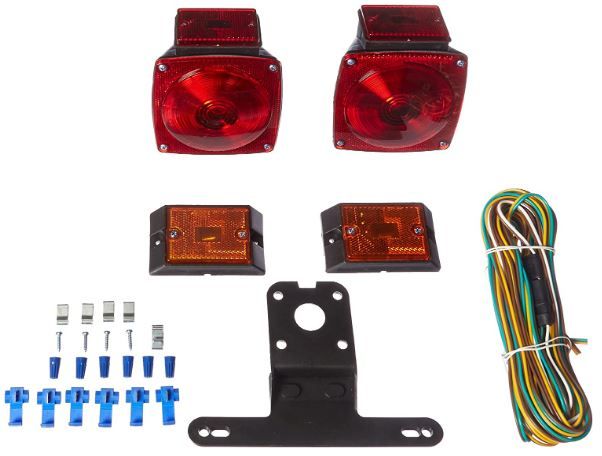
Product information
This trailer light kit is specifically designed for trailers measuring under 80 inches. It offers a comprehensive lighting solution, including stop, tail, and turn signal lights. The kit also comes with two amber clearance lights, ensuring maximum visibility and safety on the road. Additionally, it includes a wiring harness, making installation a breeze.
The kit features a 25-foot split y-style harness and 4-foot 4-pole color-coded copper wires, ensuring ease of use and installation. The large 4.5-inch X 5-inch lenses provide optimal visibility, enhancing safety during your journeys. Furthermore, the kit goes beyond just basic lighting needs and includes a license plate light and bracket. This makes it an all-inclusive package, meeting all your trailer lighting requirements.

The lights are fine. No issues with installation.

Not waterproof. The wires are cheap and could be longer.
Our Thoughts - This kit will give you all the essential parts you need. Can be used on a variety of trailers.

Good
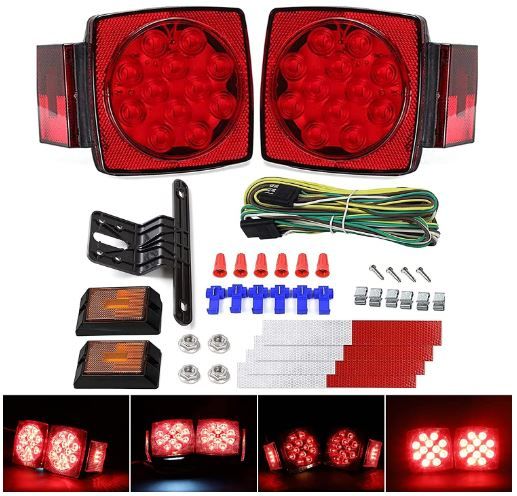
Product information
This trailer light kit provides everything necessary to set up a robust and reliable lighting system for your trailer. The kit includes 12V LED tail and turn signal lights, two amber clearance lights, a license plate bracket, wires, a wiring harness, and stainless steel hardware for easy fastening. All these components are constructed from corrosion-resistant materials, ensuring durability and long-lasting performance.
The kit's hardware, including a 22 ft. split Y-style color-coded harness, is corrosion-resistant, proving its resilience and longevity. These heavy-duty trailer lights are fully operable even in inclement weather conditions, showcasing their toughness and adaptability. With this kit, you get a durable solution that promises long-term use.
Safety is another hallmark of this trailer light kit. The lights are compliant with DOT FMVSS108 standards, ensuring federal compliance for visibility, durability, and reliability. This compliance secures safety and reduces the risk of liability in the event of property damage or personal injury. With these DOT-compliant lights, you can be assured of enhanced safety on the road.
These special LED trailer lights are versatile and suitable for trailers under 80 inches wide. They are designed to fit trailers of all shapes and sizes, whether they're for boats, RVs, jet ski trailers, or utility trailers under 80 ft in width. With this kit, you get a perfect lighting solution that adapts to your specific needs.

The product itself is fine, but other small issues put it below the standard. Fairly easy to fit on the trailer.

Some customers reported that they received used kits. Others had missing parts in the kit. Instructions could be better.
Our Thoughts - Packaging and shipping need to improve. These lights may be DOT certified, but the process that follows is bad. We can't understand why Amazon allows this type of bad packaging and shipping standard in its business.

Good
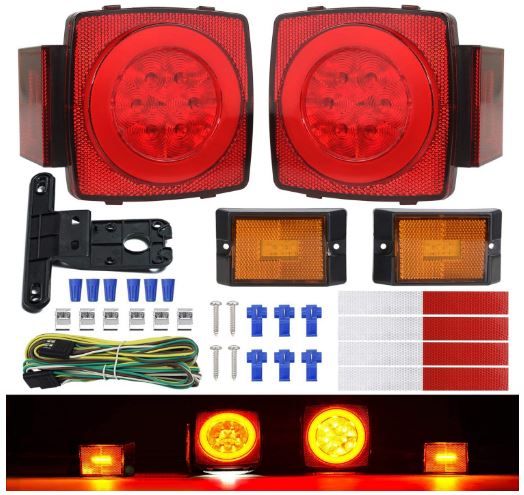
Product information
The trailer tail light kits come fully equipped with everything you need for a safe and efficient lighting system. The package includes two distinctive stop-turn LED tail lights, featuring a unique halo glow and solid light pattern design that sets them apart from other market offerings. Also included are two amber clearance lights, a 25-foot wiring harness with a 4-flat plug, a license plate bracket, and four complimentary reflective stickers for added visibility.
One standout feature of these LED trailer lights is their robust construction. There are no screws on the lampshade as the lights are fully welded together. The circuit board of the tail light is sealed, and a drain hole is strategically designed to expel any water, ensuring that water will not damage the diodes or circuit board. This excellent sealing provides superior waterproofing and submersibility. For optimal performance, it's recommended to install the trailer taillights with the drain hole facing downwards.
The utility trailer light kit also boasts a lampshade made from corrosion-resistant ABS material, complying 100% with DOT-approved standards. This ensures the lights meet the highest safety and quality regulations. The 25ft wiring harness is more durable than traditional copper-coated aluminum wires and comes with a split Y-style color-coded harness for easy installation.
These trailer lights are versatile and can be used on 80-inch width tractors, including trucks, trailers, boats, buses, lorries, vans, caravans, and snowmobiles. Ensure the correct wire connection and check for any electronic shorts before submerging underwater. With this kit, you're investing in durability, safety, and wide applicability, enhancing your driving experience.

The lights are bright and easy to install.

Customers reported that some parts were missing from the kit. Cables could be longer. Not waterproof.
Our Thoughts - Overall, this is a good product with only a few niggly issues that make it not perfect.

Good for boats
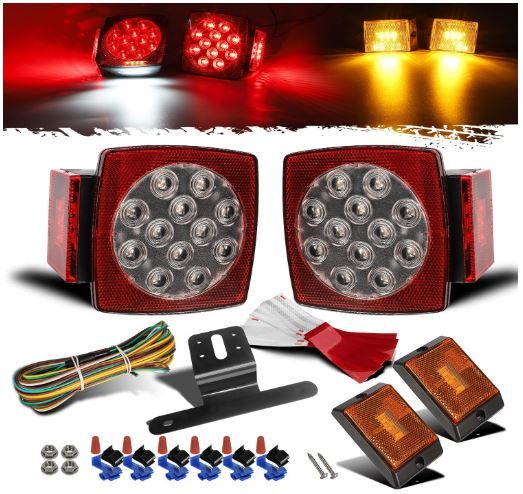
Product information
4.56" long x 3.78" tall x 2.63" deep; trailer light kit with 2 stud mount waterproof LED tail lights, corrosion-resistant license-plate bracket, 25ft wiring harness(one 21.98 feet and one 3.93 feet wiring harness), stainless steel mounting hardware, 2pcs amber clearance lights, and 4pcs reflective stickers. 2-stud mount on 2" centers.
2 Clear/Red, waterproof, stud-mounted LED trailer tail lights for less than 80" trailers, tractors, trucks, boats, snowmobiles, esp. ideal for jet ski trailer lights. Square trailer light serves 7 functions: Stop light, Turn signal light, and tail light. Rear reflector, Side marker light, Side reflex reflector, License plate illuminator(only for LH Side/Driver Side).
For this Red submersible LED trailer light kit, the right light has 16 LEDs (12 faces, 4 sides); the left/streetside light has 21 LEDs (12 faces, 4 sides, 5 bottoms). These trailer tail lights have no screws on the lamp shade, the LED trailer lights are completely welded together, and the circuit board of the tail light is sealed. Excellent tightness makes it definitely IP67 waterproof and submersible. Of course, you can also put the clear epoxy around it for a guarantee

These work as they should. Great price for what it is.

Not waterproof, must use silicon sealant on all joints. Some customers reported missing items in the kit.
Our Thoughts - No reports about bad customer service. All around is a good kit that will do the job.

FAQs: Trailer Light Kits
Is it difficult to install a trailer light kit?
Installation difficulty can vary based on the kit and your experience. However, most kits come with instructions, and there are numerous guides available. If you're not confident, it's best to seek professional installation.
How often should I check my trailer lights?
It's recommended to check your trailer lights before each trip to ensure they are functioning correctly. Regular maintenance checks are also advised.
Where can I buy a trailer light kit?
Trailer light kits can be purchased at automotive shops, specialty trailer stores, or online at Amazon.com. Compare options and prices to find the best kit for your needs.
What trailer light kit do I need for a basic utility trailer?
For most small utility trailers, a 4-pin flat LED kit covering brake lights, turn signals, tail lights, and ground is sufficient. The Hopkins 48915 or Curt 56165 covers the standard 4-pin configuration that works with the vast majority of pickup trucks and SUVs.
Do I need a 4-pin or 7-pin connector?
If your trailer has electric brakes, reverse lights, or any powered interior systems, you need a 7-pin. For basic trailer functions (brake, turn, tail, ground only) — 4-pin is standard. When in doubt, check your trailer's existing connector if it has one, or consult the trailer manufacturer's spec sheet.
Are LED trailer lights better than incandescent?
Yes, for most applications. LED trailer lights last significantly longer, draw less power, and are more resistant to vibration damage. The price difference is minimal. The only scenario where incandescent might make sense is extreme cold climates where LED brightness can drop at very low temperatures — but for most recreational and utility use cases, LED is the correct choice.
How do I fix dim or intermittent trailer lights?
Check the ground connection first — always. Disconnect the white ground wire and reconnect it to bare metal on the trailer frame, with the surface cleaned to bare metal. This fixes the majority of dim and intermittent light problems. Second check: clean the connector pins with electrical contact cleaner and repack with dielectric grease.
Can I install a trailer light kit myself?
Yes — most 4-pin kits are genuinely DIY-accessible with basic tools and an hour. The wiring is color-coded, the connections are simple, and the main technical requirement is a good ground connection rather than specialized knowledge. Larger 7-pin installations with electric brake wiring are more complex but still within DIY range for anyone comfortable with basic automotive electrical work.
How often should I replace trailer lights?
LED trailer lights don't have a fixed replacement interval — a quality LED kit properly installed and maintained can last 10+ years. Replace individual lights when they fail or when lens hazing degrades output noticeably. Replace connectors and wiring when you see consistent ground problems, pin corrosion that cleaning doesn't resolve, or visible insulation damage.
Looking for additional automotive essentials?
Check out our other articles!
 Save With Reviews
 Save With Reviews
 Save With Reviews