
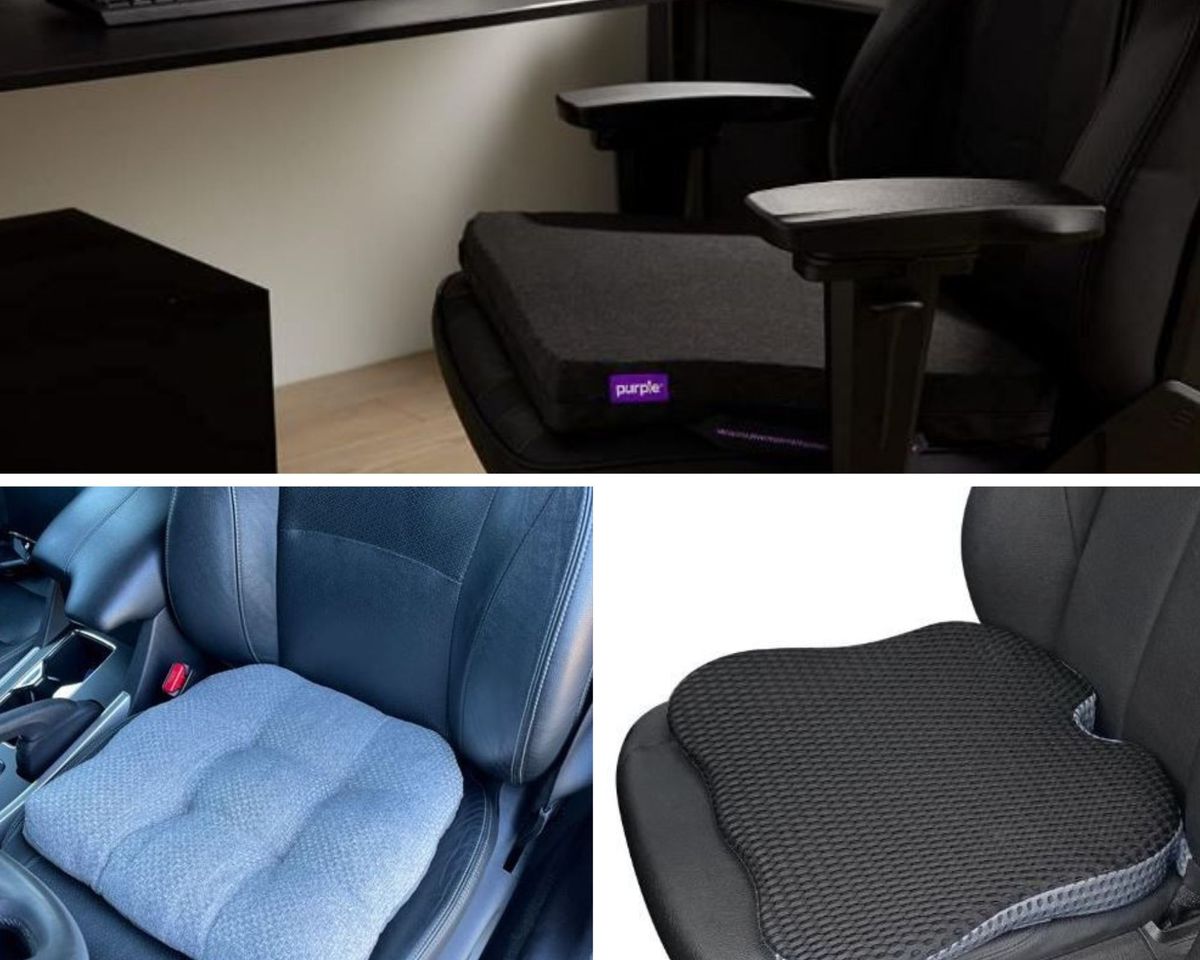
Quick Answer: The best seat cushion for most people in 2026 is the HozYi Gel Seat Cushion — TPE honeycomb gel, superior airflow, sciatic nerve pressure relief, and a large surface area that fits most seats. Best for wide or tall builds: Desk Jockey Jumbo (X-Large and 2X-Large, anti-slip bottom, 100% polyester). Best for drivers specifically: Dreamer Car Wedge (promotes spinal alignment, improves leg circulation on long drives). Best for office or bar stools: Gorilla Grip Memory Foam (tufted, hard-surface-optimised). Best all-round versatile option: Purple Double Seat Cushion (breathable grid, office/car/home/wheelchair).Reviewed and updated June 2026 by Save With Reviews.
There's a particular kind of tiredness that sits — no pun intended — somewhere between your tailbone and your lower back after you've been in a chair for four hours without moving. It's not the tiredness of exertion. It's the tiredness of compression. Tissue and nerve slowly communicating to your brain that something about this situation is anatomically incorrect, and has been for some time, and could you please address it.
Most of us ignore that signal for years. We adjust. We shift. We stand up, briefly, refill a water glass we don't need, and sit back down in the same position we just escaped from. Repeat, indefinitely, across an entire professional life.
A seat cushion is not a cure. I want to be upfront about that — there's nothing here that will undo the accumulated toll of years at a desk, or replace a proper ergonomic chair, or negotiate with a lumbar disc that's already decided to be problematic. But between "doing nothing" and "replacing all your furniture and restructuring your working posture from scratch," there's a middle option that actually works for many people and costs considerably less than either extreme.
That middle option is a well-chosen cushion. One that fits your seat. One that stays put. One that breathes. One that you'll actually use rather than sliding under the desk after three days because it kept migrating across the chair every time you shifted weight.
We tested five. Here's what we found.
Why Your Sitting Position Is Probably Not Fine
Dr. Jan Lefkowitz, founder of Body in Balance in New York, has said something that stuck with me: around the 30-minute mark, the muscles responsible for maintaining sitting posture essentially clock out. After that, you're not sitting — you're gradually collapsing. Shoulders fold forward. The head juts out ahead of the spine. Lumbar curve flattens. Discs absorb pressure in patterns they weren't designed for.
The uncomfortable part — and this is worth sitting with — is that this happens regardless of how much you care about posture. It's not a discipline failure. It's physiology. The postural muscles fatigue. The slump follows, almost mechanically, because that's what unloaded muscles do.
What a good cushion does is shift some of that mechanical equation. By tilting the pelvis slightly forward (wedge designs), or by distributing pressure away from the ischial tuberosities — the sit bones — toward a wider surface area, a cushion can extend the comfort window before the muscles give out. That's not marketing. That's load distribution. Physics, essentially, applied to the problem of your spine.
The Materials Landscape: What You're Actually Sitting On
The cushion market in 2026 has expanded far enough that the range of materials on offer is genuinely confusing if you approach it without context. So: a brief, honest summary.
Standard foam is the oldest technology. Comfortable initially, prone to compression over time, loses its properties under sustained heavy use. Fine for occasional use. Less fine if you're on it eight hours a day.
Memory foam was the upgrade for a long time — and is still widely used. It contours to body shape, distributes weight evenly, and provides better support than standard foam for extended sessions. The limitation: it retains heat. Memory foam is not breathable. In a warm office or a sun-heated car, that matters. Also, do not put memory foam in a washing machine. It will emerge as a useless, distorted sponge with deeply hurt feelings.
TPE gel is the newer generation. Thermoplastic elastomer, structured in a honeycomb grid, is both supportive and ventilated in a way memory foam fundamentally cannot be — because the grid structure creates airflow channels through the cushion itself. It doesn't trap heat. It adapts to body shape. And it maintains its structure under sustained use better than memory foam, particularly for heavier users.
Polyester/spandex blends (like the Purple Double cushion on this list) are a different approach entirely — more about the outer cover and grid structure than the foam beneath. The stretch factor makes fitting the cushion to various seat shapes easier, and the breathability is excellent.
The practical question isn't which material is theoretically superior. It's which material suits your specific use case, your body weight, your temperature sensitivity, and the seat you're actually putting it on.
At a Glance — Comparison Table
| # | Product | Material | Key Feature | Best For | Anti-Slip | Rating |
|---|---|---|---|---|---|---|
1 | HozYi Gel Seat Cushion | TPE honeycomb gel | Airflow + sciatic relief | Office, car, wheelchair | Yes | ★★★★½ — 4.5/5 |
2 | Purple Double Seat Cushion | 92% polyester / 8% spandex | Double-layer grid, breathable | Office, home, car | Yes | ★★★★¼ — 4.3/5 |
3 | Gorilla Grip Memory Foam | Memory foam (tufted) | Hard-surface support | Wooden chairs, bar stools | Yes | ★★★★ — 4.2/5 |
4 | Desk Jockey Jumbo | 100% polyester | XL/2XL for big & tall | Wheelchair, large seats | Yes | ★★★★ — 4.1/5 |
5 | Dreamer Car Wedge | Memory foam (wedge) | Posture angle, leg circulation | Long-distance driving | No (car seat) | ★★★★ — 4.0/5 |
What to Look for in a Seat Cushion
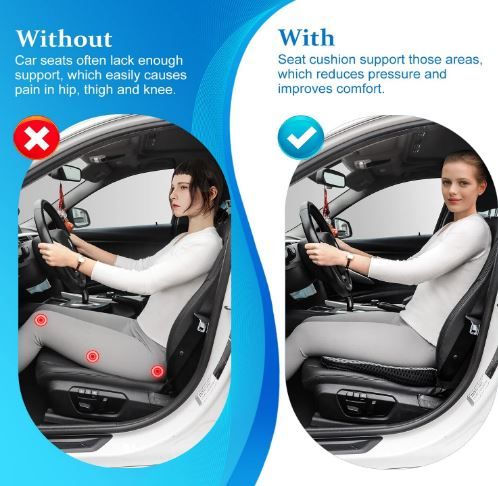
Fit your specific seat first. A cushion that migrates across the seat mid-drive or tips off the front of an office chair is worse than no cushion — it's a distraction. Measure the seat you're covering. Buy within 2–3 cm of those dimensions. An anti-slip bottom is non-negotiable for smooth seat surfaces.
Prioritise airflow if you run warm. Memory foam is the heat trap of the cushion world. Gel and grid designs breathe. If you've abandoned seat cushions in the past because they made sitting hotter, the HozYi's TPE honeycomb construction specifically addresses that.
Match material to use intensity. Occasional use at a dining table: memory foam works fine. Eight hours daily in an office chair: gel or grid. Very heavy sustained loads: oversized polyester like the Desk Jockey. Car driving with posture concerns: wedge memory foam.
Understand the washing rules before buying. Memory foam cannot go in a washing machine without risk of damage — spot-clean only, air dry. Polyester and polyester blends can go in the wash. TPE gel covers come off and wash separately. If ease of cleaning matters to you (and it should — cushions accumulate things), factor washability into your decision before purchase, not after.
Caring for Your Seat Cushion
Memory foam: never machine wash the foam itself. Spot-clean with mild detergent and cold water. Air dry completely before replacing the cover. Heat — dryers, radiators, direct sun — degrades foam structure over time.
Gel cushions: the cover washes. The gel does not. Keep gel away from sharp edges that could puncture the cell structure. Air the gel matrix occasionally to prevent any moisture accumulation in the cells.
Polyester cushions: most can be machine washed on a gentle cycle, cold water, low spin. Air dry. Check the label — manufacturing variations mean not all polyester cushions handle machine washing identically.
General: rotate cushions periodically to even out wear patterns. Store out of direct sunlight when not in use — UV degrades most cushion materials over time. Replace when the cushion no longer returns to its original thickness after use — a permanently compressed cushion is no longer performing its function.
Final Thoughts
Somewhere in the back of every office chair, every car seat, every wooden dining chair that has hosted too many hours of your life, there's a version of you that made peace with discomfort and called it normal. That version isn't wrong, exactly — adaptability is a legitimate human skill. But there's a difference between adapting to a temporary hardship and accepting unnecessary daily discomfort across thousands of hours of seated life.
A good cushion doesn't fix your posture. It doesn't replace a proper ergonomic chair. It won't negotiate with a herniated disc or restructure your relationship with your lumbar vertebrae. What it does — consistently, measurably, for most people who use one — is shift the thermal and mechanical environment your body sits in, in ways that add up across an entire day, an entire week, an entire year.
The HozYi is the one I'd start with. The gel material is genuinely better for sustained use than foam, the airflow is the feature that converts sceptics, and the price doesn't require you to treat it as a major investment. If your primary environment is the car rather than the desk, the Dreamer Wedge changes the geometry of long drives in ways that are felt before you consciously register them. And if size has historically been the reason standard cushions haven't worked — the Desk Jockey removes that constraint entirely.
Sit better. It's one of those improvements that's cheaper and more effective than most people expect it to be.
Can we help? We've done the research for you and found the best seat cushions on Amazon.
Every day, we read hundreds of reviews and try the highest-rated products we have on our list.
Seat Cushion - Reviews
HozYi Gel Seat Cushion — Best Overall
Rating: 4.5/5
Product information
Here's the thing about gel cushions that took a while to fully appreciate: the benefit isn't just comfort. It's sustained comfort. Memory foam cushions feel excellent for the first hour. The HozYi feels roughly the same at hour one as it does at hour four — because the TPE gel matrix doesn't compress and retain the compressed shape the way foam does. It returns. Consistently. Session after session.
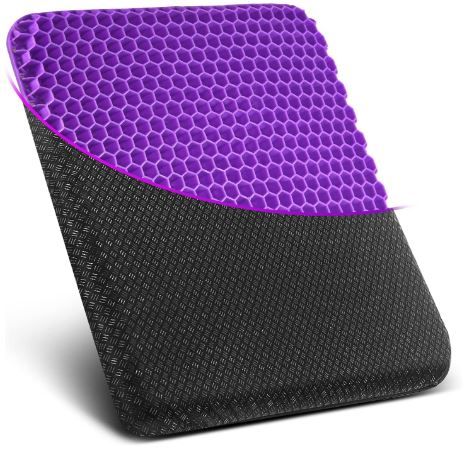
The honeycomb structure is the technical centrepiece. Each hexagonal cell in the grid is open — not filled — which means air circulates through the cushion as you shift and move, rather than being trapped beneath you. For office workers in warm environments, or drivers on long summer hauls, this is the difference between comfortable and clammy. I tested it on a 90°F afternoon, direct sun through the window, for two hours. The difference from a foam alternative was not subtle.
The large surface area matters for pressure distribution. The science here is straightforward: the wider the area over which your body weight is spread, the less concentrated the pressure on any single point. The sit bones — the two bony protrusions you're probably feeling right now if you've been reading this for a while — absorb a disproportionate share of sitting pressure on flat, hard, or inadequately padded seats. The HozYi's dimensions are designed to extend that distribution across hips and upper thighs, reducing the load on those concentrated points.
Sciatic relief is mentioned prominently in the product description and reflects genuine user feedback. The sciatic nerve runs from the lower back through the buttocks and down each leg — compressed by sitting positions that load the piriformis muscle and surrounding tissue. A wider, gel-matrix cushion that distributes pressure away from that zone doesn't eliminate sciatica, but can meaningfully reduce the seated compression that aggravates it.
The one honest limitation: this cushion, like all gel and foam options on this list, has a weight sensitivity. Very heavy users report that the cushion compresses more than it should under sustained high loads. The honeycomb cells absorb force across a range, but that range has a ceiling. If you're significantly above average weight, the Desk Jockey Jumbo — designed specifically for larger builds — is the better-suited option.
Pros
- TPE honeycomb gel maintains consistent support across extended sessions — doesn't permanently compress
- Excellent airflow prevents heat and moisture buildup — significant advantage in warm environments
- Large surface area distributes weight across hips and thighs, reducing sciatic nerve pressure
- Versatile: office, car, wheelchair, travel
- Great price-to-performance ratio for the material quality
Cons
- Not ideal for very heavy users — cells compress more under high sustained loads
- Only the cover is machine washable — the gel matrix itself requires spot-cleaning
- Gel cushions can feel slightly unfamiliar to users transitioning from traditional foam
Our Verdict: The HozYi is the seat cushion we'd recommend first. The gel material is better than foam for sustained use, the airflow design solves the heat problem that undermines memory foam alternatives, and the sciatic pressure relief is real and consistent. If you sit for more than four hours a day, this earns its place on your chair.
Purple Double Seat Cushion — Best for Versatility
Rating: 4.3/5
Product information
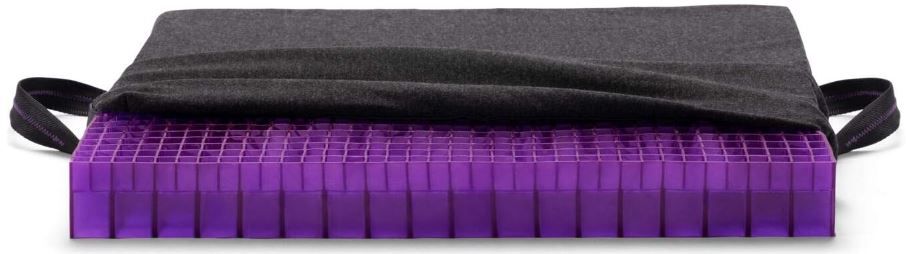
Purple is a brand that earned recognition in the mattress market before expanding into seat cushions — and the philosophy translates. Rather than relying on foam density or gel hardness for support, Purple's double-layer grid design uses a structured elastomeric grid that flexes under load and returns to form, distributing weight dynamically as you move rather than providing one static support surface.
The double-layer construction specifically addresses the comfort-versus-durability tension that single-layer cushions struggle with. The lower layer provides structural support. The upper layer provides surface comfort. Together, they produce a seating experience that holds up across extended daily use in a way that many single-layer alternatives don't. Users who have used this cushion in office chairs across an eight-hour workday consistently report that it maintains its shape and performance throughout, without the gradual flattening effect that undermines cheaper foam options by mid-afternoon.
Breathability is exceptional — genuinely better than memory foam for most users. The polyester-spandex blend combined with the grid structure keeps the seating surface cooler, and the 8% spandex content means the cushion adapts slightly to seat shapes rather than sitting rigid atop them. This matters practically: seats are not uniformly flat. Car seats, office chairs, dining room chairs — all have different profiles. A cushion that stretches slightly to meet those profiles rather than fighting them stays in place better and feels more integrated with the seat.
The absence of lumbar support is worth noting for users who specifically need lower back assistance. This cushion addresses seat-surface comfort — pressure distribution and breathability — but doesn't extend upward to support the lumbar curve. If lumbar support is your primary requirement, a separate lumbar pillow or a wedge design like the Dreamer would be a better starting point.
Pros
- Double-layer grid maintains comfort and shape across extended daily use
- Excellent breathability — consistently cooler than memory foam alternatives
- Spandex content allows the cushion to adapt to varied seat profiles
- Truly versatile: tested successfully in office chairs, car seats, home seating, and wheelchairs
- Comfortable, durable construction that holds up to prolonged use
Cons
- No lumbar support — addresses seat surface only, not lower back alignment
- Not ideal for very heavy users — weight distribution has limits
- Cover only is machine washable — the cushion body requires hand washing
Our Verdict: The Purple Double is the cushion for someone who needs one product to function across multiple settings — at the desk, in the car, at the dining table, in a wheelchair. The breathability is its strongest characteristic, and the double-layer grid delivers on its durability promise in a way that cheaper alternatives rarely match. The lumbar limitation is real, but for most users, seat-surface comfort is the primary need.
Gorilla Grip Tufted Memory Foam Chair Cushions — Best Value
Rating: 4.2/5
Product information
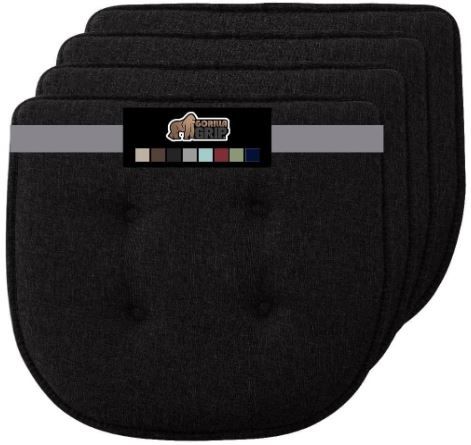
Here's an honest assessment of memory foam in 2026: it's the older technology on this list, and the newer gel materials have surpassed it in specific measurable ways — particularly airflow and long-term shape retention. But memory foam has one characteristic that gel and grid designs don't replicate as naturally: the way it gently contours to the exact shape of your body and holds that contour while you're in contact with it.
For hard surfaces specifically, this is more useful than it sounds. Wooden chairs, bar stools, kitchen chairs — seats with no padding whatsoever — are the environment where memory foam performs most consistently above its critics' expectations. The foam compresses around the sit bones, creating a customised support surface that distributes pressure across the specific geometry of your particular anatomy. On a slatted wooden dining chair, after a three-hour dinner, that experience is recognisably better than sitting on the raw wood. It's not subtle.
The tufted construction keeps the foam in place internally, preventing the gradual migration and bunching that plagues cheaper cushion designs. The tuft points hold the foam layers together structurally, which also helps the cushion maintain its surface shape through repeated use and washing.
Washing: use caution. The product is advertised as machine washable, but memory foam does not handle mechanical agitation well over time. A gentle cycle, cold water, followed by air drying (not the dryer, not even the dryer) will extend the lifespan significantly. Putting memory foam through a regular wash cycle risks structural damage — deformation, tearing at tuft points, partial disintegration of cell structure. I've seen this happen. Don't make it happen to yourself.
Pros
- Memory foam contouring is ideal for hard, unpaddded surfaces — wooden chairs, stools, benches
- Tufted construction maintains internal foam position and surface shape
- Anti-slip bottom keeps the cushion positioned on smooth hard surfaces
- Comfortable pressure relief across the sit bones for extended seated meals or work
- Good price point for the material quality
Cons
- Memory foam retains heat — less comfortable in warm environments or long sessions
- Will flatten under sustained heavy use or very high body weight
- "Machine washable" requires gentle cycle, cold water, and air drying to survive intact
- Older technology — gel alternatives now outperform it in airflow and long-term retention
Our Verdict: The Gorilla Grip is the correct choice for a specific problem: making hard chairs bearable. As an everyday office chair cushion, the gel and grid alternatives on this list outperform it. As a cushion for the wooden dining chair, the bar stool, the kitchen seat, or the bench — it's excellent for the price and does exactly what it promises.
Desk Jockey Jumbo Seat Cushion for Extra Wide Wheelchairs — Best for Large Builds
Rating: 4.1/5
Product information
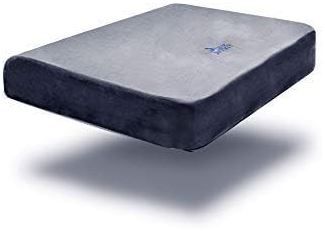
The Desk Jockey Jumbo exists because the seat cushion market largely ignores a significant portion of the population. Most cushions are sized for average dimensions — and "average" in cushion marketing means slimmer and shorter than a substantial share of actual buyers. For larger, taller, or wider individuals, a standard 40cm × 40cm cushion either doesn't cover enough surface area to distribute pressure meaningfully, or it compresses under load faster than it should, or it simply doesn't fit the seat properly.
The Jumbo addresses this directly. Two sizes — X-Large and 2X-Large — accommodate widths that standard cushions cannot. The anti-slip bottom functions reliably across both wheelchair and chair seat surfaces. The polyester construction is inherently washable without the handling anxiety of memory foam — full machine washing, regular cycle, without the degradation risk that undermines the Gorilla Grip option.
The thickness specification is worth noting: cushions greater than 50mm thick provide better comfort for this use case meaningfully, and the Desk Jockey's 75mm construction (for window seat, bench, and heavy-use applications) sits above that threshold. For wheelchair users who spend the majority of their day seated — the extended pressure distribution this creates is not a comfort preference; it's a clinical concern, and the extra thickness provides more absorption depth before pressure concentrates at the seat surface.
The feedback is honest about the polarising nature of softness: some heavier users find it too soft, some lighter users find it firmer than expected. This is the perennial cushion dilemma. No single density satisfies everyone across a weight range this wide. What the Desk Jockey does better than alternatives is provide a large enough base for meaningful pressure distribution — which matters more than any single density measurement.
Pros
- Two oversized variants (X-Large and 2X-Large) for wider seats and larger builds
- 75mm+ thickness provides more pressure absorption depth than standard cushions
- Full machine washable — polyester construction is durable through regular washing
- Anti-slip bottom functions on both wheelchair and standard chair surfaces
- Can also function as a car seat cushion for larger vehicles
Cons
- Density polarises users: reported as too soft by some heavier users, slightly firm by some lighter users
- No specific ergonomic contouring — flat surface, not shaped around sit bones
- Limited aesthetic options compared to premium cushions
Our Verdict: The Desk Jockey is the correct answer for anyone who has bought standard-size cushions and found them either too narrow, too thin under load, or simply not designed for their body. For wheelchair users especially — where seated pressure management is a genuine health concern, not just a comfort preference — the oversized dimensions and machine-washable construction are legitimate advantages.
Dreamer Car Wedge Seat Cushion — Best for Drivers
Rating: 4.0/5
Product information
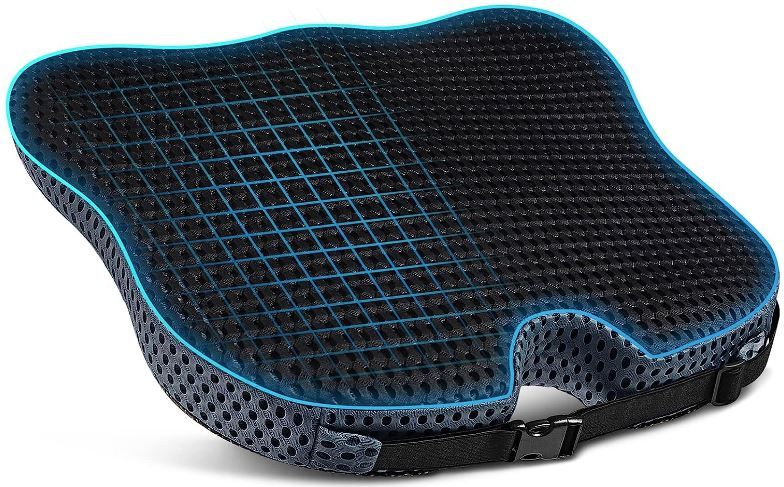
Wedge cushions operate on a different mechanical principle than flat cushions. The geometry — thick at the back, tapering toward the front — creates a subtle forward tilt to the pelvis. This tilt changes the angle between your torso and upper legs from 90 degrees (typical flat-seat position) to something closer to 100–105 degrees. That change sounds small. The effect on spinal alignment is not small.
At 90 degrees, the lumbar curve tends to flatten or reverse — the pelvis rotates backward, the lower back loses its natural inward curve, and the vertebrae stack unevenly. Over a two-hour drive, this is uncomfortable. Over a seven-hour drive, it graduates from uncomfortable to something that ruins the following day. At 100–105 degrees, the lumbar curve is better preserved, the sit bones are positioned slightly differently relative to the seat surface, and the whole spinal column sits in a more neutral alignment.
The circulation benefit is a secondary advantage that gets less attention than it deserves. Placing the wedge under the knees (rather than under the seat) reduces pressure on the backs of the thighs — the contact zone where blood vessels and nerves run — which improves circulation in the lower legs during long drives. This is particularly relevant for drivers and passengers who finish long journeys with swollen ankles or feet: reduced thigh pressure means better venous return from the legs.
The memory foam construction adapts to body shape in the way flat memory foam cushions do — which provides personalised support but also means heat retention. In a car, particularly during summer driving or parking in direct sun, this is more noticeable than in an office setting. Ventilation in the car interior is better than it used to be, but if you're prone to discomfort from warmth, the HozYi's gel construction is a cooler (literally) alternative for vehicle use.
The initial odour some users report is a known characteristic of new memory foam products — off-gassing from the manufacturing process. It typically dissipates within a few days of airing the cushion. Not everyone experiences this; those who do generally report it as resolved within a week.
Pros
- Wedge geometry promotes forward pelvic tilt — preserves lumbar curve during extended driving
- Reduces lower back strain and nerve pressure through optimal seat angle
- Under-knee placement improves leg circulation — reduces swelling on long journeys
- Memory foam construction conforms to body shape for personalised support
- Useful for both drivers and passengers
Cons
- Memory foam retains heat — more noticeable in warm vehicle environments
- Can feel insufficiently firm for heavier users under sustained load
- Occasional initial odour from new foam — dissipates with airing within a few days
- Not a substitute for professional assessment if back pain is severe or chronic
Our Verdict: The Dreamer Wedge is for drivers who finish long journeys with lower back discomfort or leg fatigue and want a practical, non-medical intervention. The wedge geometry works. The posture angle benefit is real and felt across journeys over two hours. If heat retention is a concern, air the cushion before summer drives — but for most users in most conditions, the postural benefit outweighs the thermal trade-off.
FAQs: Seat Cushions
What are the 4 different types of cushions?
When it comes to cushions, there are a plethora of options available, each offering unique aesthetics and benefits. The four primary types of cushions are throw cushions, bolster cushions, lumbar cushions, and box cushions.
Throw cushions: These are perhaps the most common and versatile type. They're typically square, rectangular, or triangular and can be used in various settings, including sofas and chairs. They come in a wide range of colors, patterns, and fabrics, making them an excellent choice for adding a decorative touch to any room.
Bolster cushions: These, on the other hand, are cylindrical and are often used for decorative purposes or additional support. They're ideal for placing under your neck or lower back for added comfort while sitting or lying down. Bolster cushions are also commonly used in yoga and physical therapy for support during certain exercises.
Lumbar cushions: These cushions are designed specifically to support the lower back and promote good posture. They're usually rectangular and are most commonly used in office chairs or car seats. Lumbar cushions can be particularly beneficial for individuals with lower back pain or those who spend extended periods sitting.
Box cushions: They are a popular choice for seating, especially in couches and lounge chairs. They're characterized by their high sides and flat top and bottom, giving them a box-like appearance. Box cushions are typically filled with foam or similar material, providing a firm yet comfortable seating surface.
In conclusion, throw cushions, bolster cushions, lumbar cushions, and box cushions each offer unique benefits and uses, catering to a wide range of needs and preferences. Whether you're looking to enhance comfort, support, or aesthetics, there's likely a cushion type that's perfect for you.
Do gel seat cushions work better than foam?
Gel seat cushions, infused with silicone gel, are often firmer than traditional memory foam cushions. This firmness does not compromise the cushion's ability to contour to your body shape. Instead, it offers a balanced blend of support and comfort that many users find beneficial.
Another advantage of gel seat cushions is their cooling effect. As highlighted by StandingDesktopper, gel-infused cushions tend to be cooler than memory foam, which can be a significant advantage for those who tend to feel warm or sweat during long sitting periods.
Furthermore, gel seat cushions excel when it comes to pressure distribution. According to Healthline, researchers have noted that gel material may distribute pressure more effectively than cushions made solely of foam. This feature makes gel cushions particularly useful for individuals suffering from lower back pain or discomfort.
However, it's important to note that the effectiveness of a seat cushion can also depend on individual preferences and needs. Some people might prefer the softness and warmth of a foam cushion, while others might favor the firmness and coolness of a gel cushion.
In conclusion, both gel and foam seat cushions have their unique advantages. Gel seat cushions tend to be firmer, cooler, and better at distributing pressure, making them an excellent choice for many individuals. However, personal comfort and preference should always be the primary considerations when choosing a seat cushion.
Are seat cushions actually worth it?
For most people who sit more than four hours a day, yes. A well-chosen cushion reduces localised pressure on the sit bones and sciatic nerve, can improve seated posture, and — for gel and grid designs — prevents the heat buildup that makes long sitting sessions uncomfortable. They're not a substitute for movement breaks or a proper ergonomic chair, but as a cost-effective intervention for everyday seated discomfort, the evidence from user experience and the underlying biomechanics both support their value.
How long does a seat cushion last?
Gel cushions typically last two to three years with daily use before cell compression reduces their effectiveness. Memory foam cushions last one to two years under daily use — less under high loads. Polyester cushions last longer for casual use but may lose shape faster under sustained weight. The indicator for replacement: if the cushion no longer returns to its original thickness after you stand up, it's no longer distributing pressure effectively.
Can a seat cushion help with sciatica?
A good cushion can reduce the seated compression on the sciatic nerve area, which may decrease the symptom intensity during and after extended sitting. It is not a medical treatment for sciatica — it doesn't address the underlying cause, whether that's a herniated disc, piriformis syndrome, or lumbar stenosis. If sciatic pain is significant or persistent, medical assessment is necessary alongside, or instead of, a cushion.
Should I use a seat cushion in my car?
Yes — particularly for drives over one hour. Car seats are designed for average proportions and average posture, not for the sustained neutral alignment that long drives require. A seat cushion — especially a wedge type — can improve pelvic tilt and reduce lower back strain over extended drives. The gel construction is better for cars in warm climates; the wedge design is better for posture and circulation.
What's the difference between memory foam and gel seat cushions?
Memory foam conforms to body shape and holds that shape — excellent for pressure distribution, but retains heat and gradually compresses permanently over time. Gel cushions (particularly TPE honeycomb construction) are breathable, don't trap heat, and maintain their structural recovery more consistently under sustained load. In 2026, gel is the better material for most daily-use scenarios; memory foam remains useful for hard surfaces and wedge designs where the shaping characteristic is particularly relevant.
You may be interested in these other reviews
 Save With Reviews
 Save With Reviews
 Save With Reviews