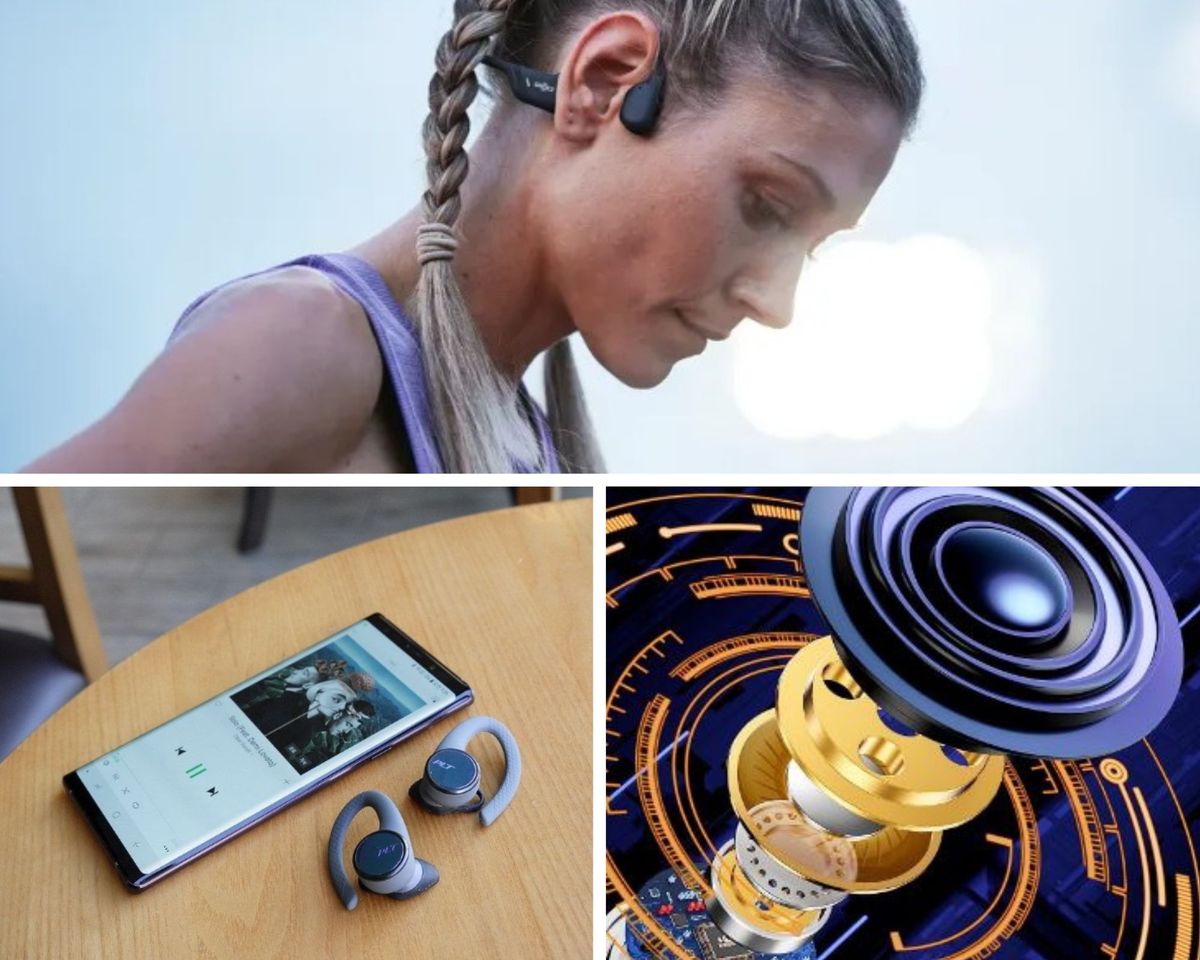
Answer: The best wireless earbuds for sports in 2026 are the Beats Powerbeats Pro — secure adjustable ear hooks, 9 hours of playtime (24+ with case), sweat- and water-resistant, Apple H1 chip. Best long-battery budget pick: Jzones Wireless Earbuds (130 hours total with case, IPX7 waterproof). Best value: GNMN V7 (48 hours total, IPX7, LED display case). Solid all-rounder: Bmani Wireless Earbuds (48-hour case, dual LED displays, sport ear hooks). Best open-ear comfort: Oladance OWS1 (16-hour playtime, Red Dot Award-winning design, no ear canal contact). Best for situational awareness: Bose Sports Open Earbuds (IPX4, natural conversation mic, 8-hour battery). Most affordable open-ear: Cleer ARC (7-hour battery, touch controls, EQ customization via app).
There's a very specific kind of fury reserved for the moment a wired earbud gets yanked halfway out of your ear at exactly the wrong second — usually right as the chorus hits, or right as you're about to break your personal best on the last rep. The cable catches an elbow, or your jacket zipper, or just its own weight, and suddenly you're one-eared and irritated, fumbling to reseat something that shouldn't require this much negotiation mid-set.
Wireless earbuds solved that problem. Mostly. Not universally — plenty of "wireless" earbuds still tether the two buds to each other with a thin cable behind your neck, which is a genuine category of product that exists and which we are not going to pretend is the same thing as true wireless. But the genuinely cable-free category has matured enough in 2026 that for anyone doing anything physical — running, lifting, cycling, hiking, the skipping rope in the backyard that nobody talks about but everyone secretly does — there's now a legitimately good option at almost every price point.
The challenge isn't finding wireless earbuds anymore. It's finding the right ones for sport specifically, which is a narrower and more demanding category than general wireless earbuds. Sport earbuds need to survive sweat. They need to stay physically in your ears through burpees, sprints, and the specific head-whip that happens during a deadlift. And they need battery life that doesn't quit at mile six of a ten-K, because "Battery Low" mid-workout is one of the more genuinely disrespectful notifications a device can send you.
We tested seven. Here's the honest breakdown.
What Actually Matters for Sport Earbuds
Secure fit is the non-negotiable. Earbuds that work beautifully for a commute or a desk day can fall out during a burpee or a sprint pivot, and there's nothing more disruptive to a workout than pausing mid-set to hunt for a rogue earbud on a gym floor. Ear hooks, wing tips, or genuinely well-engineered in-ear seals all solve this differently — but the solution has to exist. A "comfortable" earbud that isn't also a "stays put" earbud isn't actually a sport earbud.
Sweat and water resistance is measured via IPX ratings — a standardised scale for ingress protection against liquids. IPX4 is the practical minimum for sport use (resistant to splashing water from any direction). IPX7 (several products on this list) means the earbuds can survive full submersion in water up to a specified depth for a specified time — meaningfully more protection than most users will ever technically need, but a comfortable margin against heavy sweat, sudden rain, or an accidental drop in a puddle.
Battery life needs honest interpretation. Manufacturers quote two numbers: playtime per charge (how long the buds run before needing the case) and total playtime with the case's additional charges factored in. A pair advertising "130 hours" is almost certainly quoting total playtime across multiple case recharges, not continuous playback — check both numbers, because they mean very different things for how often you're actually managing charging.
Sound quality matters more than sport-focused marketing sometimes implies. A workout with genuinely engaging audio — bass that lands, clarity that doesn't turn a chorus into mush — measurably affects motivation and perceived effort. Several products on this list specifically differentiate through sound quality despite being marketed primarily on durability and fit.
Open-ear vs. sealed-ear is the newer decision point in the category. Sealed earbuds with ANC create an isolated audio bubble — excellent for blocking gym noise or busy roads, less good for situational awareness on a run near traffic. Open-ear designs (three products on this list) trade some isolation for genuine environmental awareness — hearing cars, other runners, your own breathing pattern — which matters specifically for outdoor solo athletes.
At a Glance — 2026 Comparison Table
| # | Product | Battery (buds/case) | Water Resistance | Fit Style | Best For | Rating |
|---|---|---|---|---|---|---|
1 | Beats Powerbeats Pro | 9hrs / 24+hrs total | Sweat + water resistant | Adjustable ear hooks | All-round sport, Apple ecosystem | ★★★★½ — 4.5/5 |
2 | Jzones Wireless Earbuds | Not specified / 130hrs total | IPX7 | Silicone ear hooks | Long-haul battery budget pick | ★★★★¼ — 4.3/5 |
3 | GNMN V7 | 8hrs / 48hrs total | IPX7 | Flexible ear hooks | Best value | ★★★★ — 4.2/5 |
4 | Bmani Wireless Earbuds | Not specified / 48hrs total | Weather resistant | Flexible ear hooks | All-weather sport | ★★★★ — 4.0/5 |
5 | Oladance OWS1 | 16hrs / case sold separately | Splash resistant | Open-ear, rests on ear | Comfort, hearing health | ★★★★ — 4.0/5 |
6 | Bose Sports Open Earbuds | 8hrs / not specified | IPX4 | Open-ear hooks | Situational awareness, calls | ★★★★ — 3.9/5 |
7 | Cleer ARC | 7hrs / not specified | Not IPX-rated | Open-ear, twist-on | Budget open-ear, EQ customization | ★★★★ — 3.8/5 |
Open-Ear vs. Sealed: Which Should You Choose?
Three products on this list — Oladance, Bose, and Cleer — use open-ear designs that rest on or above the ear without sealing the canal. Four — Beats, Jzones, GNMN, and Bmani — use traditional in-ear or hooked designs with varying degrees of seal and isolation.
Choose open-ear if: you run or cycle outdoors near traffic and need to hear cars and other people; you do long daily listening sessions and want to reduce ear canal contact; you take frequent calls during activity and want natural, unobstructed voice pickup; you find sealed earbuds physically uncomfortable over extended wear.
Choose sealed/hooked if: you train primarily indoors in loud gym environments and want maximum isolation; you prioritise deep bass and maximum audio immersion; you need the most secure possible fit for high-intensity, high-impact training (open-ear designs, while improved, generally still trail dedicated ear-hook sealed designs on absolute fit security during extreme movement).
Neither category is objectively superior — the right choice depends entirely on where and how you're actually training.
Final Thoughts
There's a moment, somewhere around the fourth or fifth kilometre of an outdoor run, where the right pair of earbuds stops being something you're aware of at all. They're just there, doing the job, staying in place, delivering whatever's on the playlist without demanding any attention of their own. That's the actual goal of sport earbuds — not maximum feature count, not the flashiest spec sheet, just the absence of interruption.
The Powerbeats Pro gets closest to that disappearing act for most users — secure fit, strong battery, solid sound, minimal fuss. The Jzones and GNMN options prove that genuinely long battery life and real waterproofing don't require premium pricing. The Bmani rounds out the sealed-design budget tier with unusually transparent battery monitoring. And the open-ear trio — Oladance, Bose, Cleer — each make a legitimate case for prioritising awareness and comfort over maximum isolation, at three different price points and with three different specific strengths.
None of these will run the workout for you. But the right pair stops getting in the way of it — which, on the days when motivation is already running thin, might be exactly the difference that gets you out the door.
Can we help? We've done the research for you and found the Best Wireless Earbuds on Amazon.
Every day, we read hundreds of reviews and try the highest-rated products we have on our list.
Best Wireless Earbuds - Reviews
Beats Powerbeats Pro — Best Overall
Rating: 4.5/5
Product information
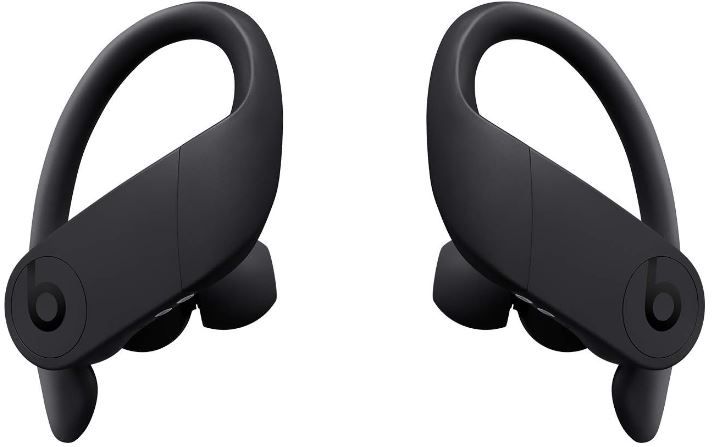
The Powerbeats Pro earns its position through a combination that's genuinely difficult to find elsewhere on this list simultaneously: secure adjustable ear hooks that actually stay put through intense training, sound quality that doesn't feel like an afterthought to the fitness marketing, and battery life that comfortably outlasts any single workout you're likely to do — 9 hours before you even touch the case, 24-plus hours total once the case gets involved.
The Apple H1 chip is the quiet differentiator for iPhone users specifically — instant pairing, seamless device switching across an Apple ecosystem, and the kind of "it just works" connectivity that Android-first earbuds sometimes struggle to replicate on iOS. Class 1 Bluetooth extends the wireless range meaningfully beyond the Class 2 standard most competing earbuds use — practically relevant if you're the type who leaves your phone in a locker or a gym bag rather than strapped to your arm during a workout.
The adjustable ear hooks are the actual engineering achievement here. Unlike fixed silicone hooks that fit some ear shapes well and others poorly, the Powerbeats Pro's adjustable design accommodates a wider range of ear geometries — a genuine advantage for a product category where "one size fits most" frequently means "one size fits some, uncomfortably tolerates the rest."
The honest limitation, repeated by multiple reviewers: these are not noise-cancelling earbuds, and the isolation they provide is limited despite the secure fit. If ANC-level noise blocking is a priority — say, for gym environments with loud, inconsistent ambient noise — the Powerbeats Pro's isolation performance will underwhelm relative to sealed ANC alternatives, even though the physical fit itself is excellent. Price is also a genuine consideration; these sit at the premium end of the sport earbud category, and the size — while contributing to stability — may feel large for smaller ears.
Pros
- 9 hours battery per charge, 24+ hours total with case — genuinely all-day coverage
- Adjustable ear hooks accommodate a wide range of ear shapes securely
- Apple H1 chip: excellent iOS pairing, device switching, and connectivity
- Class 1 Bluetooth extends wireless range beyond most competitors
- Sweat and water resistant construction built for intense training
- Auto Play/Pause and on-bud controls simplify workout management
Cons
- Not noise-cancelling — isolation performance is limited despite the secure fit
- Premium pricing relative to the category
- Larger fit than some alternatives — may not suit smaller ears comfortably
- Limited colour options relative to some competitors
- Not fully waterproof — sweat and splash resistant only, not submersion-rated
Our Verdict: The Powerbeats Pro earns "best overall" by not compromising on the things that actually matter for sport use — fit security, battery longevity, and sound quality — while accepting that it's not trying to be an ANC product. For most active users, especially in the Apple ecosystem, this is the safest and most complete recommendation on this list.
Jzones Wireless Earbuds Bluetooth Headphones — Best Long-Haul Battery Budget Pick
Rating: 4.3/5
Product information
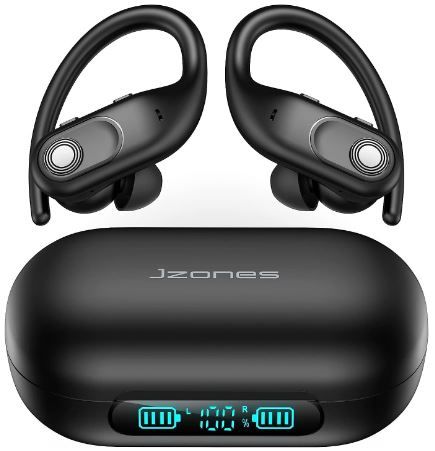
The Jzones earbuds make their case almost entirely on one specification: total playtime. A 2500mAh charging case supporting 16 full recharges translates to over 130 hours of cumulative playback before the case itself needs recharging — a genuinely rare figure in this category, and one that fundamentally changes how often you think about charging at all. For multi-day trips, extended training blocks, or simply the chronic forgetting-to-charge-things type of user, this is a meaningfully different relationship with battery anxiety than most earbuds offer.
The case doubling as an emergency power bank for your phone (via Type-C or wireless charging compatibility) is a genuinely useful secondary function — not something you'll use daily, but a legitimate convenience during long outdoor days or travel when a phone charge becomes urgent, and options are limited.
IPX7 waterproofing — full submersion resistance, not just splash resistance — combined with internal nano-coating gives these earbuds durability that exceeds what most sport use actually demands, which functions as a comfortable safety margin rather than a necessity. The 10mm driver delivers genuinely solid stereo sound with reasonable bass depth for the price point — not audiophile-tier, but far from the "paper cup" sound quality that budget wireless earbuds sometimes deliver.
One-step pairing (automatic power-on and connection the moment the case opens) removes a genuine friction point that older Bluetooth earbuds struggled with, and the inclusion of three ear cap sizes acknowledges that fit varies meaningfully across users — a detail some competitors skip.
The honest limitations: no active noise cancellation, meaning ambient gym or street noise remains audible regardless of fit quality. Fit consistency is reported as variable across users — some find the silicone ear hooks secure, others report needing to experiment with cap sizes to find a stable fit, which is a fair amount of trial and error for a product marketed on comfort.
Pros
- 130+ hours total playtime — among the longest cumulative battery life in the category
- Case doubles as an emergency phone power bank via Type-C or wireless charging
- IPX7 waterproof rating — full submersion resistance, well above sport-use minimums
- 10mm driver delivers solid stereo sound with reasonable bass for the price
- One-step auto-pairing removes connection friction
- Three included ear cap sizes for fit customisation
Cons
- No active noise cancellation
- Fit reported as inconsistent across different ear shapes — may require cap experimentation
- Per-charge playtime (before case recharge) not clearly specified by the manufacturer
- Budget-tier build quality relative to premium alternatives on this list
Our Verdict: The Jzones earbuds are for anyone who genuinely hates thinking about charging — the cumulative battery figure here is difficult to match at this price point. If fit security matters more to you than raw battery numbers, be prepared to experiment with the included ear caps to find your stable configuration.
GNMN V7 Bluetooth Headphones Wireless Earbuds — Best Value
Rating: 4.2/5
Product information
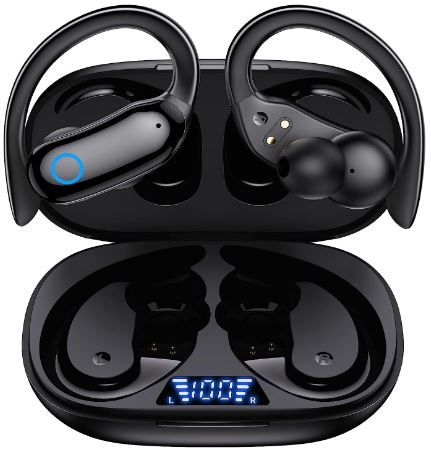
The GNMN V7 targets a specific and genuinely useful middle ground: strong battery life, real IPX7 waterproofing, and a flexible ear hook fit — all at a price point noticeably below the Beats and comparable to or better than the budget alternatives on this list. It's the "does everything reasonably well without overcharging for any single feature" entry, which is a legitimate value proposition in a category full of products that either underdeliver or overprice.
Eight hours per charge, extending to roughly 48 hours total via the charging case, is comfortably above the "5+ hours" threshold that most sport users actually need per session, with enough case-based recharging to cover multiple days between full case charges. The LED power display on the case is a small but genuinely useful convenience — at-a-glance battery status without needing to open a companion app or guess based on indicator light patterns.
The 11mm driver with large chamber acoustic design produces notably strong bass and clear mids for the price tier — the "large chamber" design specifically refers to internal acoustic space that reduces sound compression and distortion at higher volumes, a detail that matters more than it initially sounds for workout use, where volume tends to run higher than casual listening to compensate for ambient noise and physical exertion.
Fast auto-pairing on case opening removes setup friction, and touch controls handle volume, track changes, and calls without requiring you to fumble for your phone mid-set — a genuinely practical consideration when your hands are occupied with a barbell or a jump rope.
The limitations mirror most of the budget-to-mid-tier options on this list: no active noise cancellation, and fit comfort varies by individual ear shape despite the flexible hook design. Some reviews note the touch controls can be occasionally over-sensitive, registering accidental taps during vigorous movement.
Pros
- Strong battery: 8 hours per charge, ~48 hours total — comfortably exceeds typical workout needs
- IPX7 waterproof rating — genuine sweat and rain protection margin
- 11mm driver with large chamber design delivers strong bass and clarity for the price
- LED power display for at-a-glance battery monitoring
- Fast auto-pairing and responsive touch controls
- Excellent price-to-feature ratio — the strongest value proposition on this list
Cons
- No active noise cancellation
- Touch controls occasionally over-sensitive during vigorous movement
- Fit comfort varies by ear shape despite flexible hook design
- Build materials reflect the budget price point — less premium feel than higher-tier options
Our Verdict: The GNMN V7 is the pick for buyers who want genuinely solid sport performance — battery, waterproofing, sound — without paying premium prices for features (ANC, ecosystem chip integration) they may not specifically need. For the price, it's difficult to find a more balanced sport earbud.
Bmani Wireless Earbuds Bluetooth Headphones — Best All-Weather Sport Pick
Rating: 4.0/5
Product information
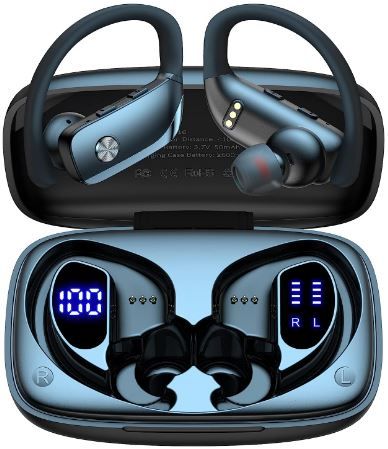
The Bmani earbuds differentiate primarily through their charging case's dual LED display system — a genuinely more informative monitoring setup than most competitors offer. The left-side display shows overall case battery percentage; the right side shows individual earbud charging status via four separate indicators, each representing 25% of a single bud's charge. For anyone who's been burned by a charging case with vague or absent battery indication, this level of transparency is a meaningful quality-of-life improvement.
Weather resistance is emphasised throughout the marketing — camping, running, and rainy-day workouts are all specifically called out as intended use cases — though it's worth noting the manufacturer doesn't publish a specific IPX rating figure, unlike the Jzones and GNMN entries on this list, which both cite IPX7 explicitly. Treat the Bmani's weather resistance as adequate for typical sweat and light rain exposure rather than assuming submersion-level protection without a published rating to confirm it.
The sport-focused ear hook design, combined with three included ear cap sizes, targets the same secure-fit priority that dominates this entire category — and user feedback specifically praises the stability during intense training, though (consistent with several products on this list) individual comfort varies by ear shape.
One-button control simplifies operation for users who find touch-gesture interfaces fiddly mid-workout — a single press handles the core functions (calls, pairing, power) without requiring the more complex tap patterns some competitors use, which can be genuinely difficult to execute precisely while your hands and attention are occupied elsewhere.
Pros
- Dual LED display system provides unusually transparent battery monitoring for both case and individual buds
- ~48 hours total playtime via case — solid coverage for multi-day use
- Sport-focused ear hooks with three included cap sizes for fit customisation
- Built-in microphone for hands-free calling during activity
- Simple one-button control reduces mid-workout interface friction
- Weather-resistant construction suited to rain, sweat, and outdoor conditions
Cons
- No published specific IPX rating — weather resistance claims aren't independently quantified
- No active noise cancellation
- Fit and comfort reported as variable across different ear shapes
- Limited noise isolation in loud environments
Our Verdict: The Bmani earbuds are a solid all-weather sport option, particularly for users who value clear battery transparency and simple physical controls over touch gestures. The absence of a specific published IPX rating is worth factoring in if precise water resistance certification matters to your specific use case (regular submersion risk, for instance).
Oladance OWS1 Open-Ear Headphones — Best Open-Ear Comfort
Rating: 4.0/5
Product information
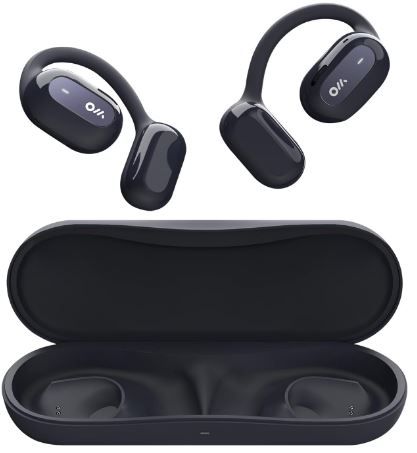
The Oladance OWS1 takes the most distinctive design approach on this list — rather than sealing into or hooking around the ear canal, the OWS1 rests on top of the ear entirely, making zero contact with the ear canal itself. This is a genuinely different category of product from the sealed and semi-sealed earbuds elsewhere on this list, and it's built around a specific value proposition: hearing health preservation and all-day comfort, prioritised above noise isolation.
The dual 16.5mm dynamic drivers — roughly three times the size of a typical earbud driver — are the technical justification for why an open-ear design can still deliver genuinely rich sound rather than the thin, tinny audio open-ear designs sometimes produce. Larger drivers move more air and reproduce a wider frequency range with more fidelity, and reviewers specifically note the OWS1 achieves an "intimate concert-like" quality that's unusual for a design that isn't sealing sound directly into your ear canal.
The hearing health angle is genuine, not just marketing framing. Traditional in-ear designs create sealed pressure environments in the ear canal that, over years of heavy use, some audiologists associate with increased risk of certain ear health issues — earwax impaction, canal irritation, and pressure-related discomfort among them. The OWS1's zero-canal-contact design sidesteps these specific risks entirely, which is a meaningfully different value proposition than "better sound" or "longer battery" — it's positioning itself as a fundamentally safer long-term listening approach.
Sixteen hours of playtime per charge is strong — among the best single-charge figures on this list — though it's worth noting clearly that the included case is a basic carrying case, not a charging case; the charging travel case that would extend total playtime is sold as a separate accessory, which changes the value calculation depending on whether you factor that additional purchase into your budget.
The Red Dot Award recognition (a respected international design award) reflects genuine engineering achievement in the multi-point support system that distributes the earbuds' weight evenly across the ear — solving the "will this fall off during a sprint" problem that open-ear designs generally struggle with more than sealed alternatives.
Pros
- Zero ear canal contact — genuine hearing health benefit for heavy daily users
- Dual 16.5mm drivers deliver surprisingly rich, immersive sound for an open-ear design
- 16 hours' playtime per charge — among the strongest single-charge figures on this list
- Red Dot Award-winning multi-point support system for secure, evenly distributed fit
- Excellent voice clarity for calls
- Bluetooth 5.2 for stable, modern connectivity
Cons
- Limited noise isolation — inherent to the open-ear design, not a defect
- Charging travel case sold separately — factor this into total cost
- Premium price point relative to sealed alternatives with similar feature sets
- Fit security, while strong for the category, is reported as less secure than sealed in-ear designs by some users
Our Verdict: The Oladance OWS1 is for users who specifically want situational awareness and long-term hearing health prioritised over maximum isolation — outdoor runners near traffic, anyone doing long daily listening sessions who's thought about ear canal health, or simply people who find sealed earbuds uncomfortable over extended wear. The sound quality achievement for an open-ear design is genuinely impressive.
Bose Sports Open Earbuds — Best for Situational Awareness & Calls
Rating: 3.9/5
Product information
Bose brings its microphone engineering pedigree specifically to bear on the open-ear category, and the result is a product whose standout feature isn't sound quality or battery life — it's call performance. The directional microphone system is specifically tuned to isolate your voice from ambient noise, and with nothing covering or inserted into your ears, the experience of taking a call is described by reviewers as close to a genuinely natural face-to-face conversation — a meaningfully different experience from most earbud calling, which often feels compressed and artificial by comparison.
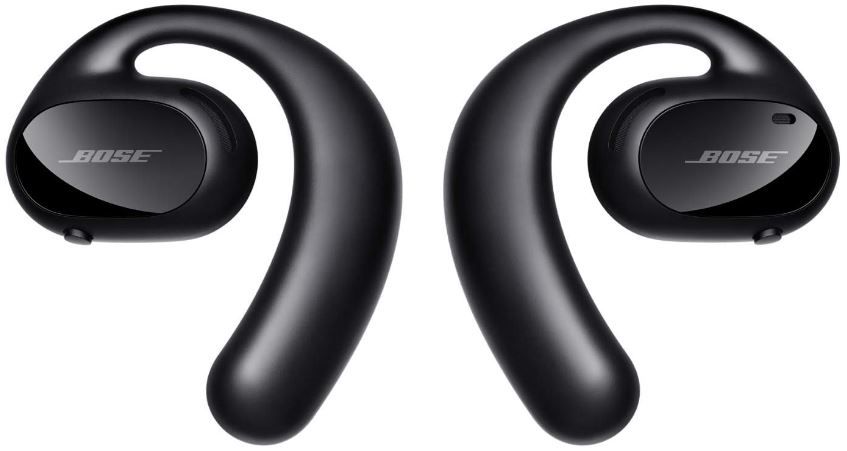
The open-ear design sits above the ear canal without covering it, prioritising the same situational awareness value proposition as the Oladance above, but with Bose's specific engineering emphasis on balanced, accurate audio reproduction rather than maximum driver size or bass emphasis. Reviewers describe the sound as "flat and balanced" in the mid-range — a deliberately neutral tuning that suits podcasts, audiobooks, and voice content particularly well, though bass-heavy listeners may find the low end underwhelming relative to sealed alternatives with dedicated bass drivers.
IPX4 rating is the sport-use minimum rather than a generous margin — adequate for sweat and splash exposure during typical training, but a step below the IPX7 submersion resistance that the Jzones and GNMN entries on this list provide. For most gym and outdoor running use, IPX4 is genuinely sufficient; it's worth knowing the difference if your activities involve more extreme water exposure.
Charging speed is a genuinely practical highlight: a full charge takes 2 hours, but a quick 30-minute top-up delivers 3 hours of playtime — meaningfully useful for the "forgot to charge overnight" scenario that affects most wireless earbud users eventually.
The fit uses over-ear hooks for security — reviewers confirm they stay in place during physical activity, addressing the open-ear category's general fit-security concern reasonably well, though not quite matching the dedicated multi-point support engineering of the Oladance above.
Pros
- Directional microphone delivers genuinely natural, clear call quality
- Balanced, accurate sound tuning — excellent for podcasts, audiobooks, voice content
- Fast partial charging: 30 minutes yields 3 hours of playtime
- Secure over-ear hook fit for physical activity
- IPX4 sweat and weather resistance adequate for typical training use
- Bose brand reliability and build quality
Cons
- IPX4 is the minimum sport-use rating — less margin than IPX7 alternatives on this list
- Flat mid-range tuning means less bass presence than bass-forward alternatives
- 8-hour battery life is average for the category, not a standout figure
- Limited noise isolation inherent to open-ear design
Our Verdict: The Bose Sports Open Earbuds are the right choice specifically for users who prioritise call quality and balanced, accurate audio over maximum bass or battery life — particularly for outdoor runners and cyclists who need situational awareness alongside genuinely clear phone conversations mid-activity.
Cleer ARC True Wireless Headphones — Best Budget Open-Ear
Rating: 3.8/5
Product information
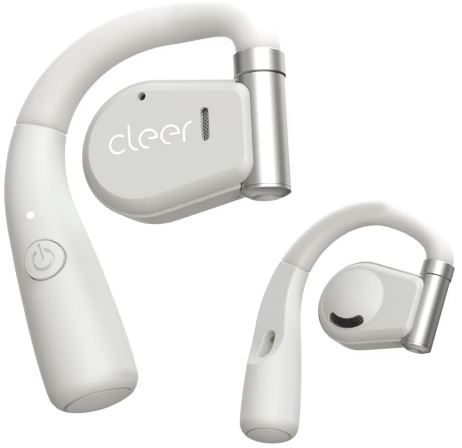
The Cleer ARC positions itself at the accessible end of the open-ear category, and the twist-on fit mechanism is its most distinctive physical feature — rather than a standard hook or a rest-on-top design, the ARC's buds twist into position on the ear, aiming for a combination of security and comfort through a slightly different mechanical approach than its open-ear competitors on this list.
The 16.2mm neodymium drivers deliver genuinely dynamic, detailed sound for the price point, and the Cleer+ companion app extends the value proposition meaningfully by allowing EQ customisation — adjusting the sound signature to personal preference rather than accepting a single fixed tuning, a feature that's often reserved for more premium earbuds and a welcome inclusion here. Firmware update support through the same app is a smaller but genuinely useful longevity feature, allowing the product to receive performance and bug-fix improvements over its lifespan rather than shipping in a fixed, unchangeable state.
Touch controls handle volume, track skipping, play/pause, and call management, plus native voice assistant access — a comprehensive control set for the price tier, and customisable through the Cleer+ app if the default gesture mapping doesn't suit your preferences.
Seven hours of battery life is the lowest single-charge figure on this list, and the case's charging capability (rather than functioning as a genuine multi-charge power bank the way several competitors' cases do) means total playtime between full case recharges is more limited than the Jzones, GNMN, or Bmani entries above. For shorter workouts and daily commute use, this is entirely adequate; for extended multi-hour training blocks or multi-day trips without charging access, it's a genuine limitation worth planning around.
The absence of a published IPX rating is a meaningful gap for a product marketed partly around outdoor and active use — unlike several competitors on this list that explicitly cite IPX4 or IPX7 certification, the Cleer ARC doesn't provide a specific water/sweat resistance figure, making it harder to assess objectively how it will hold up against heavy sweat exposure.
Pros
- 16.2mm neodymium drivers deliver dynamic, detailed sound for the price
- Cleer+ app enables genuine EQ customisation — rare at this price point
- Firmware update support extends product longevity and performance over time
- Comprehensive touch controls including native voice assistant access
- Comfortable, lightweight construction with flexible hinge design
- Twist-on fit mechanism offers a differentiated approach to open-ear security
Cons
- 7-hour battery life is the shortest single-charge figure on this list
- No published IPX water/sweat resistance rating
- Limited noise isolation inherent to open-ear design
- Some users report a lack of deep bass response
- Sound leakage reported at higher volumes — others nearby may hear your audio
Our Verdict: The Cleer ARC is a reasonable budget entry into the open-ear category, particularly for users who value the EQ customisation and firmware support that competitors in this price range often skip. The unrated water resistance and shorter battery life are the trade-offs worth weighing against the lower price point.
FAQs: Wireless Earbuds
Is it worth getting wireless earbuds?
Yes, they are worthwhile, mostly if you want physical fitness or travel. Wireless earphones have actually come to be a lot more affordable in recent times. The absence of cables permits an extra superb range of movement and connectivity with a vast array of devices, and with today's technology, battery life has improved to a point where one can wear them for hours.
What is the lifespan of wireless earbuds?
You ought to get approximately 2 years out of economical or average-quality earbuds. Best wireless earbuds like those mentioned above can last for four or 5 years if properly cared for. In addition, earbuds have a 2 - 4 year ordinary lifespan.
How do you know true wireless earbuds are safe for your ears?
The first thing you need to do is make sure that you are using true wireless sports earbuds. We know that there are some very good names out there with great quality wireless earbuds with all the bells and whistles, including noise cancellation, but most are not going to hold up while doing physical activities. Nothing worse than having your earbuds fall out and interrupt your routine. One of the best things about true wireless earbuds is that you can be sure that you’re getting a safe product.
Some companies sell true wireless earbuds that are not safe and can cause issues with your hearing. One of the best ways to make sure that you are getting a safe product is to make sure that you are looking for a wireless sports earbud that has a wireless safety standard. These standards ensure that the earbud is safe and that it works with a variety of devices. It also means that the earbud is designed to be safe for your ears.
Is it worth getting wireless earbuds for sports?
Yes, particularly for fitness and travel use. Wireless earbuds have become significantly more affordable in recent years, and battery life has improved to the point where multi-hour sessions without recharging are standard rather than exceptional. The freedom of movement without cable interference is a genuine, measurable improvement for active use specifically.
What is the lifespan of wireless earbuds?
Budget or average-quality earbuds typically last around two years with regular use. Higher-quality sport earbuds, properly cared for, can last four to five years. Battery capacity degrades gradually over charge cycles regardless of build quality — expect somewhat reduced per-charge playtime after one to two years of daily use, even on premium products.
Are true wireless earbuds safe for extended use?
Look for products with clear safety and connectivity certifications, and be cautious of unbranded or unrated products claiming noise cancellation without any published safety standard. True wireless earbuds from established manufacturers with published Bluetooth version numbers and clear specifications are generally safe for extended daily use. If ear canal health is a specific concern, open-ear designs like the Oladance eliminate ear canal contact.
Do all noise-cancelling earbuds need ear tips?
Yes — active noise cancellation relies on a sealed environment (created by silicone or foam ear tips) to work effectively, since the technology cancels sound waves within an enclosed acoustic space. Open-ear designs, by definition, don't seal the ear canal and therefore can't provide the same active noise cancellation performance, though they offer genuine situational awareness benefits in exchange.
What IPX rating do I actually need for sport earbuds?
IPX4 is the practical minimum for sweat and splash resistance during typical gym or outdoor training. IPX7 (offered by the Jzones and GNMN entries on this list) provides full submersion resistance — more protection than most users need, but a comfortable safety margin for heavy sweat, sudden rain, or accidental water exposure.
You may be interested in these other reviews.
 Neil Fajardo
 Neil Fajardo
 Neil Fajardo