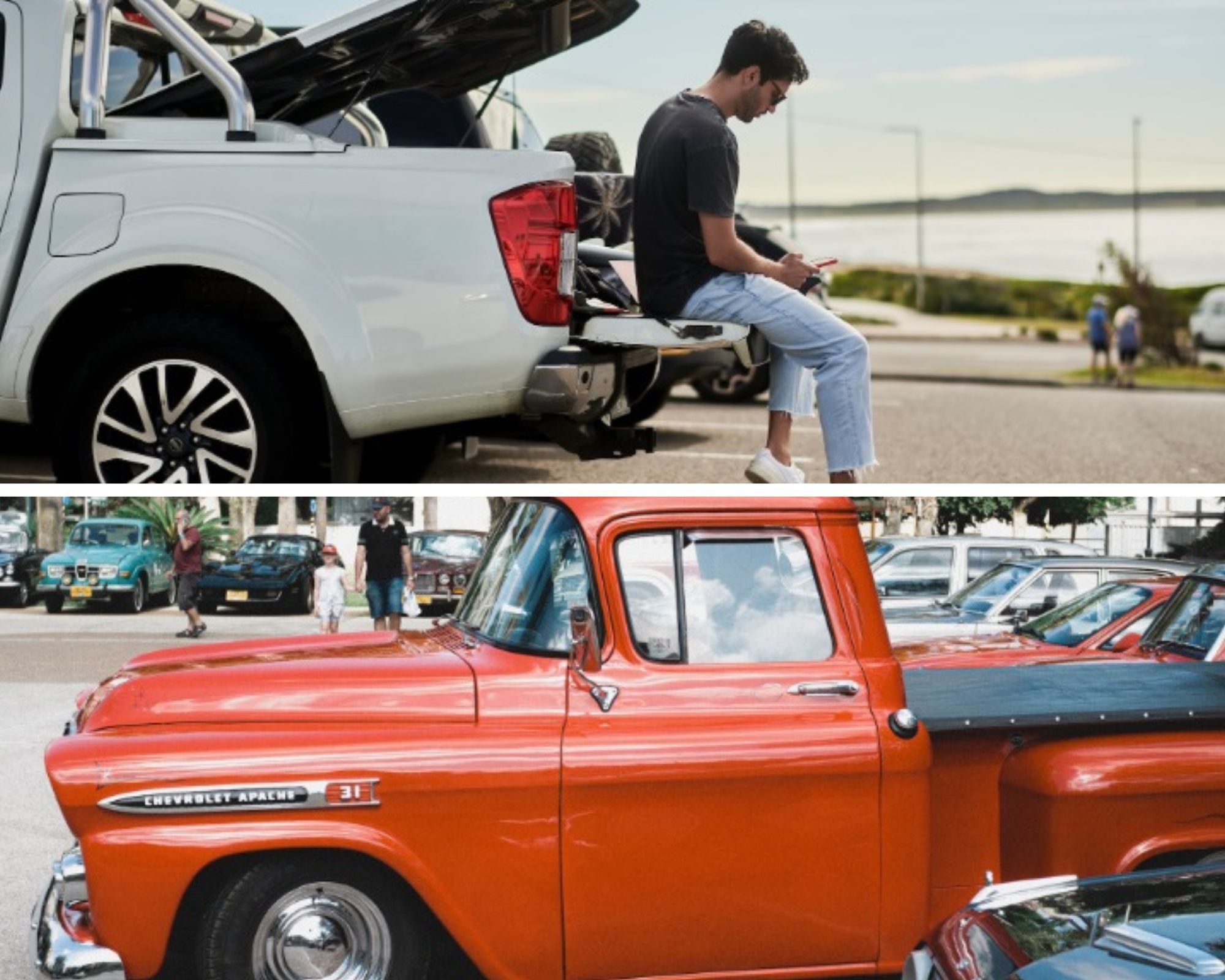


Getting into a tall pickup should not feel like the first stage of climbing Everest.
Yet that's more or less what happens with some trucks—especially after bigger tires or a lift kit enter the picture. One foot goes up, you grab the steering wheel, pull yourself sideways, and hope nobody in the parking lot is watching.
Running boards fix that rather ordinary problem.
A good set gives you a solid, non-slip step into the cab. It can also help children and older passengers, give muddy boots somewhere to land before reaching the carpet, and offer some protection from stones and road debris.
But choosing the best running boards is slightly different from buying most truck accessories.
You cannot simply choose the one you like best.
It has to fit.
Year. Make. Model. Cab configuration. Sometimes body generation too.
Get one of those wrong and the shiny new running boards sitting on your garage floor become two very long, very heavy paperweights.
Let's avoid that.
What Are the Best Running Boards?
The best running boards combine secure footing, durable construction, corrosion resistance, vehicle-specific fitment, and a step height that suits your truck or SUV.
For many truck owners wanting strong value without spending a fortune, the Tyger Auto 3.5-inch Rider is one of our favorite fixed-step choices.
Drivers wanting a wider aluminum platform should look at the Rough Country HD2 or APS iBoard 6-inch.
For lifted trucks, the N-Fab Podium drop-step design deserves consideration.
Chevy and GMC owners shopping on a tighter budget should look closely at the COMNOVA 6-inch Running Boards.
And if you want the step to disappear when the door closes?
That's where the AMP Research PowerStep comes in.
Expensive, yes.
Very cool...
Also yes.
Best Running Boards
| Running Board | Best For | Style | Material/Construction | Main Advantage |
|---|---|---|---|---|
| Tyger Auto 3.5" Rider | Best Overall Value | Fixed oval step | Carbon steel | Strong balance of price, footing and easy installation |
| Rough Country HD2 | Best Aluminum Board | Fixed full-width board | Aluminum | Wide step and corrosion resistance |
| APS iBoard 6" | Best Wide Flat Step | Flat running board | Aluminum/stainless variants | Large, easy-to-use stepping surface |
| N-Fab Podium Steps | Best for Lifted Trucks | Drop step | Stainless/steel variants | Lower individual stepping points |
| AMP Research PowerStep | Best Powered Running Board | Automatic retractable | Aluminum | Deploys automatically and retracts out of sight |
| COMNOVA 6" Running Boards | Best Budget Wide Board | Fixed running board | Vehicle-specific steel variants | Wide platform at an attractive price |
One thing before you buy
These running boards are vehicle-specific.
The names in this table refer to product families. Amazon sells different versions for different trucks and SUVs.
Always confirm:
- Model year
- Make
- Model
- Cab style
- Number of doors
- New or Classic body style where applicable
- Gas, hybrid, or EV exclusions on certain powered boards
Amazon's Confirmed Fit tool is useful, but I'd still read the actual fitment description.
Twice.
This is one product where five extra minutes of checking can save an impressively annoying return.
Which Running Boards Should You Buy?
Here's the quick version.
Buy the Tyger Auto Rider if...
You want an affordable fixed side step with a moderate-width stepping surface and lots of vehicle-specific options.
Our pick: Best Overall Value.
Buy the Rough Country HD2 if...
You want a broad aluminum running board with a more conventional factory-style appearance.
Our pick: Best Aluminum Running Board.
Buy the APS iBoard if...
Maximum stepping area matters—especially for children, family members, or everyday use.
Our pick: Best Wide Flat Step.
Buy the N-Fab Podium if...
You own a lifted truck or simply like the lower drop-step design.
Our pick: Best for Lifted Trucks.
Buy the AMP Research PowerStep if...
You want the board there when you need it and gone when you don't—and budget isn't the first consideration.
Our pick: Best Powered Running Board.
Buy the COMNOVA 6-inch if...
You have a compatible Silverado or Sierra and want a wide running board without spending premium money.
Our pick: Best Budget Wide Board.
Are Running Boards Universal?
No. Most quality running boards are vehicle-specific.
This may be the single most important answer in this guide.
Compatibility can depend on:
- Vehicle year
- Manufacturer
- Model
- Body generation
- Cab configuration
- Number of doors
- Wheelbase
- Factory rocker panels
- Hybrid or electric drivetrain components
- Existing factory running boards or rock rails
For example, Tyger explicitly separates SuperCrew and SuperCab applications, while AMP PowerStep fitment can even distinguish between regular gas F-150 models, PowerBoost hybrids, and Lightning EVs.
Never buy running boards based only on the truck model name.
Running Boards vs. Nerf Bars vs. Side Steps: What's the Difference?
These terms have become rather messy.
Manufacturers use them differently, and Amazon titles sometimes throw all three into one sentence for good measure.
Generally:
Running Boards
Usually provide a wider, flatter stepping surface running along much of the cab.
Think:
platform.
Nerf Bars
Traditionally use round or oval tubing with smaller stepping pads located near the doors.
Think:
tube.
Drop Steps / Side Steps
Use a rail or tube with individual steps hanging lower beneath each door.
Think:
little staircase.
The lines now blur.
A product may be marketed as:
Running Boards Side Steps Nerf Bars Step Rails
Which clears absolutely nothing up.
Focus on the actual design rather than the label.
What Width Running Board Is Best?
For general everyday use, roughly 4 to 6 inches of usable stepping width is comfortable for many people.
A wider board offers more room for:
- Large shoes
- Work boots
- Children
- Older passengers
- Cleaning mud from footwear
- Reaching roof racks
Narrower oval bars can look sleeker and preserve more clearance.
Neither is automatically better.
A six-inch board is wonderful for an 80-year-old passenger.
A narrow drop step might be preferable on a lifted off-road build.
Different truck. Different life.
Aluminum vs. Steel Running Boards
Aluminum Running Boards
Advantages:
- Naturally corrosion-resistant
- Relatively lightweight
- Good strength-to-weight ratio
- Useful in snowy and salty climates
- Often have a clean OEM-style appearance
Possible disadvantage:
- Can cost more than basic steel alternatives
Carbon Steel Running Boards
Advantages:
- Strong
- Widely available
- Often less expensive
- Excellent for rugged tube and drop-step designs
Possible disadvantage:
- Depends heavily on its protective coating to resist corrosion
Stainless Steel Running Boards
Advantages:
- Strong corrosion resistance
- Attractive polished or black finishes
- Long service life when well constructed
Possible disadvantage:
- Can cost more and add weight
For most people, material isn't the only deciding factor.
A badly fitted aluminum board is worse than a properly fitted steel one.
Fit first.
Material second.
Do Running Boards Reduce Ground Clearance?
Fixed running boards can reduce effective side clearance because they sit below or beside the rocker panel.
How much depends on the design.
High-and-tight nerf bars lose less clearance.
Drop steps hang lower.
Wide traditional boards may extend farther outward.
Powered running boards such as AMP Research PowerStep retract closer to the body when not being used, which is one reason they're attractive on expensive trucks and lifted vehicles.
For serious off-road driving, think about obstacles.
A nice wide six-inch family running board is brilliant outside Costco.
Less brilliant when a boulder is attempting to occupy the same space.
Are Running Boards the Same as Rock Sliders?
No.
This distinction matters.
Running boards are primarily designed to assist entry and exit.
Rock sliders are designed as structural off-road protection, typically mounting more substantially to the vehicle and taking loads that ordinary running boards aren't intended to withstand.
Some heavy-duty step systems offer useful rocker-panel protection.
That still doesn't automatically make them rock sliders.
If you're building a vehicle specifically for technical off-roading, buy equipment designed for that job.
How Much Weight Can Running Boards Hold?
It varies considerably.
Many quality aftermarket running boards publish capacities in the several-hundred-pound range. Tyger currently specifies 500 pounds for many Rider applications, while several current AMP PowerStep versions specify 600 pounds.
But don't assume.
Look at the manufacturer rating for your exact part number.
Also pay attention to how the manufacturer describes capacity—per side, per board, or overall.
The bracket system and installation quality matter just as much as the rail itself.
A 500-pound rail attached badly is merely a very strong object coming loose.
Are Running Boards Easy to Install?
Fixed running boards can be surprisingly straightforward.
Many modern trucks already have factory mounting locations along the rocker panel.
That lets manufacturers build application-specific brackets that bolt directly into place.
Tyger states that many Rider applications require no drilling, and Rough Country describes the HD2 as a bolt-on installation on supported models.
A typical DIY job may require:
- Ratchet
- Sockets
- Torque wrench
- Wrenches
- Safety glasses
- Maybe another pair of hands
Powered running boards are another story.
You now have electrical connections, control modules, and moving mechanisms involved.
An experienced DIY owner may still handle it.
If wiring diagrams cause your soul to leave your body, professional installation might be money well spent.
Do You Have to Drill Holes to Install Running Boards?
Often, no.
Many modern vehicle-specific running boards use existing factory mounting points.
However, some applications still require drilling or modifications.
Even within one product family.
For example, Tyger notes minor drilling requirements on some older Ram applications while many newer applications are completely bolt-on.
Check installation instructions before ordering if drilling is something you absolutely don't want to do.
Are Powered Running Boards Worth It?
Powered running boards are worth considering if you want easier entry without permanently sacrificing side clearance or appearance.
They're especially attractive for:
- Lifted trucks
- Luxury pickups
- Families
- Older passengers
- Owners who dislike fixed boards
- Drivers who frequently enter the vehicle at night
They're less attractive when:
- Budget matters most
- Simplicity matters
- You frequently drive through mud and debris
- You don't want electrical components
- A $150–$300 fixed board already solves the problem
A powered board is a luxury solution.
A very nice luxury solution.
But a fixed steel bar has never needed a software update.
Something is reassuring about that.
Are Running Boards Good for Older Passengers?
They can be extremely useful.
For somebody with limited mobility, the important factors are:
- Step height
- Step width
- Non-slip surface
- Stability
- Grab-handle availability
A very narrow nerf bar might look great but provide less confidence than a wide five- or six-inch board.
Likewise, a running board mounted too high may not reduce the first step enough.
If accessibility is the main reason for buying, prioritize function over styling.
Your passenger probably doesn't care whether the board looks aggressive.
They care whether they can get into the truck without performing gymnastics.
Are Running Boards Good for Kids?
Generally, yes.
Pickup cab floors can sit surprisingly high relative to a small child.
A wide running board creates an intermediate step and can make entry considerably easier.
Again, wider surfaces tend to be more forgiving for small feet.
Teach children not to jump on, crawl beneath, or play around powered running boards.
Moving mechanical steps deserve respect.
Tiny fingers don't understand product warranties.
Do Running Boards Protect Your Truck?
To a degree.
Running boards can help intercept:
- Mud
- Stones
- Gravel
- Road spray
- Some light side contact
They may reduce the amount of debris striking lower door and rocker-panel areas.
But they aren't a replacement for dedicated armor.
A runaway shopping cart?
Maybe your running board gets there first.
A large rock on an off-road trail?
Different conversation.
Do Running Boards Affect Gas Mileage?
A fixed running board changes airflow around the vehicle to some degree, but the real-world fuel-economy effect depends on the truck, board shape, speed, and other factors.
It's unlikely to be the first thing I'd use to choose between two ordinary fixed boards.
Powered steps have an aerodynamic advantage in principle because they retract closer to the vehicle when the doors are closed.
Still, if fuel economy is your dominant concern...
you may have chosen an interesting hobby by driving a lifted full-size pickup.
Black or Stainless Running Boards?
Black running boards dominate the modern truck market for a reason.
They work visually with:
- Black wheels
- Fender flares
- Bed covers
- Dark trim
- Off-road builds
Polished stainless can look excellent on trucks with chrome bumpers and factory chrome trim.
There's no SEO-approved answer here.
Look at your truck.
Choose what looks right.
Sometimes aesthetics are allowed to be simple.
How to Choose the Best Running Boards
1. Confirm Your Exact Vehicle
Start here.
Write down:
Year + Make + Model + Cab
Example:
2024 Ford F-150 SuperCrew
not:
Ford truck.
Amazon will thank you.
Your return-delivery driver will thank you more.
2. Decide Why You Need Them
For children and older passengers?
Get wide, stable steps.
Lifted truck?
Consider a lower drop step.
Off-road clearance?
High-and-tight or retractable may make more sense.
Appearance?
Now you can worry about black versus stainless.
3. Check Step Width
Three inches feels very different from six.
Imagine placing a wet work boot on it.
That mental test tells you quite a lot.
4. Check Material and Finish
For winter climates, corrosion resistance deserves extra attention.
Look for:
- Aluminum
- Stainless steel
- E-coating
- Powder coating
- Protected hardware
Salt has no respect for expensive accessories.
5. Check the Load Rating
Don't assume every board holds the same weight.
Use the exact manufacturer's rating.
6. Check Installation Requirements
Look for:
- No-drill installation
- Factory mounting points
- Included brackets
- Wiring requirements on powered models
- Body-style exclusions
7. Read the Warranty
Long structural warranties can be reassuring.
Also check whether finish, electrical components, and motors have different coverage terms.
Fine print.
Nobody loves it.
Still useful.
How We Selected These Running Boards
Save With Reviews does not claim that our editorial team physically installed and road-tested every running board in this guide.
Our recommendations are based on research that considers:
- Current U.S. availability
- Manufacturer specifications
- Vehicle fitment range
- Construction material
- Step width and design
- Load ratings where published
- Installation requirements
- Warranty information
- Independent automotive reviews
- Current Amazon availability
- Owner feedback patterns
- Relative value
- Product relevance in 2026
We also favor products that have clear vehicle-specific fitment information.
That matters enormously in this category.
A fantastic running board that doesn't fit your truck is still a terrible purchase.
Are Running Boards Worth It?
Running boards are worth buying when a truck or SUV's step-in height makes entry uncomfortable, when passengers need easier access, or when you want an additional stepping surface along the vehicle.
They can also improve appearance.
But accessibility comes first.
After living with a good set for a while, climbing into the same truck without them feels strangely unfinished.
Like somebody removed the bottom stair from a staircase.
You can still get up there.
You'd just rather not.
Final Verdict
If you're looking for a strong balance of price, design, and everyday practicality, the Tyger Auto 3.5-inch Rider is our overall value pick.
For a wide aluminum step, look at the Rough Country HD2.
If maximum stepping area matters, the APS iBoard 6-inch is difficult to ignore.
Lifted truck?
The N-Fab Podium deserves a close look.
Want the premium solution?
The AMP Research PowerStep gives you automatic deployment and then disappears neatly when you're driving.
And Silverado/Sierra owners searching for a lower-priced six-inch board should consider COMNOVA.
But before adding any of them to your Amazon cart, check one last thing:
Your exact fitment.
Not just the model.
The cab too.
I've mentioned that approximately seventeen times now, which feels about right.
Can we help? We've done the research for you and found the Best running Boards on Amazon.
Every day, we read hundreds of reviews and try the highest-rated products we have on our list.
Best Running Boards - Reviews
Tyger Auto 3.5-Inch Rider Running Boards — Best Overall Value.
Product information
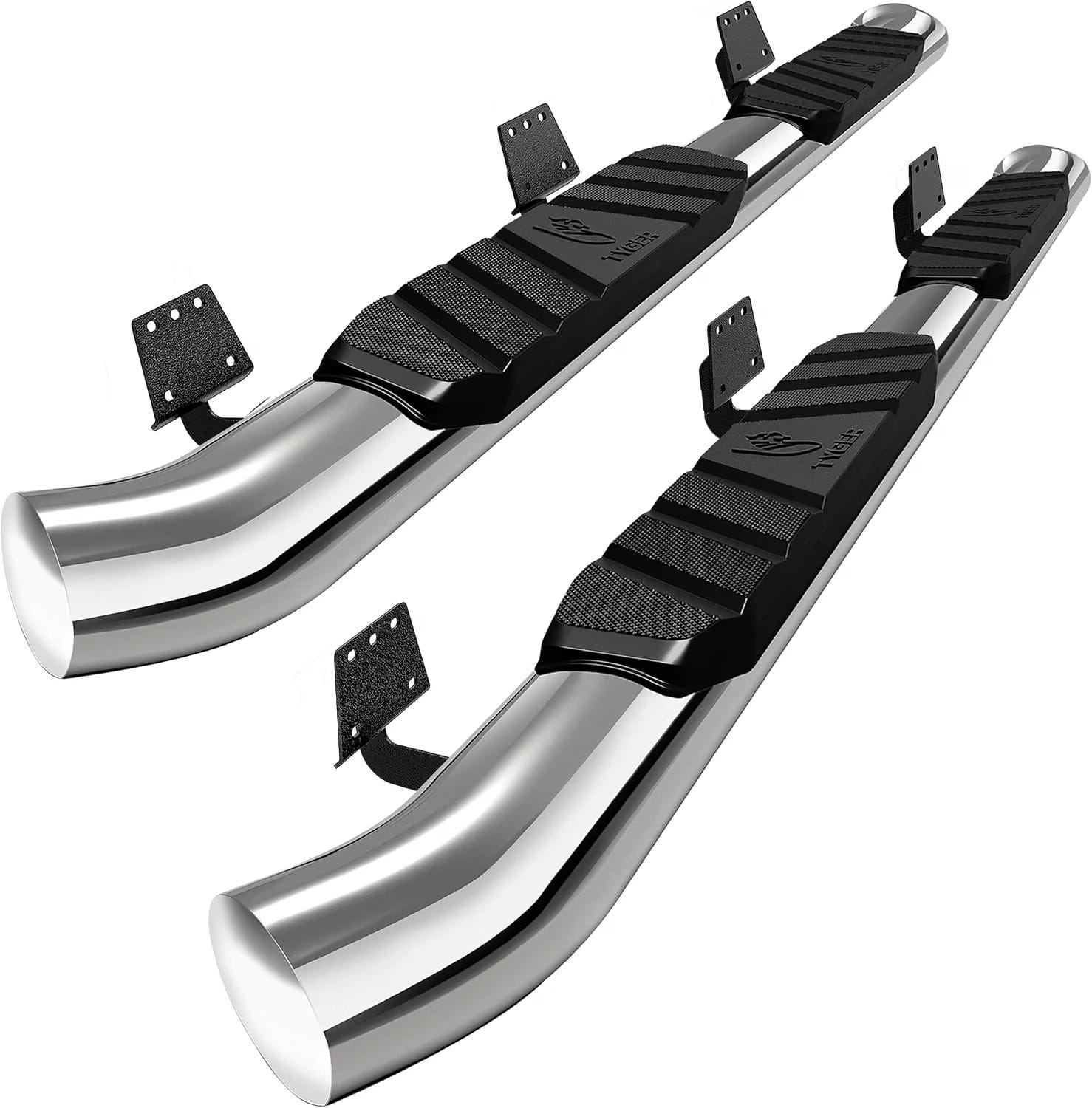
The Tyger Auto Rider 3.5-inch Running Boards sit in a nice middle ground.
They're not massive plank-style boards.
They're not skinny old-school round nerf bars either.
Instead, Tyger uses an oval-tube shape with a roughly 3.5-inch stepping surface. That gives your shoe a decent place to land while keeping the boards relatively close to the body.
For several current vehicle applications, Tyger rates the Rider at 500 pounds and supplies the mounting brackets and hardware for a bolt-on installation. Many versions require no drilling. The company currently backs the Rider line with a three-year warranty for U.S. customers.
One current Amazon version, TG-SS2F35058, fits 2015–2026 Ford F-150 SuperCrew trucks, 2022–2026 F-150 Lightning SuperCrew models, and specified 2017–2026 F-250/F-350 Super Duty applications. Amazon tracking currently identifies that exact listing under ASIN B07YLD4PD8.
And that's where fitment gets serious.
SuperCrew?
Yes.
SuperCab?
No, not with that particular part.
Two trucks can sit side by side, both wearing F-150 badges, and need different hardware.
Best for:
Truck owners wanting a dependable fixed running board without spending premium money.
Why we like it:
- 3.5-inch oval stepping surface
- Textured non-slip area
- 500-lb manufacturer rating on many current applications
- Vehicle-specific brackets
- Many no-drill applications
- Textured black finish
- Good balance between step width and ground clearance
- Three-year U.S. warranty
- Large selection of vehicle-specific versions
What we'd think about first:
It's still a steel product.
In areas that use road salt heavily, inspect the finish occasionally—especially around hardware and places where the coating becomes chipped.
And make sure you buy the right cab.
I know. I've said that already.
I'm going to say it again later too.
Our verdict:
Best overall value.
The Tyger Rider makes sense for somebody who wants running boards that look reasonably understated, provide a proper foothold, and don't require AMP PowerStep money.
Rough Country HD2 Aluminum Running Boards — Best Aluminum Running Boards.
Product information
Steel is strong.
Rust, unfortunately, also enjoys steel.
That's one reason aluminum running boards are attractive—particularly in wet climates, snowy states, and areas where road salt spends several months attempting to dissolve everything underneath a vehicle.
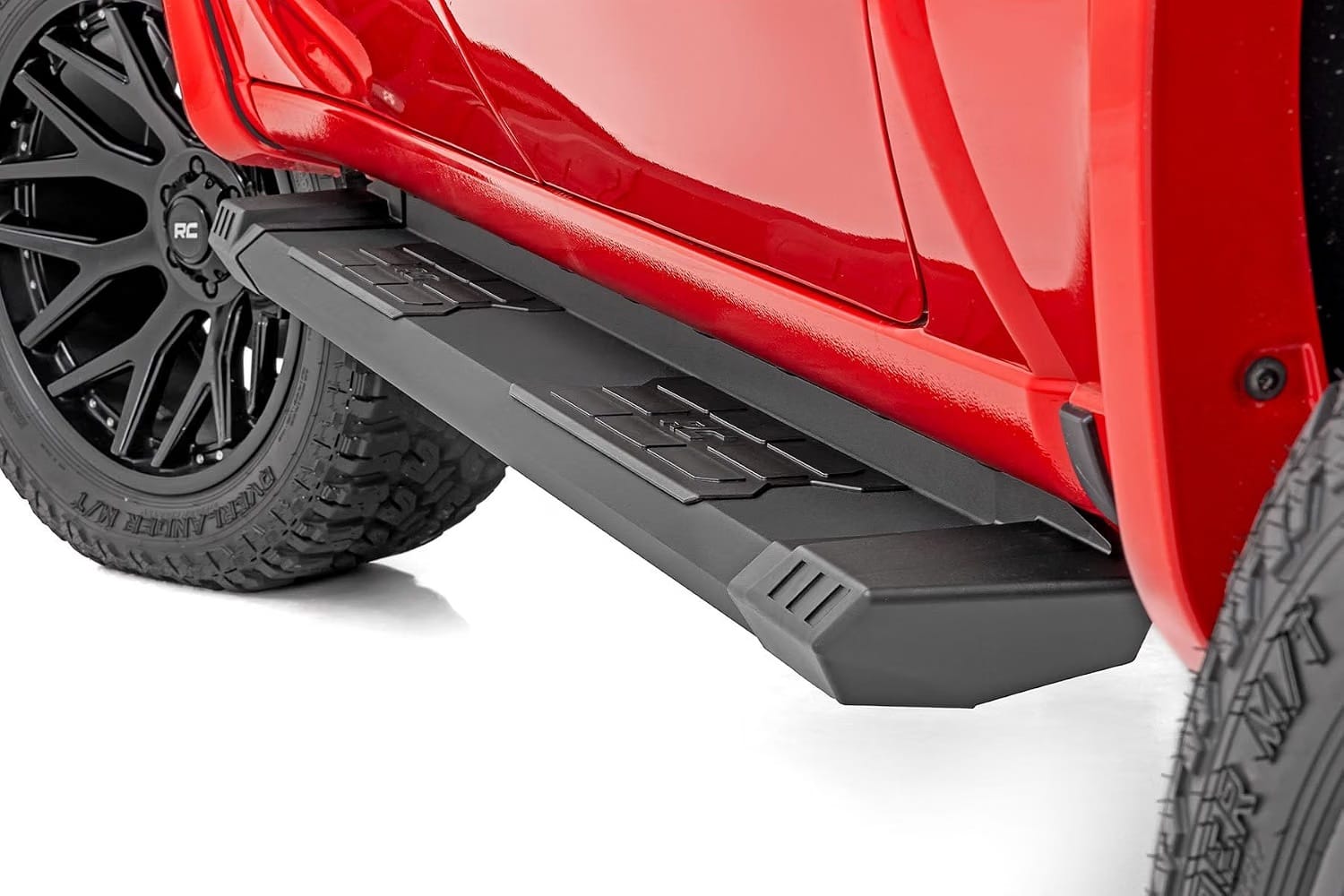
The Rough Country HD2 Running Boards use a one-piece aluminum construction with a black finish and broad non-slip stepping area.
Rough Country's current Chevy/GMC HD2 version provides cab-length coverage, bolt-on installation without drilling, and is designed to help shield the vehicle from road debris. The structural components carry Rough Country's limited lifetime warranty, while the finish has separate, shorter coverage.
The company also offers vehicle-specific HD2 applications for trucks including the Toyota Tacoma and Ram 1500.
This isn't the lowest-cost option here.
But aluminum has a pleasant habit of being both fairly strong and relatively light.
Pick up an enormous steel board and then an aluminum equivalent, and your lower back quickly develops opinions on material science.
Best for:
Daily-driven trucks where corrosion resistance and a wide, conventional running-board surface matter.
Why we like it:
- One-piece aluminum construction
- Wide stepping surface
- Textured non-slip tread
- Full cab-length appearance
- Corrosion-resistant material
- Vehicle-specific bolt-on installation
- No drilling on many applications
- Helps hide exposed frame areas
- Suitable with or without body lifts on supported applications
- Strong structural warranty
What we'd think about first:
The HD2 isn't designed as a true rock slider.
There's an important difference.
A running board can protect against some debris and minor bumps, but serious off-road rock sliders are structurally designed to take much harder impacts and often support vehicle weight.
Don't confuse the two merely because both happen to be long and black.
Our verdict:
Best aluminum fixed board in our group.
If you live somewhere that experiences rain, snow, salt, and slush—basically weather behaving badly—aluminum becomes especially attractive.
APS iBoard 6-Inch Running Boards — Best Wide Flat Step.
Product information
Some running boards look like tubes.
The APS iBoard looks more like... a board.
Which seems fair enough, given the name.
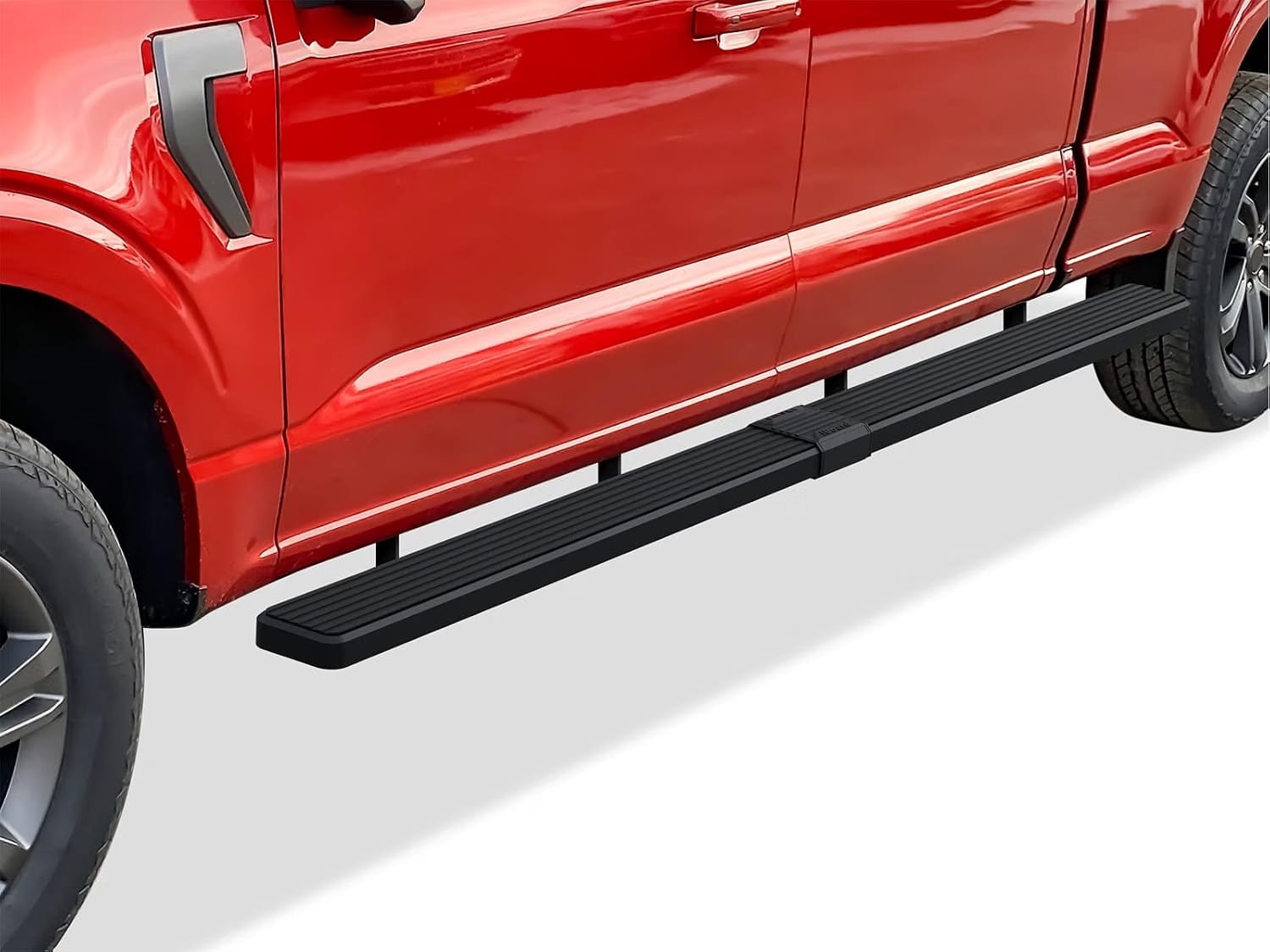
Its broad flat design provides a large stepping area instead of limiting your foot to a small pad positioned beneath each door.
Current 6-inch iBoard versions use a full-width corrugated/non-slip stepping surface, and certain vehicle-specific models carry a 500-pound load rating. APS supplies brackets and mounting hardware with its application-specific kits.
The flat style is particularly useful for families.
A child doesn't have to locate one little step pad.
An older passenger has more area to place a foot.
Someone climbing up to reach a roof rack has more room to reposition.
And when you're standing outside the truck with muddy work boots, that extra width feels rather nice.
Best for:
Families, daily drivers, and anyone who prefers a wide, conventional running-board platform.
Why we like it:
- Wide 6-inch platform on popular variants
- Full-length non-slip surface
- 500-lb rating on selected current applications
- Clean, relatively OEM-style appearance
- Vehicle-specific brackets
- Good stepping area for children and older passengers
- Multiple finishes and material configurations available
- Straightforward design
What we'd think about first:
APS offers a lot of versions.
That sounds good—and it is—but it also means Amazon titles can become hilariously long.
APS 6-inch iBoard Ram 1500 Crew Cab New Body Style Except Classic...
You get the idea.
Read all of it.
A 2019 Ram 1500 New Body Style and a 2019 Ram 1500 Classic are not the same fitment problem.
Our verdict:
Best wide flat running board.
If your priority is a generous place to put your foot rather than a rugged tube/drop-step appearance, the iBoard design makes a lot of sense.
N-Fab Podium Steps — Best Running Boards for Lifted Trucks.
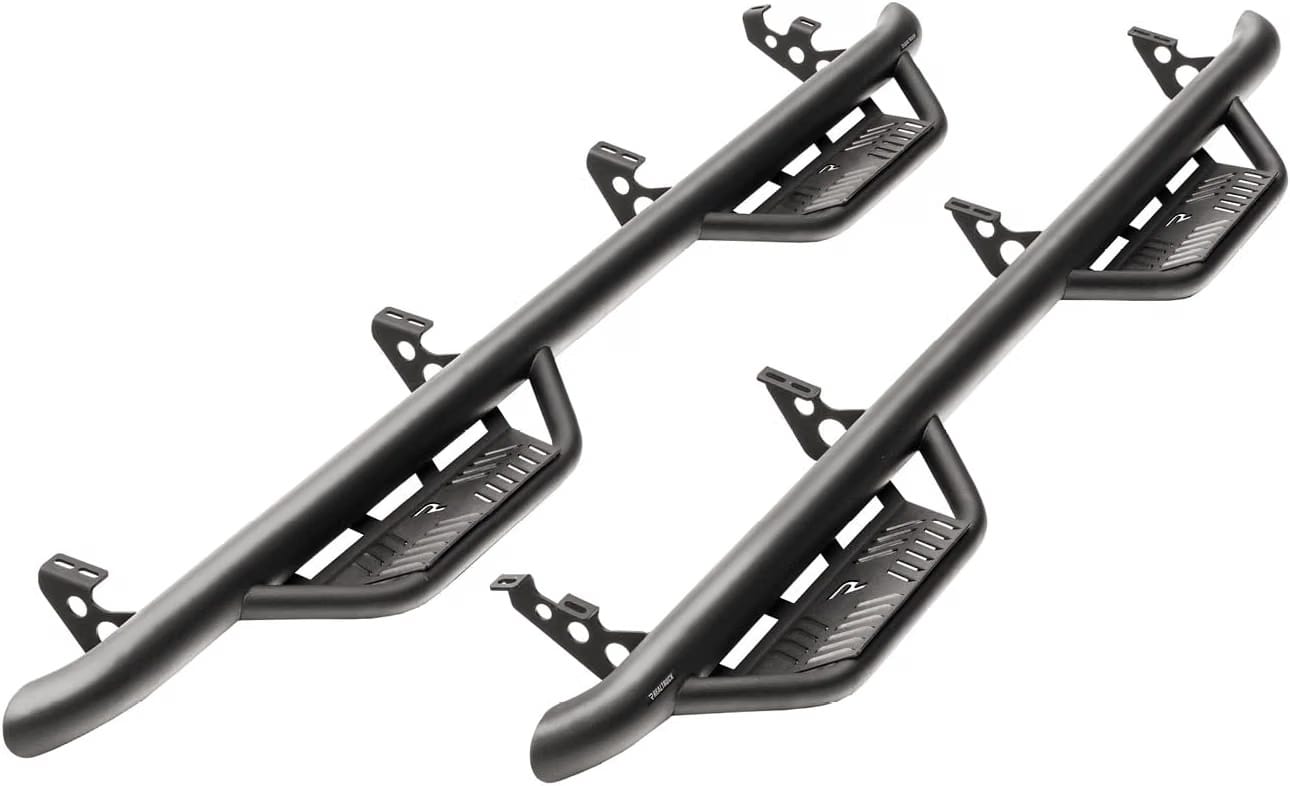
Product information
Lift a truck several inches and a conventional running board can sometimes end up in an awkward place.
Still high.
Now you have a step...
to reach the step.
Not ideal.
The N-Fab Podium takes a different approach with individual drop-down stepping points.
N-Fab's Podium design runs high and tight along the vehicle body while placing the actual step lower, making it useful on both stock-height and lifted trucks. The Podium SS uses stainless-steel construction, a fully welded one-piece design, and can be found in cab-length and wheel-to-wheel configurations depending on application.
Car and Driver's 2026 running-board comparison selected the N-Fab Podium as its Best Overall fixed truck step and highlighted its large serrated step surface and straightforward installation.
There's also an aesthetic advantage.
A big flat board says:
practical family truck.
A drop step says:
somebody has been browsing the off-road catalog again.
Both are perfectly respectable life choices.
Best for:
Lifted trucks, off-road styling, and buyers wanting individual drop steps rather than one wide platform.
Why we like it:
- Drop-step design
- High-and-tight main tube
- Useful on stock and lifted trucks
- Large individual stepping areas
- Serrated/non-slip step surface
- Stainless and black-finish options
- One-piece construction on applicable models
- Cab-length and some wheel-to-wheel configurations
- Strong manufacturer warranty on certain Podium versions
What we'd think about first:
Drop steps hang lower than the main tube.
That's their job.
But off-roaders should think carefully about terrain clearance. A low step that makes getting into a lifted truck easier can also become one of the first things to meet a rock.
Everything is a compromise eventually.
Our verdict:
Best choice for a lifted-truck look and lower step-in point.
AMP Research PowerStep — Best Powered Running Boards.
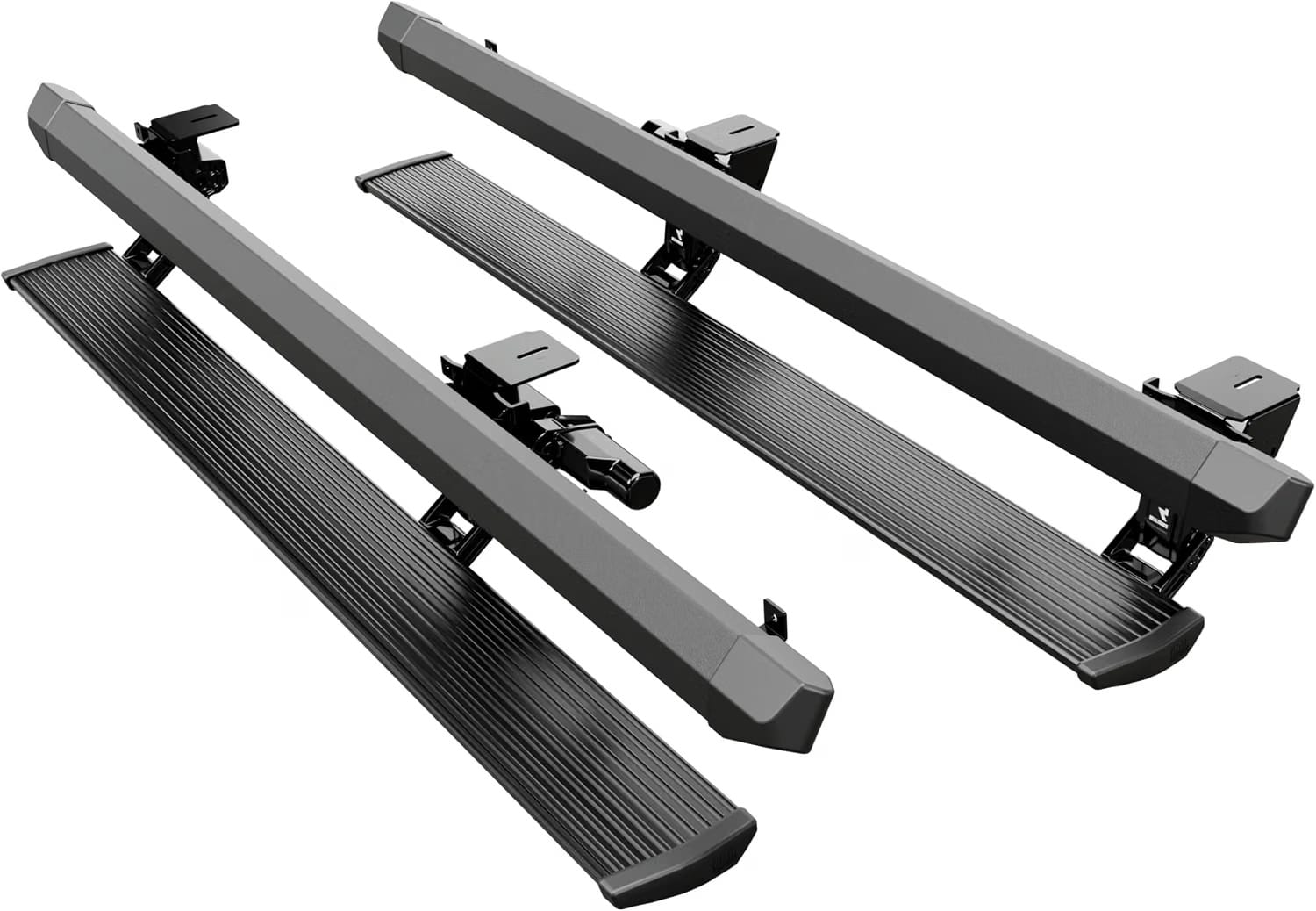
Product information
Now we reach the expensive toys.
Except the AMP Research PowerStep isn't really a toy.
It's a clever answer to the biggest running-board compromise.
Fixed boards are convenient because they're always there.
But...
they're always there.
They can reduce clearance, affect the truck's profile, and collect whatever winter roads decide to throw at them.
PowerStep boards automatically extend when a door opens, then retract against the vehicle after the door closes.
Current vehicle-specific PowerStep Plug-N-Play versions are rated up to 600 pounds, include LED lighting, use a black textured finish, and carry AMP's five-year/60,000-mile warranty on applicable products.
For example, AMP part 76152-01A supports specified 2021–2026 Ford F-150 gas models, but excludes PowerBoost hybrid and Lightning versions. Other part numbers cover Ram, Silverado, Sierra, Tacoma, and additional platforms.
Again: the same truck name does not necessarily mean the same PowerStep.
Best for:
Buyers who want maximum convenience, cleaner appearance, and better clearance when the steps aren't being used.
Why we like it:
- Automatically deploys when the door opens
- Automatically retracts when doors close
- Up to 600-lb rating on current versions
- LED step lighting
- Aluminum construction
- Improved clearance when retracted
- Clean appearance
- Plug-N-Play versions available
- Strong warranty
- Excellent for tall and lifted trucks
What we'd think about first:
Price.
Obviously.
A Tyger or COMNOVA fixed board is basically metal, brackets, and hardware.
A PowerStep adds motors, wiring, control electronics, and moving parts.
That means more convenience—but also greater installation complexity and more components that could eventually require attention.
Owners who regularly drive through deep mud, road salt, or frozen slush should also follow cleaning and maintenance recommendations around the moving mechanisms.
Our verdict:
Best premium powered running board.
Do you need electrically retractable running boards?
Probably not.
Will you grin the first few times they quietly unfold when the door opens?
Probably.
COMNOVA 6-Inch Running Boards — Best Budget Wide Running Boards.
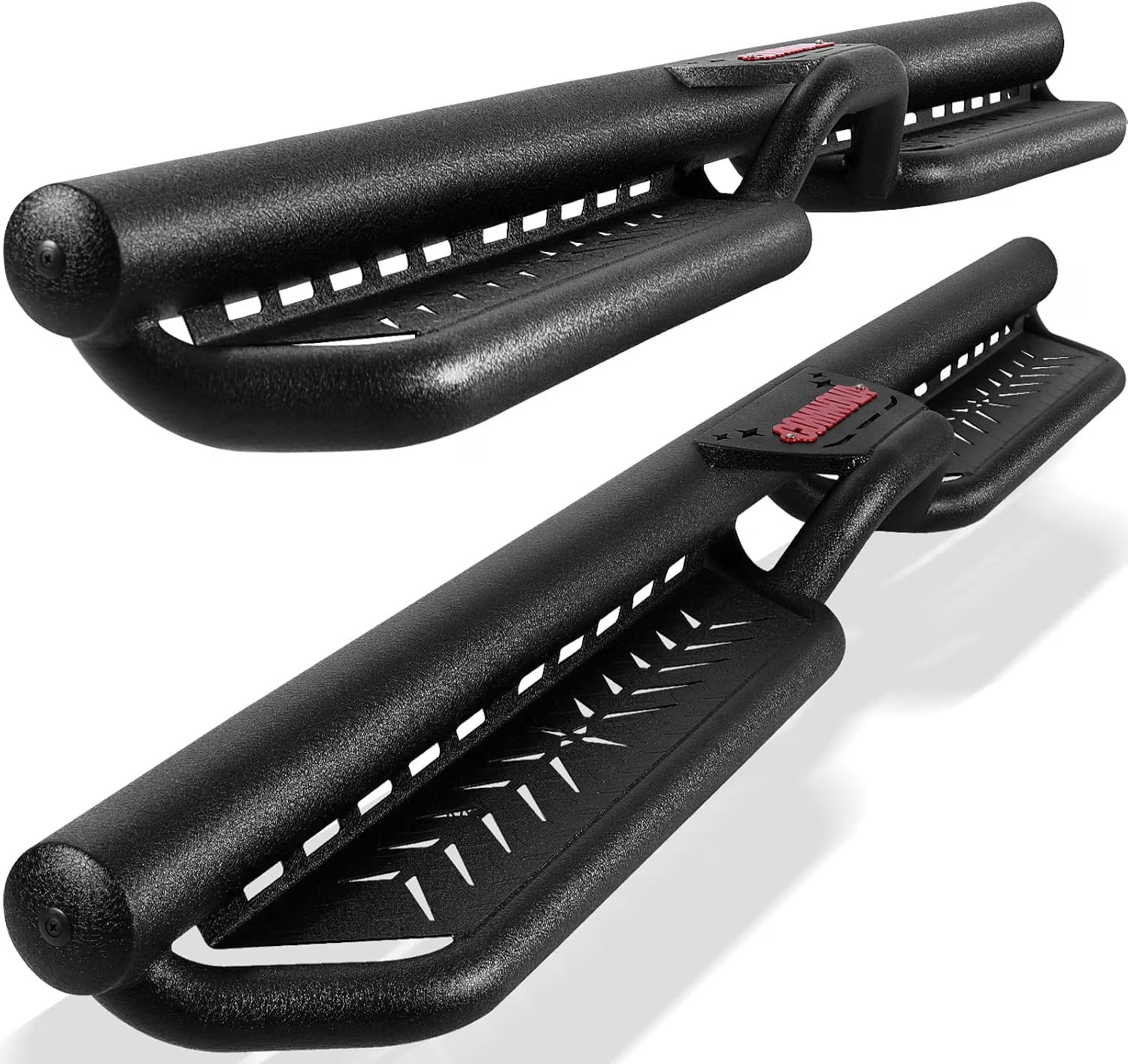
Product information
Not everyone wants to spend $400, $800, or somewhere north of $1,000 just to make getting into a truck easier.
Enter COMNOVA.
One of its current 6-inch Amazon listings fits the specified 2019–2026 Chevy Silverado 1500 Crew Cab and 2020–2026 Silverado/Sierra 2500HD and 3500HD Crew Cab trucks. Current Amazon marketplace tracking identifies the popular listing as ASIN B08NGT9XNL.
The design provides a broad 6-inch stepping area, multiple mounting brackets, and an adjustable slider-style position on the relevant version.
That's a lot of practical running board for the money.
And this is where budget accessories sometimes surprise you.
A running board doesn't need Wi-Fi.
It doesn't need artificial intelligence.
It doesn't need an app.
It needs to fit properly, remain solid, and give your boot somewhere dependable to land.
Refreshing, really.
Best for:
Silverado and Sierra owners wanting a wide step at a budget-friendly price.
Why we like it:
- 6-inch stepping surface
- Broad non-slip area
- Vehicle-specific brackets
- Adjustable positioning on supported versions
- Current Amazon availability
- Popular Silverado/Sierra fitments
- 500-lb rating listed for current applicable versions
- Competitive price category
What we'd think about first:
The Amazon product family includes different constructions and fitments, so don't assume every COMNOVA 6-inch listing has identical materials or hardware.
The exact Silverado/Sierra variant matters.
Also note exclusions such as certain LD/Limited or previous-generation models.
Our verdict:
Best budget wide-board option in this roundup.
Particularly appealing if you own one of the supported Silverado or Sierra Crew Cab models.
FAQs: Running Boards
Is there a safe weight limit for running boards?
The majority of running boards have a safety weight factor of about 300 lbs.
However, the higher-quality running boards can take as much as 600 lbs
Check to see the maker's specifications for your running boards to locate the precise safety weight factor.
Can running boards be retracted when not in use?
The majority of running boards are installed to be fixed in the open position. However, there are some electric power running boards available that will open and retract when not in use. When the door is opened, an electric motor will swing the board out, and when the door is closed, the board will swing back towards the side panel.
What are the best running boards for trucks?
The best running boards depend on the truck and intended use. Tyger Auto Rider is a strong value option, Rough Country HD2 offers an aluminum platform, N-Fab Podium works well for drop-step applications, and AMP Research PowerStep is a premium powered choice.
Are running boards universal?
No. Most good running boards are designed for specific vehicle years, models, and cab configurations. Always confirm compatibility before ordering.
What is the difference between running boards and nerf bars?
Running boards usually provide a wider continuous stepping surface. Nerf bars traditionally use round or oval tubing with individual step pads, although manufacturers increasingly use the terms interchangeably.
How wide should running boards be?
Around four to six inches is comfortable for many everyday users. Wider boards provide more space for work boots, children, and older passengers, while narrower steps can preserve a sleeker appearance and additional clearance.
Are aluminum running boards better than steel?
Aluminum offers excellent corrosion resistance and lower weight. Steel is strong and often less expensive but depends more heavily on protective coatings to prevent corrosion. Neither material is automatically best for every vehicle.
Do running boards reduce ground clearance?
Fixed and drop-step running boards can reduce side clearance. Powered running boards retract closer to the vehicle when not being used, which can preserve more clearance.
How much weight can running boards hold?
Capacity varies by model. Many quality boards are rated for several hundred pounds. For example, current Tyger Rider applications are often rated to 500 pounds, while several AMP PowerStep variants are rated to 600 pounds. Always verify the exact product specification.
Can I install running boards myself?
Many fixed running boards use factory mounting locations and can be installed with basic hand tools. Powered running boards are more complex because electrical wiring and control components are involved.
Do running boards require drilling?
Many modern vehicle-specific running boards require no drilling, but this varies by truck and product. Always review the installation guide for your exact application.
Are power running boards worth the money?
Power running boards can be worth it for buyers who value automatic operation, clean styling, and ground clearance. Fixed running boards are considerably less expensive and mechanically simpler.
Are running boards good for lifted trucks?
Yes, particularly drop-step and powered designs that provide a lower stepping point. Check that the step position actually reduces the climb created by your particular lift.
Can running boards protect rocker panels?
Running boards can reduce some mud, gravel, and road debris reaching lower bodywork, but they should not be confused with structural rock sliders designed for serious off-road protection.
You may be interested in checking out these other reviews.
 Save With Reviews
 Save With Reviews
 Save With Reviews