
Color is one of those things most people barely think about.
The red tomato. Green traffic light. Purple shirt. Brown leaves. You look, your brain sorts it out, and life keeps moving.
But if you have color vision deficiency, some of those differences aren't quite so obvious. Red can melt toward brown. Green gets muddy. Purple sometimes decides it would rather be blue. And then somebody asks, “Can't you see that's green?”
Well... apparently not.
Color blind glasses are designed to alter the light reaching your eyes so that
For some people, though, the difference can be noticeable.
For others?
Subtle.
And occasionally, almost nothing.
That's why choosing the right glasses—and understanding what they realistically can and cannot do—is especially important.
What Are the Best Color Blind Glasses?
The best color-blind glasses are lenses matched to your specific type of color vision deficiency —especially Deutan or Protan red-green deficiency —and to where you plan to wear them—indoors, outdoors, or both.
For someone wanting a versatile first pair, the Pilestone TP-025 Lens B is one of the better-known options.
If indoor use is the priority, the Pilestone TP-021 Lens C is worth considering.
For buyers who want a more premium option, EnChroma's Deutan and Protan outdoor glasses remain among the best-known specialist products.
But don't buy a random pair first and figure out your color blindness later.
That's backwards.
Best Color Blind Glasses.
| Color Blind Glasses | Best For | Designed Mainly For | Environment | Key Advantage |
|---|---|---|---|---|
| Pilestone TP-025 Lens B | Best Overall Value | Red-Green CVD | Indoor & Outdoor | Versatile everyday option |
| Pilestone TP-021 Lens C | Best for Indoor Use | Mild/Moderate Red-Green CVD | Indoor | Lighter indoor-oriented lens |
| Pilestone TP-012 Lens A | Best Casual Style | Mild/Moderate Red-Green CVD | Indoor & Outdoor | Traditional everyday frame |
| EnChroma Altavista Outdoor Deutan | Best Premium Deutan Pick | Deutan | Outdoor | Specialist spectral-filter lens |
| EnChroma Cyclotron Outdoor Protan | Best Premium Protan Pick | Protan | Outdoor | Protan-specific lens option |
Important: Color vision deficiency varies from one person to another. A pair that produces a noticeable improvement for one user may produce a smaller change—or no useful change—for somebody else.
Amazon inventory also changes frequently, so confirm the exact lens type, not merely the frame name, before ordering.
Do Color Blind Glasses Really Work?
Here's the answer without marketing fireworks:
Color blind glasses can help some people distinguish certain colors more easily, particularly some people with red-green color vision deficiency, but they do not cure color blindness, and they do not work equally well for everyone.
The National Eye Institute states that special glasses and contact lenses may help people with color vision deficiency distinguish colors by increasing contrast between them. It also makes clear that inherited color vision deficiency currently has no cure.
Scientific studies have produced more complicated results.
One controlled study of 86 people with color vision deficiency found no overall improvement on clinical color-vision tests while wearing EnChroma lenses; some color distinctions improved while others became worse.
Another study comparing EnChroma and VINO filters found measurable changes with both and a larger effect with VINO under its particular test conditions, but researchers still concluded that the evidence did not support describing the technology as correcting red-green color deficiency.
So...
Do they work?
Sometimes, depending on what you mean by work.
Do they cure color blindness?
No.
What Is Color Blindness?
Color blindness—more accurately called color vision deficiency—is a condition in which someone has difficulty distinguishing certain colors.
It usually does not mean seeing the world entirely in black and white.
That's a common misconception.
Most people with color vision deficiency see plenty of color.
Certain shades simply become harder to distinguish.
The National Eye Institute says roughly 1 in 12 men has some form of color vision deficiency.
There are several major types.
Deutan vs. Protan vs. Tritan: What's the Difference?
Deutan Color Blindness
Deutan is a form of red-green color vision deficiency associated with altered green-sensitive cone response.
People may have difficulty distinguishing:
- Green and brown
- Red and green
- Blue and purple
- Pink and gray
- Certain orange and green shades
Deutan is extremely common among people with inherited color vision deficiency.
Protan Color Blindness
Protan is another red-green deficiency, but it involves altered red-sensitive cone response.
Reds can appear darker than they do to people with typical color vision.
Common confusion may involve:
- Red and green
- Red and brown
- Purple and blue
- Pink and gray
- Orange and green
Tritan Color Blindness
Tritan deficiency affects blue-yellow discrimination and is much less common.
Confusion can occur between:
- Blue and green
- Yellow and violet
- Some pinks and grays
Most popular commercial color blind glasses primarily target red-green deficiencies, so people with Tritan deficiency need to read product specifications very carefully.
How Do You Know What Type of Color Blindness You Have?
Don't guess because red and green occasionally look strange.
A proper color vision test is better.
Eye doctors commonly use color plate tests—the familiar circles made up of colored dots containing numbers or patterns.
Other diagnostic methods include hue-arrangement testing and anomaloscope testing.
The National Eye Institute recommends professional testing when you think you or your child may have color vision deficiency.
Online tests can provide a useful indication.
But screens vary.
Brightness varies.
Color settings vary.
Night mode can turn your beautifully calibrated test into orange soup.
For an important diagnosis, see an eye-care professional.
Can Color Blind Glasses Cure Color Blindness?
No.
This needs to be painfully clear because phrases such as “color blindness correction glasses” can sound medical.
The glasses do not repair cone cells.
They do not change your genetics.
They don't permanently alter your color vision after you remove them.
Instead, filtered lenses manipulate incoming light so some colors may become easier to distinguish while the glasses are being worn.
The National Eye Institute states that inherited color vision deficiency currently has no cure.
What Do Color Blind Glasses Actually Change?
Imagine two colors that normally arrive at your visual system looking too similar.
Filtered lenses can reduce parts of the light spectrum where those signals overlap.
The result may increase perceived separation.
Think of two singers performing at almost the same pitch.
Hard to separate.
Move one voice slightly away, and suddenly you can hear two distinct parts.
Not a perfect scientific analogy.
But you get the idea.
The glasses aren't adding a new sensory receptor.
They're changing the information reaching the receptors you already have.
Why Do Some People Have Dramatic Reactions to Color Blind Glasses?
You've probably seen the videos.
Somebody receives color blind glasses as a gift.
They put them on.
Pause.
Look around.
Cry.
Everybody else cries.
The dog probably cries.
They're powerful videos, but don't assume your experience will look the same.
A person's reaction can depend on:
- Type of color vision deficiency
- Severity
- Lens design
- Outdoor versus indoor lighting
- What colors surround them
- Expectations
- Adaptation time
- Individual visual perception
For one person, flowers may suddenly become dramatically separated.
For another, the change could feel like somebody adjusted the color settings on a television.
Both experiences are legitimate.
Can Color Blind Glasses Help You Pass a Color Blindness Test?
They shouldn't be used that way.
Color vision examinations are intended to measure your underlying color discrimination.
Wearing tinted or color-enhancing lenses during such testing changes the stimulus you're being tested with.
EnChroma itself says tinted lenses are not permitted during clinical or occupational color-vision screening and should not be used in an attempt to pass such tests.
If a career requires a specific level of color perception—aviation, electrical work, or certain transportation roles, for example—follow that occupation's testing requirements.
Don't try to hack the eye test.
Can You Drive With Color Blind Glasses?
This one needs caution.
Do not assume that because glasses make certain colors easier to distinguish, they are automatically appropriate for driving.
Some tinted lenses can alter signal brightness or the appearance of other colors.
Manufacturer instructions vary by product.
One clinical paper notes that EnChroma labeling has warned against using its glasses while driving.
Always check the exact manufacturer's current safety instructions for the pair you're considering.
For driving, color enhancement should never replace position, shape, and situational recognition of signals.
Indoor vs. Outdoor Color Blind Glasses.
This distinction is surprisingly important.
Outdoor Glasses
Outdoor lenses generally work with strong natural light.
They may have:
- Darker tint
- Greater spectral filtering
- UV protection
- Sunglass-style appearance
Colors can feel more dramatic outside because sunlight provides a broad spectrum and plenty of intensity.
Indoor Glasses
Indoor lenses generally allow more light through.
They're designed for places such as:
- Offices
- Schools
- Homes
- Workshops
- Computer environments
Wearing dark outdoor glasses under fluorescent office lights can feel like doing spreadsheets inside a nightclub.
Possible.
Not ideal.
Can You Wear Color Blind Glasses Over Prescription Glasses?
Some manufacturers offer fit-over designs, while others provide prescription lens options.
If you already wear prescription glasses, you essentially have three choices:
- Buy a fit-over color-enhancing frame.
- Ask whether the manufacturer offers your prescription.
- Wear contacts underneath plano color-enhancing glasses.
Don't try balancing two normal frames on top of one another.
I've tried enough ridiculous combinations of sunglasses and reading glasses to confirm that gravity eventually wins.
How to Choose the Best Color Blind Glasses.
1. Find Your Color Vision Type First
This is number one for a reason.
Don't buy:
“COLOR BLIND GLASSES — WORKS FOR EVERYBODY!”
and hope.
Determine whether you have:
- Deutan
- Protan
- Tritan
- Another form of color vision deficiency
Then match the lens.
2. Consider Severity
Mild and severe deficiencies don't necessarily respond to filters in the same way.
Read the manufacturer's lens recommendations carefully.
3. Decide Where You'll Wear Them
Mostly outdoors?
Choose an outdoor lens.
Office or school?
Consider indoor.
A mixture?
Look for an all-purpose option, understanding there may be compromises.
4. Check the Return Policy
This is unusually important for color blind glasses.
Two people with broadly similar diagnoses may have very different subjective experiences.
A generous return period gives you a chance to try the glasses in actual environments.
Trees.
Flowers.
Traffic signs.
Clothing.
Screens.
Food.
A rainbow, if nature cooperates.
5. Look at UV Protection
Outdoor color blind glasses should provide appropriate ultraviolet protection if they are intended to function as sunglasses.
Color enhancement isn't much of a bargain if the eyewear ignores basic sun protection.
6. Make Sure the Frame Fits
Lens technology gets all the attention.
Your nose may disagree.
Consider:
- Frame width
- Temple length
- Nose bridge
- Weight
- Prescription compatibility
- Head size
Glasses that become uncomfortable after twenty minutes eventually live in a drawer.
The drawer contains many technological dreams.
Are Expensive Color Blind Glasses Better?
Not automatically.
Premium brands may offer:
- More sophisticated spectral filtering
- More frame choices
- Prescription options
- Better coatings
- Better build quality
- Longer trial periods
But paying more doesn't guarantee that your visual system will experience a greater improvement.
That's what makes this category so unusual.
A $300 pair isn't automatically three times more useful than a $100 pair.
Your eyes didn't receive the pricing spreadsheet.
Color Blind Glasses vs. Color Identification Apps
Sometimes the best solution isn't glasses.
If your problem is simply:
“What color is this wire?”
or
“Is this shirt navy or black?”
a smartphone color-identification app may be more practical.
Phone accessibility features can also modify display colors to make interfaces easier to interpret.
Glasses are better suited to changing the appearance of the broader environment.
Apps are better when you need to identify a specific color.
They're complementary tools.
Are Color Blind Glasses Worth Buying?
Color blind glasses may be worth trying if you have a compatible red-green color vision deficiency and want greater color separation in certain situations, provided you understand that results vary and the glasses do not cure color blindness.
That's the sensible answer.
Not:
“You WILL finally see the world normally!”
We can't promise that.
Nobody responsibly can.
If the glasses make autumn leaves easier to distinguish, improve a hobby, help you enjoy artwork differently, or simply let you experience certain colors with more separation, that may be worth quite a lot personally.
Even if the effect isn't clinically transformational.
Sometimes enjoyment matters too.
Which Color Blind Glasses Should You Buy?
For a first relatively affordable experiment, I'd start with the Pilestone TP-025 Lens B, assuming that lens matches your type of red-green deficiency.
If you mainly want help indoors, look at the Pilestone TP-021 Lens C.
For everyday styling, the Pilestone TP-012 Lens A deserves consideration.
If you've confirmed Deutan deficiency and want a premium outdoor option, look at EnChroma Altavista Outdoor Deutan.
For Protan deficiency, consider the EnChroma Cyclotron Outdoor Protan.
The important word in all of those sentences is:
if.
Match the lens to your eyes first.
How We Selected These Color Blind Glasses
Save With Reviews does not claim that our editorial team has clinically tested every pair of glasses in this guide.
Our recommendations consider:
- Intended color vision deficiency
- Lens type
- Indoor/outdoor purpose
- Manufacturer information
- Current product relevance
- Frame construction
- UV protection where appropriate
- Independent research
- Ease of purchase
- Relative value
- U.S. availability
We also look carefully at health-related claims.
Color blind glasses should not be presented as a medical cure because current evidence does not support that conclusion.
Transparency matters more than a dramatic sales pitch.
Especially when somebody's vision is involved.
Final Verdict
Color blind glasses occupy a strange middle ground.
They're not a cure.
They're not necessarily a gimmick either.
For the right person, with the right type of red-green color vision deficiency, a well-matched filter may make certain colors easier to separate.
Maybe the red berries finally stand out from the bush.
Maybe a purple shirt looks properly different from blue.
Maybe sunset takes on another dimension.
Or maybe the improvement is modest.
That's okay too.
The smartest approach is to find out your color-vision type, choose the appropriate lens, buy from somewhere with a reasonable return policy, and judge the glasses in real life rather than expecting a miracle.
Color is personal.
Apparently more personal than most of us realized.
Need help? We've done the research for you and found the Best Color Blind Glasses on Amazon. Every day, we read hundreds of reviews and try the highest-rated products we have on our list.
Best Color Blind Glasses - Reviews
Pilestone TP-025 Lens B — Best Overall Value
Product information
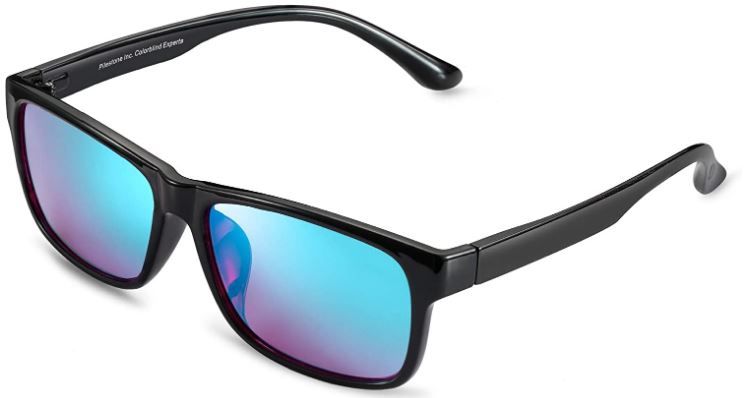
The Pilestone TP-025 Lens B is probably the place I'd start if somebody wanted to experiment with color blind glasses without immediately jumping into the most expensive end of the category.
It's designed for red-green color vision deficiency and can be used in indoor and outdoor environments.
The idea isn't to magically manufacture colors your visual system cannot perceive.
Instead, the tinted filtering changes the relationship between certain wavelengths reaching the eye, which can make some previously confusing colors appear more separated.
Sounds terribly clinical.
In practice, the experience might be something much simpler.
A red flower suddenly looks more distinct from its green leaves.
A traffic sign stands out differently.
Pink isn't quite as washed into gray.
Or perhaps you put the glasses on and think...
That's it?
Both reactions happen.
Best for:
People wanting a relatively accessible first pair for red-green color vision deficiency.
Why consider them:
- Designed for red-green color vision deficiency
- Indoor and outdoor use
- Lightweight frame
- UV protection
- Scratch-resistant lens design
- More affordable than many premium specialist glasses
- Easy starting point for first-time users
What we'd think about first:
The lens tint can alter colors that you already distinguish perfectly well.
That's the tradeoff with filtered lenses. Improving separation in one part of the spectrum doesn't mean every color becomes more accurate.
Our verdict:
Best overall value for somebody trying color blind glasses for the first time.
Just make sure Lens B is appropriate for your particular deficiency before ordering.
Pilestone TP-021 Lens C — Best Color Blind Glasses for Indoor Use.
Product information
Indoor lighting is weird.
Really weird, actually.
Walk from bright sunlight into an office filled with cool-white LEDs, and colors can change more than you'd expect. Add computer monitors, fluorescent lamps, and beige office walls, and suddenly everything looks as though somebody turned saturation down.
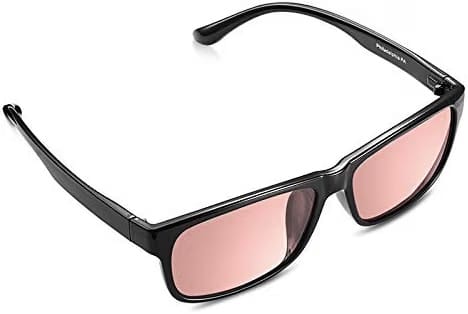
The Pilestone TP-021 Lens C is intended more specifically for indoor use and mild-to-moderate red-green color vision deficiency.
That makes it interesting for:
- Office environments
- Computer work
- Classrooms
- Reading charts
- Crafts and hobbies
- Everyday indoor activities
The advantage is that you aren't necessarily wearing a pair of dark, sunglass-like filters while sitting at your desk.
Because that gets old.
Fast.
Best for:
People who primarily want help differentiating colors under indoor lighting.
Why consider them:
- Indoor-oriented lens
- Designed for red-green deficiency
- Lightweight TR90-style frame
- Useful for office or classroom environments
- Less dark than outdoor-focused glasses
- Everyday appearance
Potential downside:
Indoor lenses generally don't produce the same high-contrast experience that stronger outdoor filters may provide in sunlight.
That's not necessarily a flaw.
It's a compromise.
Our verdict:
Best choice here if most of your color-related difficulties happen indoors.
Good
Product information
Some color blind glasses look... medical.
Others look like protective laboratory eyewear.
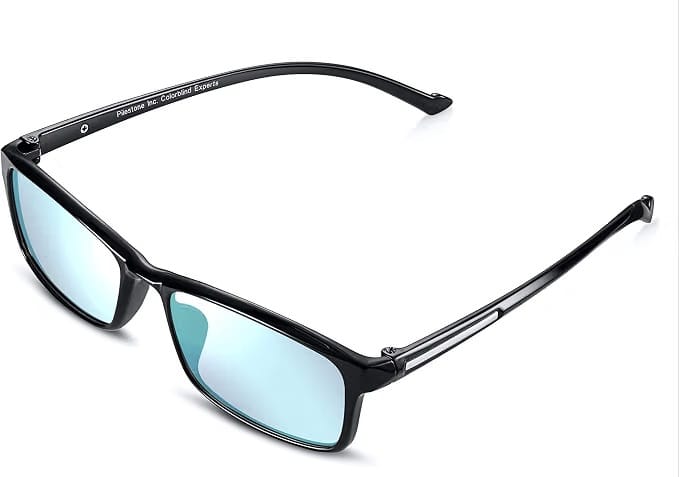
The Pilestone TP-012 Lens A is more conventional.
Normal-looking frame.
Normal-looking shape.
Well, mostly normal-looking—the lenses still have a noticeable tint because physics refuses to cooperate with fashion completely.
The TP-012 is aimed at certain forms of mild-to-moderate red-green color deficiency and is marketed for both indoor and outdoor environments.
It can make sense for somebody who wants to wear the glasses casually without carrying separate indoor and outdoor pairs everywhere.
Best for:
Casual everyday use.
Why consider them:
- Traditional frame design
- Intended for red-green color deficiency
- Indoor/outdoor versatility
- UV protection
- Relatively lightweight
- Useful as a first experimental pair
Potential downside:
An all-around lens usually involves compromises.
A lens optimized specifically for bright outdoor conditions may deliver stronger separation outside, while a dedicated indoor lens may feel more comfortable under artificial lighting.
One pair doing everything perfectly would be lovely.
Eyes are apparently more complicated than that.
Our verdict:
A sensible choice if style and versatility matter nearly as much as color enhancement.
EnChroma Altavista Outdoor Deutan — Best Premium Glasses for Deutan Color Blindness.
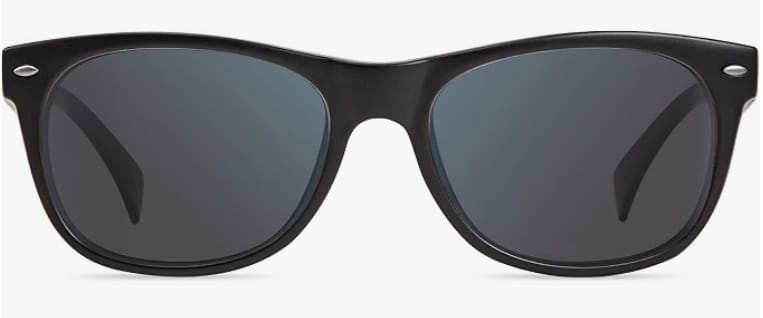
Product information
EnChroma is probably the name most people encounter first when researching color blind glasses.
Videos showing people becoming emotional after putting on EnChroma glasses have circulated online for years.
Some are genuinely moving.
They're also capable of creating unrealistic expectations.
The EnChroma Altavista Outdoor Deutan is designed specifically for people with Deutan red-green color vision deficiency.
Deutan deficiency involves altered sensitivity associated with green-responsive cones and is among the most common forms of inherited color vision deficiency.
EnChroma uses spectral filtering designed to change the separation between certain color signals.
In bright daylight, some users report stronger differences between reds, greens, oranges, and related shades.
But—and this matters—the scientific evidence surrounding color-enhancing glasses is mixed.
Research involving EnChroma lenses has found that they can alter color perception, but controlled clinical studies haven't consistently demonstrated an overall normalization or broad improvement of color discrimination.
That doesn't mean nobody perceives a benefit.
It means we shouldn't promise one.
Best for:
People with diagnosed or reasonably well-established Deutan color vision deficiency who want a premium outdoor option.
Why consider them:
- Specifically offered for Deutan deficiency
- Specialist spectral filtering
- Outdoor use
- UV protection
- Premium frame choices
- Prescription options may be available through EnChroma
- Established specialist brand
Potential downside:
Price.
These aren't impulse-purchase sunglasses.
And because results vary between individuals, buying from a retailer with a reasonable return policy becomes particularly important.
Our verdict:
Premium choice for Deutan users willing to spend more—but manage expectations.
EnChroma Cyclotron Outdoor Protan — Best Premium Protan Color Blind Glasses.
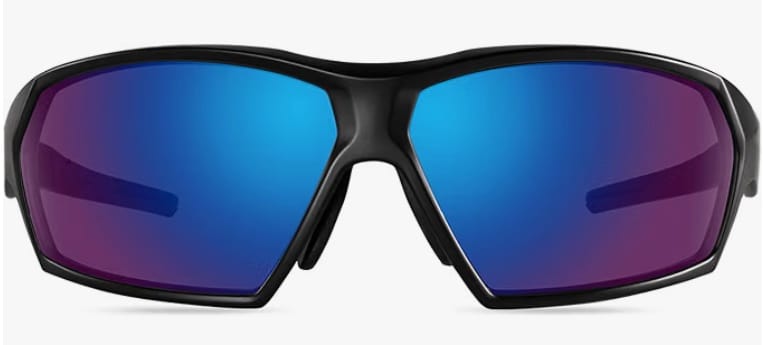
Product information
Here's where knowing your type becomes important.
Protan and Deutan aren't interchangeable labels.
Someone with Protan color vision deficiency has an issue associated with the red-sensitive portion of the visual system. Reds may appear darker, and distinguishing certain red, green, orange, and brown shades can be difficult.
The EnChroma Cyclotron Outdoor Protan uses a lens specifically aimed at Protan deficiency.
That's why I wouldn't simply recommend “EnChroma glasses.”
Which ones?
For whom?
Under what lighting?
Those details matter.
Best for:
People with Protan red-green color vision deficiency who want an outdoor-oriented premium pair.
Why consider them:
- Protan-specific lens
- Outdoor spectral filtering
- UV protection
- Premium frame construction
- Specialist color-vision brand
- Designed for bright daylight
Potential downside:
Like other filtered color-enhancing glasses, they can improve the distinction of some colors while altering others.
They should not be viewed as restoring normal color vision.
Our verdict:
Our premium outdoor pick for Protan deficiency.
If you're unsure whether you're Protan or Deutan, determine that first.
Seriously.
That is more important than picking a frame color.
FAQs: Color Blind Glasses.
Just how do color blindness adjustment glasses work?
Color blindness impacts the way the cones in your retina view wavelengths of light. In turn, your brain's capacity to distinguish between certain shades suffers. Color blindness modification glasses have tinted lenses that can get rid of particular wavelengths of light, so you can distinguish between colors a lot more easily.
Are there any side effects from putting on color blindness correction glasses?
You shouldn't experience any adverse effects from making use of color blindness correction glasses. If you observe that you're having a headache or experiencing eye strain, it might be a sign that you require an update to your vision prescription. Speak with an eye care professional to see to it that you're utilizing the ideal glasses for your vision concerns.
Can one get prescription color-blind glasses?
While a majority of color-blind glasses may resemble sunglasses in appearance, they offer a variety of lens options, including prescription lenses. If you have vision issues such as myopia, hypermetropia, or astigmatism, you can get color-blind glasses tailored to your specific eyeglass prescription.
Do color blind glasses really work?
Color blind glasses can change color perception and may help some people distinguish certain colors more easily, especially some people with red-green color vision deficiency. Results vary considerably, and the glasses do not cure color blindness.
What are the best color blind glasses?
The best glasses depend on your type of color vision deficiency. Pilestone offers several relatively affordable options, while EnChroma provides premium lenses specifically designed for certain Deutan and Protan deficiencies.
Can color blind glasses cure color blindness?
No. Inherited color vision deficiency currently has no cure. Filtered glasses change the wavelengths of light reaching the eye and may improve contrast between some colors while the glasses are being worn.
Do color blind glasses work for red-green color blindness?
Many commercial color blind glasses are specifically designed for red-green deficiencies such as Deutan and Protan. Their effectiveness varies according to the person's type, severity, lens, and lighting conditions.
Do color blind glasses work for everyone?
No. Some users perceive substantial differences, others experience modest changes, and some notice little useful improvement.
What is the difference between Deutan and Protan color blindness?
Deutan involves altered green-sensitive color vision, while Protan involves altered red-sensitive color vision. Both fall under red-green color vision deficiency, but different filtered lenses may be recommended for each.
Can you wear color blind glasses indoors?
Yes, but choose an indoor or indoor-compatible lens. Outdoor models may be too dark or strongly tinted for comfortable indoor use.
Can color blind glasses help you pass an Ishihara test?
Color-enhancing or tinted glasses should not be used to try to pass clinical or occupational color vision testing. Such testing is intended to measure underlying color vision without tinted filters.
Can I drive while wearing color blind glasses?
Do not assume every color blind lens is approved for driving. Check the manufacturer's instructions for the exact model, as tinted lenses can alter brightness and color appearance.
Can children use color blind glasses?
Some manufacturers offer glasses for children, but parents should first consider professional color-vision testing and confirm that the product is appropriate for the child's type of deficiency.
How do I know which color blind glasses I need?
A professional eye examination is the most reliable way to identify your type of color vision deficiency. Once you know whether you have Deutan, Protan, Tritan, or another form, you can choose a compatible lens.
 Neil Fajardo
 Neil Fajardo
 Elice Zanker