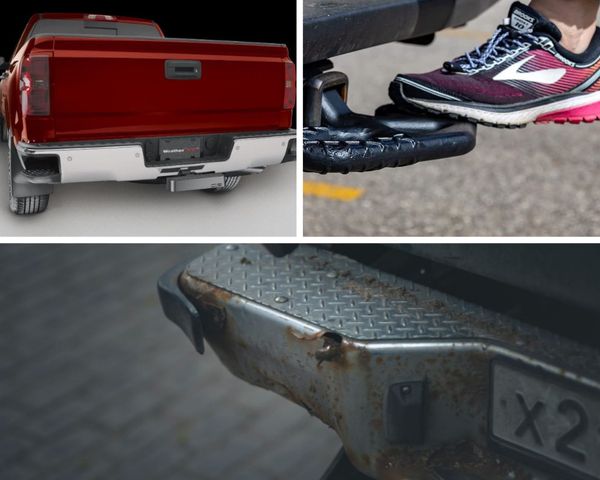


A tie‑down strap is a length of heavy‑duty webbing — usually polyester or nylon — with a tensioning mechanism (ratchet, cam buckle, or simple cinch) that secures cargo to a vehicle, trailer, roof rack, or anchor point during transport. The right strap depends on your load weight, cargo type, and where you're hauling it.
Types of Tie‑Down Straps
Not every strap does the same job. Here's a breakdown of the four main categories and when each one makes sense.
1. Ratchet Straps
Best for: Heavy loads, flatbed hauling, motorcycle transport, anything that absolutely cannot move.
Ratchet straps are the workhorse of the tie‑down world. A ratcheting mechanism lets you crank the webbing tight with serious mechanical advantage — we're talking thousands of pounds of tension from a hand‑operated lever.
- Working Load Limits (WLL): Typically 500 lbs on the light end up to 5,400+ lbs for 4‑inch heavy‑duty models.
- Pros: High tension, adjustable, lockable, and widely available.
- Cons: Can over‑tighten and crush delicate cargo if you're not careful. The ratchet mechanism can also pinch fingers — ask anyone who's learned that lesson once.
2. Cam Buckle Straps
Best for: Lighter or fragile loads — kayaks, furniture with soft finishes, bundled boxes.
Cam buckle straps use a spring‑loaded cam that grips the webbing when you pull it through. No ratcheting, no cranking — just thread and pull. They apply less force than ratchet straps, which is actually the point: you get enough hold without the risk of denting a canoe or cracking a wooden headboard.
- WLL: Usually 200–600 lbs.
- Pros: Gentle tension, fast to use, lightweight.
- Cons: Not enough holding power for heavy or high‑wind loads.
3. Lashing (Cinch) Straps
Best for: Bundling items together, light securing tasks, and organizing gear.
These are the simplest designs — a strap with a basic buckle. No moving parts beyond the buckle itself. They're great for wrapping around a stack of boards, holding sleeping bags to a pack frame, or keeping extension cords from turning into a tangled mess in your garage.
- WLL: Generally under 500 lbs.
- Pros: Cheap, light, nearly indestructible in normal use.
- Cons: Limited tension; not a standalone solution for transport loads.
4. Bungee Cords and Tarp Straps
Best for: Tarps, canopies, lightweight or oddly shaped items that need a flexible hold.
Elastic tie‑downs stretch and grip, which makes them useful for items that shift slightly or have irregular shapes. They're the "good enough for now" option — holding a tarp over firewood, keeping a cooler lid from flapping, securing a sleeping pad to a roof rack.
- WLL: Low — these are not rated for serious cargo.
- Pros: Flexible, reusable, quick to attach.
- Cons: Can snap back (eye protection is smart), not suitable for highway‑speed loads.
How to Choose the Right Tie‑Down Straps
Picking the wrong strap is either wasteful (too heavy‑duty for a light job) or dangerous (too light for a heavy one). Here's what to evaluate before buying.
What Is Working Load Limit (WLL)?
The Working Load Limit is the maximum weight a strap is rated to handle during normal use. It's typically one‑third of the strap's breaking strength, which builds in a safety margin.
Rule of thumb: Your strap's WLL should exceed the weight of your cargo. If you're securing 1,200 lbs of equipment, don't use a strap rated at 1,000 lbs — go higher.
| Strap Width | Typical WLL | Best Use Case |
|---|---|---|
1" | 300–500 lbs | Light gear, motorcycles |
2" | 1,000–3,300 lbs | General cargo, furniture, ATVs |
3" | 3,000–5,000 lbs | Heavy equipment, pallets |
4" | 5,400+ lbs | Flatbed freight, industrial loads |
Breaking Strength vs. WLL
Breaking strength is the force at which the strap will physically fail. It should be printed on the label (if it's not, that's a red flag — skip that strap). A quality strap's breaking strength is roughly 3× its WLL.
Match the Strap Type to the Cargo
- Heavy, rigid loads (machinery, vehicles, pallets) → Ratchet straps.
- Medium, fragile loads (furniture, boats, instruments) → Cam buckle straps.
- Light bundling (camping gear, lumber stacks) → Lashing/cinch straps.
- Flexible cover duty (tarps, canopies) → Bungee cords.
Check the Hardware
End fittings matter. Look for:
- S‑hooks (common, but can slip off thin anchor points)
- J‑hooks (better grip on flatbed rails)
- Flat hooks (won't scratch painted surfaces)
- D‑rings or E‑track fittings (for enclosed trailers)

How to Use Ratchet Tie‑Down Straps (Step by Step)
Ratchet straps are the most common — and the most commonly misused. Here's how to do it right.
Step 1: Thread the Strap
Open the ratchet handle fully. Find the slot (mandrel) at the center of the ratchet spool. Feed the free end of the webbing through the slot from underneath, then pull it through until you have a few inches of tail.
Step 2: Remove the Slack
Before you start ratcheting, pull the free end by hand to take up as much slack as possible. The ratchet mechanism works best when it only needs to take up the last bit of tension — not yards of loose webbing.
Step 3: Tighten with the Ratchet
Pump the handle open and closed — usually 3 to 5 full strokes get you to proper tension. The cargo should feel locked in place but not crushed. Over‑tightening can warp panels, crack plastic, or stretch the strap beyond its safe range.
Step 4: Lock the Handle
Push the handle down to the closed/flat position. It should click and hold. Give the whole setup a firm shake — if anything shifts, add another stroke.
Step 5: Release (When You Arrive)
Pull the release lever (pawl) while lifting the handle to the fully open/flat position. The spool will unlock, and you can pull the webbing free. If it's stuck, check that the pawl is fully disengaged — forcing it can damage the mechanism.
Pro tip: Store straps loosely rolled, not bunched. Tight knots weaken webbing over time, and a tangled ratchet strap in a hurry is nobody's idea of a good morning.
Quick verdict
If you buy one set, make it the Rhino USA 1" × 15' ratchet set — padded handles, safety-clip hooks and a lifetime warranty have made it the most trusted everyday kit on Amazon. Chasing maximum ratings on a budget? The AUGO 4-pack posts the highest working load of any 1-inch kit here and thousands more ratings to back it. Hauling genuinely heavy gear, step up to the Rhino USA Heavy Duty kit or the single EVEREST S1022; counting dollars, the Cartman 6-pack puts six serviceable straps in a bag for the price of a pizza.
| Strap | Rating | Reviews | Break strength / WLL | Price (approx.) | Best for |
|---|---|---|---|---|---|
| Rhino USA Ratchet Set 4-Pack (1" × 15') | 4.3/5 | 18,705 | 1,823 lb / 607 lb | ~$40 | Everyday all-rounder |
| AUGO Ratchet Straps 4-Pack (1" × 15') | 4.7/5 | 23,634 | 2,200 lb / 733 lb | ~$36 | Strongest 1-inch kit |
| Rhino USA Heavy Duty Kit 4-Pack (1.6" × 8') | 4.7/5 | 9,389 | 5,208 lb / 1,736 lb | ~$60 | Heavy loads, trailers |
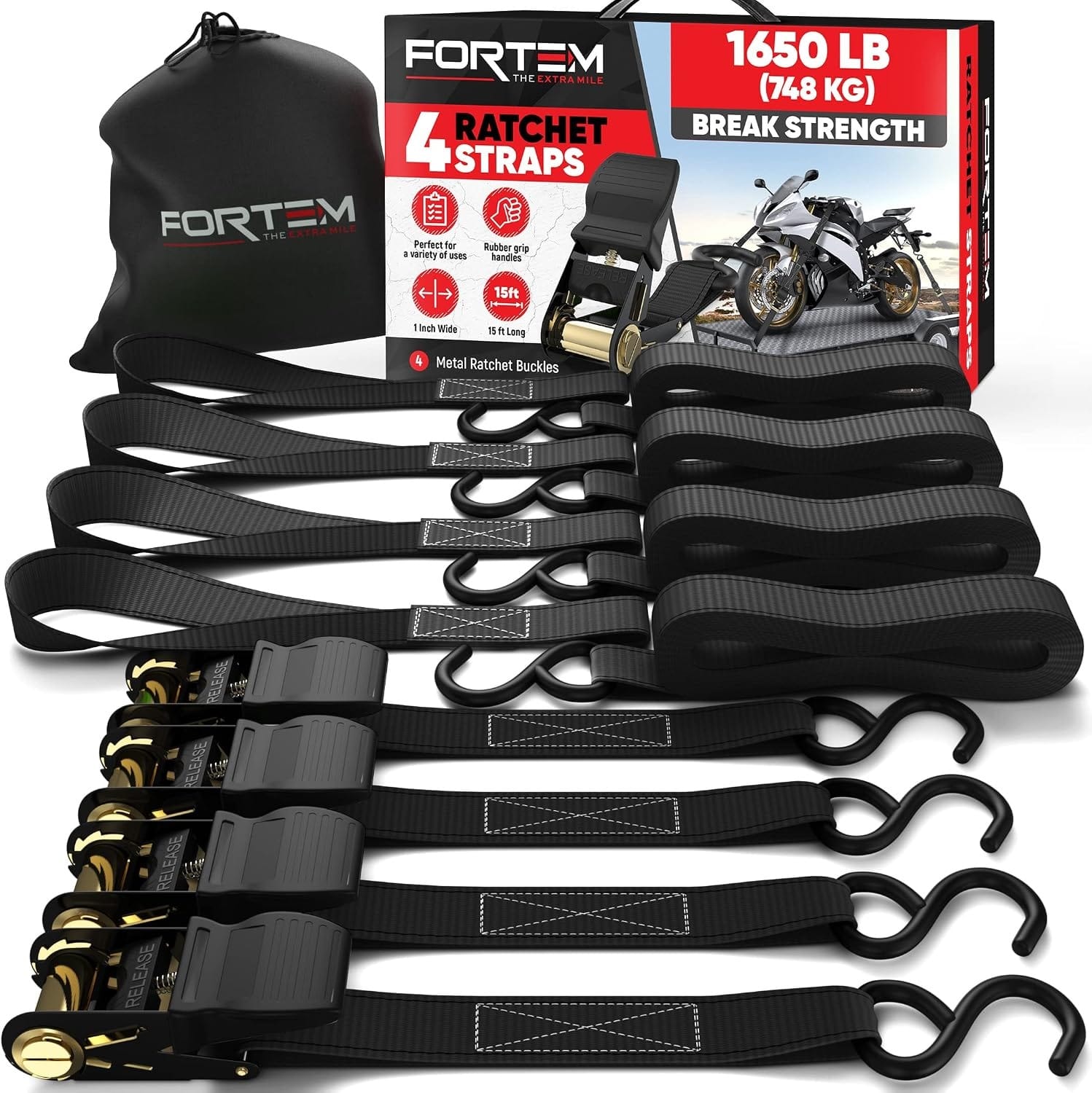
| FORTEM Ratchet Straps 4-Pack (1" × 15') | 4.5/5 | 13,866 | 1,650 lb / 550 lb | ~$21 | Light cargo, easy handling |
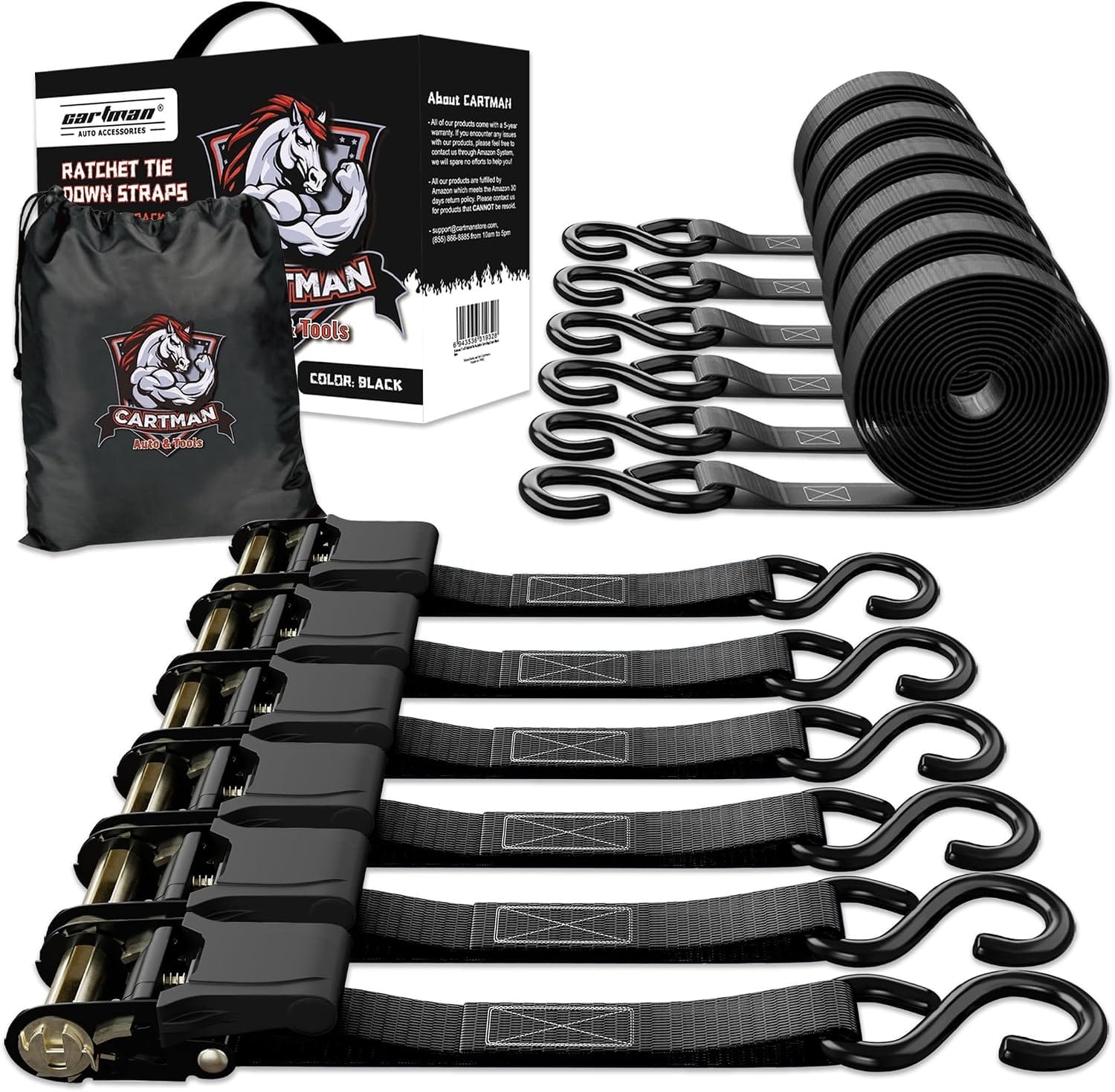
| Cartman Ratchet Tie Downs 6-Pack (1" × 15') | 4.6/5 | 2,756 | 1,500 lb / 500 lb | ~$23 | Best value per strap |
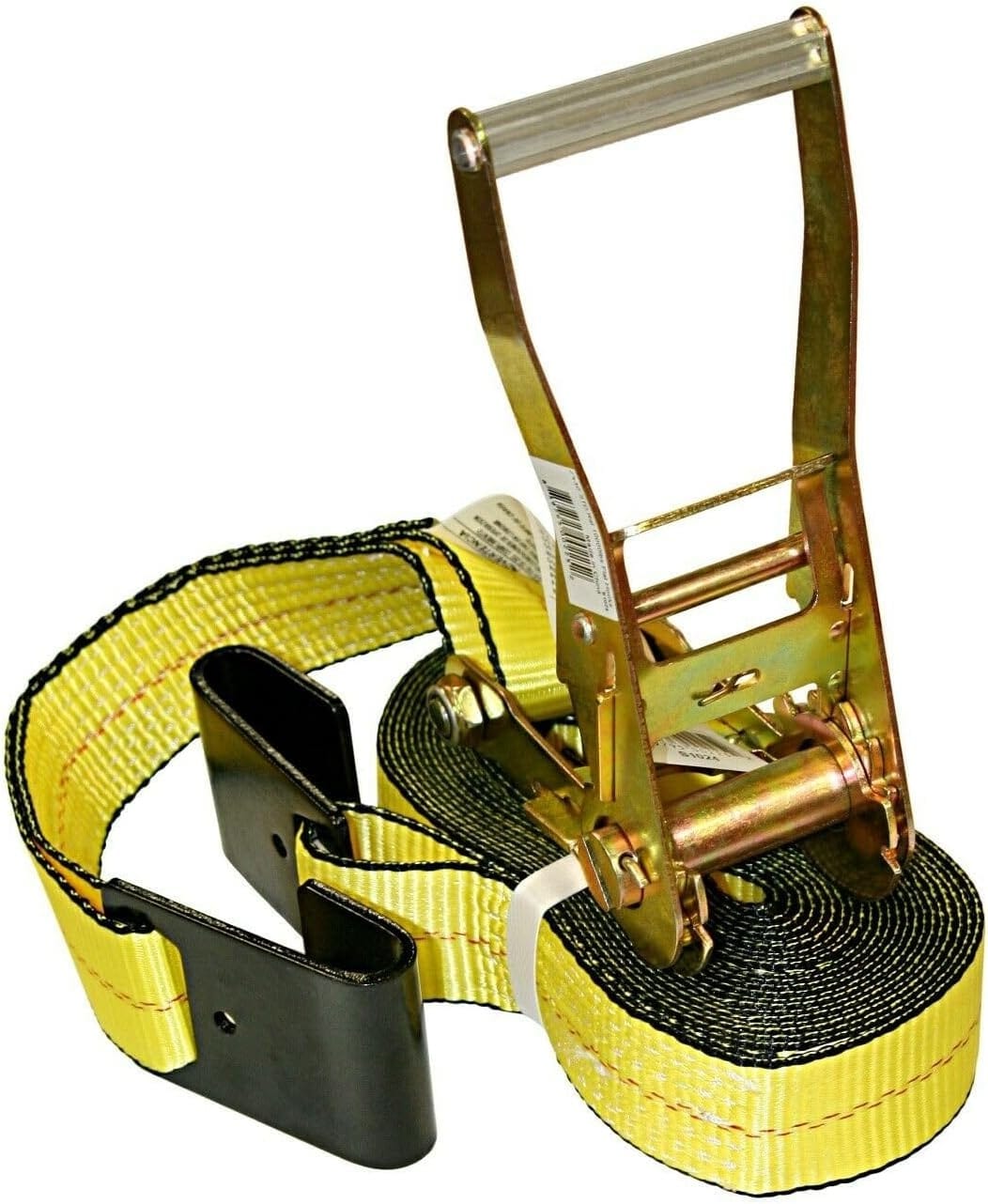
| EVEREST S1022 (2" × 27', single) | 4.7/5 | 1,197 | 10,000 lb / 3,333 lb | ~$14 | Flatbeds, very heavy loads |
Conclusion
The right tie‑down strap keeps your cargo secure, your vehicle safe, and other drivers out of danger. Whether you need heavy‑duty ratchet straps for flatbed freight or simple cam buckles for a weekend camping trip, the key is matching the strap's capacity to your load's weight and shape.
Check the WLL, inspect the hardware, and don't skip the "remove slack" step — it makes everything else work better. Quality straps from reputable brands pay for themselves the first time they prevent a load from shifting at 70 mph.
Can we help? We've done the research for you and found the Best Tie-Down Straps on Amazon.
Every day, we read hundreds of reviews and try the highest-rated products we have on our list.
Best Tie-Down Straps - Reviews
The Best
Product information
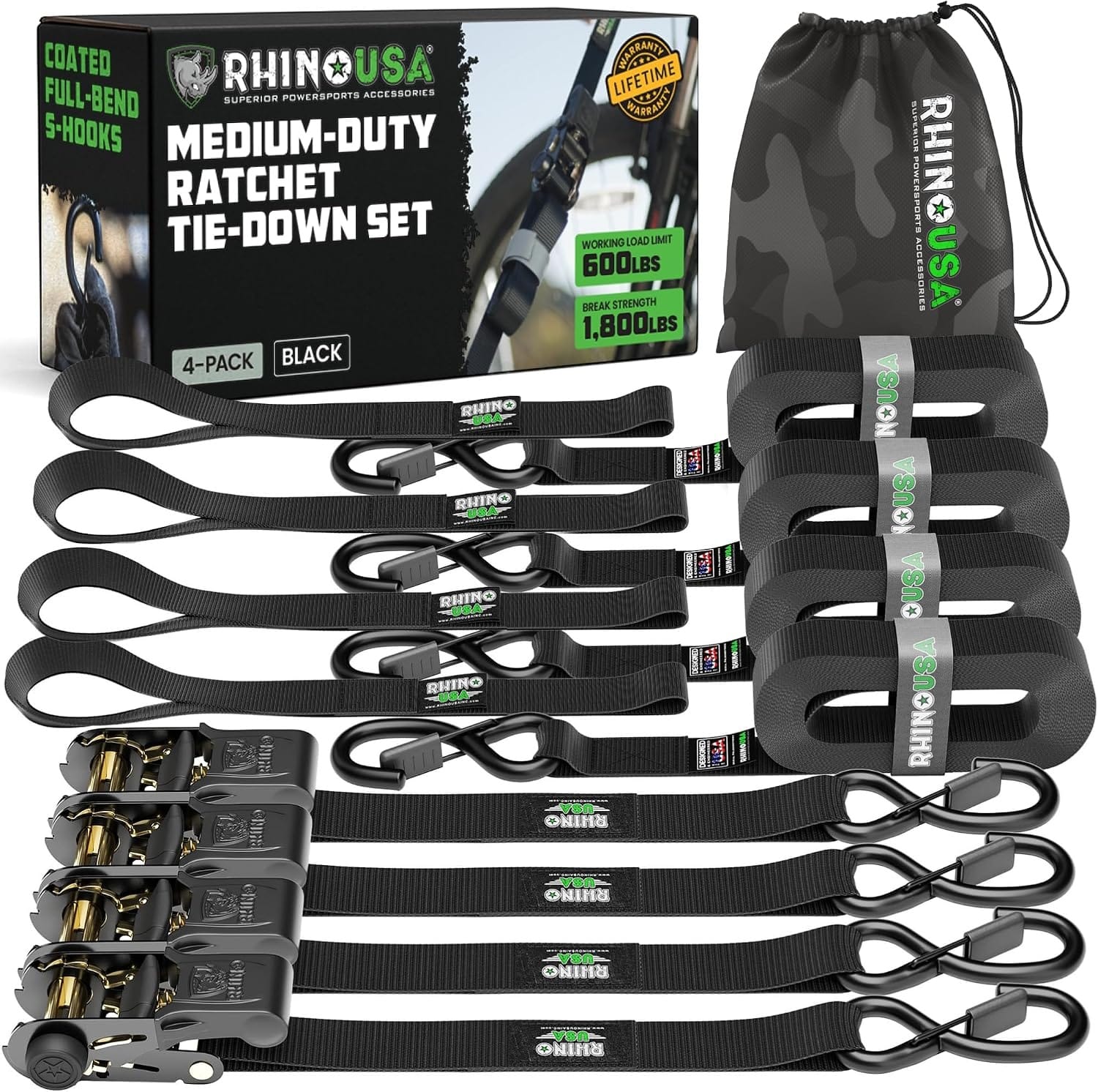
Rhino USA's medium-duty 4-pack pairs 1-inch by 15-foot polyester webbing with a 1,823 lb breaking strength and a 607 lb working load limit per strap — honest, lab-tested numbers rather than packet puffery. The ratchets have padded handles and end-cap grips, the S-hooks are coated and fitted with safety clips so they stay put over bumps, and the box includes four soft-loop straps and a drawstring storage bag. Rhino backs the set with a lifetime replacement warranty, which is a big part of why this kit has collected more than 18,000 Amazon ratings.
Pros
- Padded ratchet handles are genuinely comfortable to crank tight
- Safety-clip S-hooks stay attached to anchor points on rough roads
- Soft loops included for handlebars and painted frames — no metal-on-paint contact
- Lifetime replacement warranty, rare at this price
Cons
- Costs more than no-name 1-inch kits with similar paper specs
- The 607 lb working load limit is medium-duty — not the pick for vehicles on trailers
- Designed in the USA but manufactured in China, and a small share of buyers report quality-control slips
Our Thoughts
This is the set we point most people at. Nothing about it is extreme — the ratings are mid-pack for a 1-inch strap — but the details are right: the handles don't chew your palms, the hooks don't pop off, the soft loops solve the scratch problem, and if a ratchet ever fails, the warranty has you covered. Buyers consistently praise exactly those things, and the complaints are the usual premium-brand ones: price, and wanting more working load than a 1-inch strap can give. If your loads are motorcycles, ATVs, furniture, and appliances, this is the one-and-done purchase.
Very Good
Product information
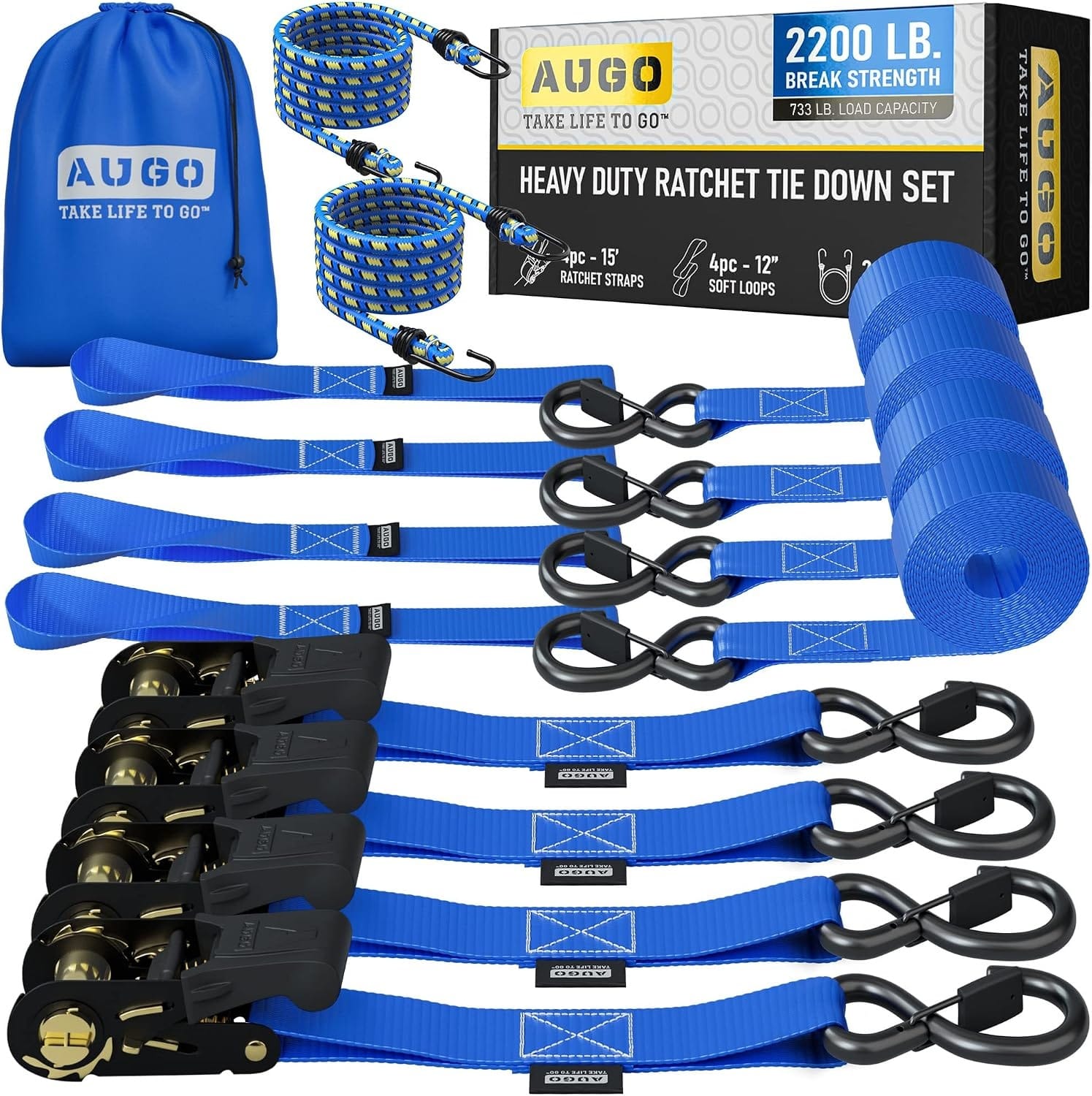
AUGO's 4-pack is the quiet overachiever of the 1-inch class: 2,200 lb breaking strength and a 733 lb working load limit per strap, the highest working load of any 1-inch kit in this roundup. The S-hooks are rubber-coated with safety locks, the ratchets have a quick-release latch, and the kit is generous — four straps, four soft loops, two bungee cords, and a storage bag. Roughly 23,600 Amazon ratings averaging 4.7 stars make it one of the most-reviewed strap sets on the site.
Pros
- Highest working load limit (733 lb) of the 1-inch kits here
- Rubber-coated locking hooks protect paint and stay hooked
- Biggest ratings base in the roundup — 4.7 stars across ~23,600 reviews
- Extras included: soft loops, bungee cords and a storage bag
Cons
- Fixed 15 ft length is a lot of strap for small loads (and only just enough for some big ones)
- Some buyers report loosening a touch on long hauls — re-check tension after the first stretch of road
- Pricier than basic 4-packs with lower ratings
Our Thoughts
If you judge purely on numbers, AUGO beats the top pick: more working load, more reviews, a slightly higher average score. It lands second only because Rhino's padded handles and lifetime warranty are the nicer long-term ownership story. The buyer feedback pattern is consistent — strong webbing, hooks that stay put, and a kit that covers bikes, kayaks, and household moves without drama. Anyone who tie-downs weekly and wants the strongest 1-inch set before stepping up in size should start here.
Very Good
Product information
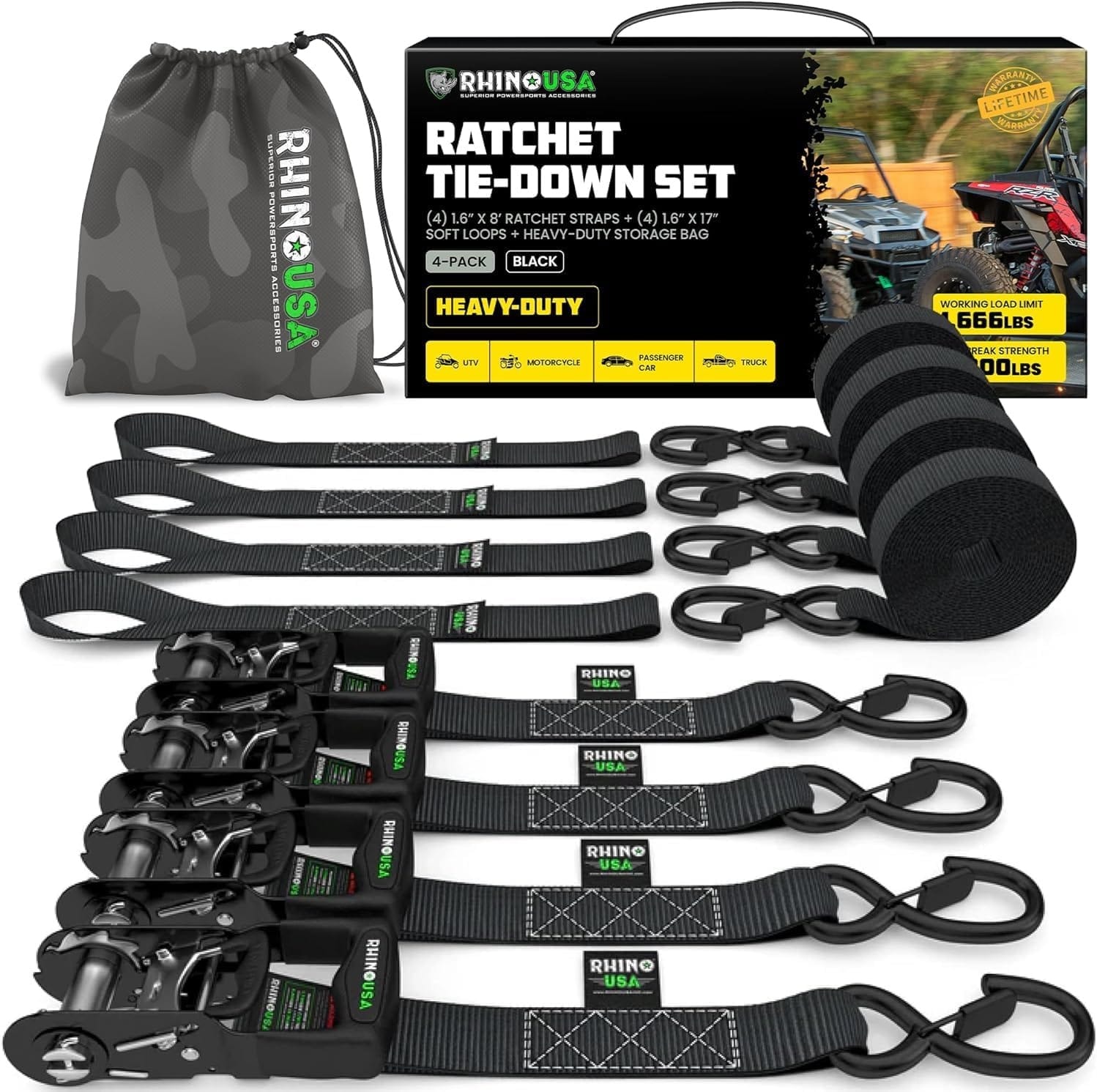
When a 1-inch strap won't cut it, this is Rhino's answer: four 1.6-inch by 8-foot straps rated at 5,208 lb breaking strength and a hefty 1,736 lb working load limit each. The wider webbing spreads clamping force over more area (kinder to cargo, slower to fray), the handles are padded, the hooks are coated chromoly steel, and four soft-loop straps come in the box. It sits at the top of Amazon's powersports tie-down charts and holds 4.7 stars across roughly 9,400 ratings.
Pros
- 1,736 lb working load limit per strap — nearly triple the 1-inch kits
- Wide 1.6" webbing is durable and gentler on loads
- Padded handles make high tension manageable by hand
- Soft loops included; coated hooks resist rust and scratches
Cons
- The most expensive set in this roundup
- 8 ft straps are shorter than the 15 ft kits — awkward for tall or bulky loads
- Buyers note the ratchets can be stubborn to adjust once cranked fully tight
Our Thoughts
This kit is for the loads that make you nervous: big adventure bikes, side-by-sides, compact tractors, heavy toolboxes. Four of these give you a combined working load over 6,900 lb, which covers most trailer work short of a full-size car. The honest limitations are length and price — if your cargo is tall, you'll wish for the 15-foot version of life, and if your loads are light, you're paying for strength you'll never use. For everyone in between, it's the strongest set here that still works like an everyday kit.
Best Value
Product information
Cartman's pitch is simple: more straps, less money. Six 1-inch by 15-foot ratchet straps rated at 1,500 lb breaking strength and 500 lb working load limit each, with rubber-coated S-hooks and a carry bag, for roughly twenty-three dollars — under four dollars a strap. Around 2,800 Amazon ratings average a healthy 4.6 stars, which suggests the basics are done properly despite the bargain pricing.
Pros
- Six straps per pack — the lowest cost per strap in this roundup
- Rubber-coated hooks and grips, unusual at this price
- 4.6-star average from ~2,800 ratings
- Carry bag included to keep the set together
Cons
- 500 lb working load limit is strictly light-to-medium duty
- The box is straps and a bag only — no soft loops or bungees
- Smaller review base than the big brands, so long-term durability is less proven
Our Thoughts
This is the pack for people who lose straps, lend straps, and keep a set in every vehicle "just in case". Individually they're unremarkable — mid-range ratings, standard hardware — but six of them at this price changes the maths: a full four-point tie-down for a trailer load costs you about sixteen dollars in straps. Keep them within their 500 lb per-strap limit, use them for furniture, whitegoods, bikes and building supplies, and the Cartman set is genuinely hard to beat on value.
Very Good
Product information
FORTEM's 4-pack keeps things simple and comfortable: 1-inch by 15-foot straps rated at 1,650 lb breaking strength and 550 lb working load limit, rubber-grip handles that reviewers single out for praise, coated S-hooks, four soft loops and a carry bag. Around 13,900 Amazon ratings average 4.5 stars, and it typically sells for about twenty dollars — brand-name gear at a no-name price. A one-year manufacturer warranty is included.
Pros
- Rubber-grip handles are the most comfortable in this price range
- Complete kit: soft loops, coated hooks and a carry bag
- Weather-resistant coatings suit straps that live in the ute tray
- Strong value — often the cheapest branded 4-pack on Amazon
Cons
- 550 lb working load limit is the lightest of the ratchet kits here
- 1-inch webbing isn't the choice for heavy machinery
- One-year warranty only, against Rhino's lifetime cover
Our Thoughts
FORTEM earns its place as the easy-handling option. The 550 lb working load limit honestly caps it at light-to-medium work — kayaks, bikes, furniture, camping kit, the weekly tip run — but within that lane, buyers love the grips and the general fit and finish, and the price makes it painless to keep a set in every vehicle. Just don't ask it to hold a ride-on mower at highway speed and expect the numbers to save you; step up to the AUGO or Rhino HD if that's your world.
Good
Product information
The S1022 is a different species from the kits above: one professional-grade 2-inch by 27-foot strap with a 10,000 lb breaking strength and a 3,333 lb working load limit, a flat hook made to grab trailer rub rails, and a wide aluminium ratchet handle. It's the style of strap flatbed operators use daily, sold singly — and it costs about fourteen dollars. Around 1,200 Amazon ratings average 4.7 stars, with owner reports of it holding multi-tonne loads, including trailers in storm conditions.
Pros
- 3,333 lb working load limit from a single strap
- Flat hook is purpose-built for flatbed and trailer rails
- Aluminium handle resists the corrosion that kills cheap ratchets
- Remarkably cheap for its strength class
Cons
- Sold as a single strap — most jobs need at least two
- The big flat hooks can mark painted surfaces and don't suit small anchor points
- No instructions in the box; it assumes you know ratchet straps
- Complete overkill for light cargo
Our Thoughts
If everything else in this roundup is a ute strap, the S1022 is a truck strap. Buyers use it for cars on trailers, farm machinery, building materials and storm-proofing, and the feedback is the same story repeated: it just holds. The catches are practical, not structural — you need to buy multiples, the hardware is bulky, and the hooks belong on steel rails rather than anywhere near paintwork. For genuinely heavy work, it's the easiest recommendation here; for a kayak run, buy literally anything else on this list.
FAQs: Tie-Down Straps
How do thread tie-down straps work?
You will need a threader, a strap, and a ratchet mechanism that can be found at any hardware store. First, thread the strap through the ratchet mechanism until the end of the strap is exposed. Put the strap over the top of the handle of the ratchet mechanism so that the end of the strap is now at the opposite side of the ratchet mechanism. Wrap the strap around the ratchet mechanism so that it is now on the opposite side of the strap that was originally on the top of the handle of the ratchet mechanism. Thread the strap through the end of the ratchet mechanism and tighten the ratchet mechanism by moving the strap up and down. Tighten it until it is as tight as you want it.
What is the strongest type of tie‑down strap?
Ratchet straps offer the highest tension and WLL ratings, with heavy‑duty 4‑inch models rated above 5,400 lbs.
Can I use ratchet straps on a car roof rack?
Yes, but use soft‑loop straps or protective sleeves to avoid scratching the rack or vehicle paint. Don't over‑tighten.
How often should tie‑down straps be replaced?
Inspect before each use. Replace immediately if you see fraying, cuts, UV fading, or damaged stitching. Most manufacturers recommend replacement after 5–7 years of regular use.
Are cam buckle straps strong enough for highway driving?
For lighter loads (under 500 lbs), yes. For anything heavier or at sustained highway speeds, ratchet straps are the safer choice.
What's the difference between WLL and breaking strength?
WLL is the safe working maximum; breaking strength is the failure point. Breaking strength is typically 3× the WLL.
The reviews below may be of interest to you.
 Save With Reviews

 Save With Reviews

 Save With Reviews