

The best home EV charger for most electric vehicle owners is a Level 2, 240V hardwired unit rated at 40 to 48 amps, which delivers 25 to 44 miles of range per hour of charging. This fully replenishes most EVs overnight (3 to 8 hours from near-empty). Look for a unit that is UL-listed, NEMA 4 rated for outdoor use, Wi-Fi enabled for scheduling and monitoring, and compatible with your vehicle's connector type. As of 2026, most new EVs sold in North America use the NACS (North American Charging Standard) connector, though J1772 remains common on older models.
Quick Picks:
- Best Overall → 48-amp hardwired Level 2 charger with Wi-Fi, NACS, and J1772 compatibility
- Best for Future-Proofing → 48-amp unit with adjustable amperage and dual-connector support
- Best Budget → 32-amp plug-in Level 2 charger under $400
- Best Portable → 240V plug-in unit with NEMA 14-50 plug and carrying case
- Best Smart Features → Wi-Fi/Bluetooth charger with app-based scheduling, energy tracking, and utility rate integration,
Why Charge at Home?
Over 80% of EV charging happens at home, according to the U.S. Department of Energy. Home charging is cheaper than public charging (often significantly cheaper), more convenient (plug in when you arrive, wake up to a full battery), and eliminates the time spent finding and waiting at public stations.
The math is straightforward. The average American drives about 37 miles per day. A Level 2 home charger delivering 30 miles of range per hour replenishes that daily driving in just over one hour. Plug in after dinner, and the car is full by bedtime. No detours, no waiting, no per-kWh markups from public charging networks.
For most EV owners, a home charger is not an accessory. It is the primary fueling infrastructure.
What Is a Home EV Charger?
A home EV charger (technically called EVSE, Electric Vehicle Supply Equipment) is a device that safely delivers electricity from your home's electrical system to your vehicle's onboard charger. The EVSE manages the connection, monitors for faults, and communicates with the vehicle to regulate the charging session.
The vehicle's onboard charger (built into the car) actually converts AC power from the wall into DC power to charge the battery. The home EVSE controls the flow and ensures safety. This is why different vehicles charge at different speeds on the same EVSE: the onboard charger's capacity is the limiting factor.
Level 1 vs. Level 2: Which Do You Need?
These are the two types of home EV charging. Understanding the difference is the most important decision in this process.
Level 1 Charging (120V)
Level 1 uses a standard 120-volt household outlet (the same outlet you plug a lamp or phone charger into). Every EV comes with a Level 1 charging cord in the trunk.
| Specification | Details |
|---|---|
Voltage | 120V AC |
Amperage | 12 to 16 amps |
Charging speed | 3 to 5 miles of range per hour |
Time to full charge (60 kWh battery) | 40 to 60+ hours |
Installation required | None (plugs into existing outlet) |
Cost | $0 (included with vehicle) |
When Level 1 makes sense:
- You drive fewer than 30 miles per day
- You have 12+ hours of charging time available each night
- You own a plug-in hybrid (PHEV) with a small battery (8 to 18 kWh)
- You are renting and cannot install a dedicated circuit
When Level 1 is not enough:
- You drive more than 40 miles per day
- You need the car ready on short notice
- You own a full battery EV with a 60 to 100+ kWh battery
- You live in a cold climate (cold weather increases energy consumption and slows charging)
Level 2 Charging (240V)
Level 2 uses a 240-volt circuit (the same voltage as an electric dryer or oven) and a dedicated EVSE unit mounted on a wall or pedestal.
| Specification | Details |
|---|---|
Voltage | 240V AC |
Amperage | 16 to 48 amps (varies by unit) |
Charging speed | 12 to 44 miles of range per hour |
Time to full charge (60 kWh battery) | 4 to 8 hours |
Installation required | Yes (dedicated 240V circuit, usually by a licensed electrician) |
Cost | $300 to $700 for the unit, plus $200 to $1,000+ for installation |
Level 2 is the recommended standard for home EV charging. It replenishes a full day's driving in 1 to 2 hours and can fully charge most EVs overnight. The vast majority of dedicated home EV chargers are Level 2 units.
Side-by-Side Comparison
| Factor | Level 1 (120V) | Level 2 (240V) |
|---|---|---|
Range added per hour | 3 to 5 miles | 12 to 44 miles |
Overnight charge (10 hours) | 30 to 50 miles | 120 to 440 miles |
Installation | None | Electrician required |
Upfront cost | $0 | $500 to $1,500 total |
Best for | PHEVs, low-mileage drivers | All BEV owners, daily commuters |
What About DC Fast Charging at Home?
DC Fast Charging (Level 3) is not available for home installation. It requires industrial-grade electrical infrastructure (480V+ three-phase power) and costs $30,000 to $100,000+ per station. DC fast chargers are found at public charging stations, highway rest stops, and commercial locations only.
Connectors and Compatibility (2026 Update)
The EV connector landscape has shifted significantly. Here is where things stand as of 2026.
NACS (North American Charging Standard)
Formerly the Tesla proprietary connector, NACS has been adopted as the standard by nearly every major automaker for the North American market. Starting with 2025 model year vehicles, most new EVs from Ford, GM, Rivian, Hyundai, BMW, Mercedes, Volkswagen, and others ship with NACS ports.
If you are buying a new EV in 2025 or 2026, it almost certainly uses NACS.
J1772
The previous North American standard. Still found on millions of EVs on the road (2024 and earlier model years from non-Tesla brands). J1772 chargers remain widely available, and NACS-to-J1772 adapters are inexpensive ($15 to $30).
CCS (Combined Charging System)
Used for DC fast charging on non-Tesla vehicles (2024 and earlier). Being phased out in favor of NACS for new models, but is still present at many public fast-charging stations.
What This Means for Your Home Charger Purchase
- If you own a 2025+ EV: Look for a charger with a NACS connector or a unit that includes both NACS and J1772 cables/adapters.
- If you own a 2024 or earlier non-Tesla EV, a J1772 charger is what you need. You can add a J1772-to-NACS adapter later if you switch vehicles.
- If you own a Tesla (any year): NACS is native. Older Teslas came with J1772 adapters as well.
- Best future-proofing strategy: Buy a charger with a NACS connector and keep a NACS-to-J1772 adapter on hand. This covers current and future vehicles.
What to Look for When Buying a Home EV Charger
1. Amperage and Charging Speed
The charger's amperage directly determines how fast it charges your vehicle.
| Charger Amperage | Circuit Breaker Required | Miles of Range Per Hour | Best For |
|---|---|---|---|
16 amps | 20-amp breaker | 10 to 12 miles/hr | PHEVs, light use |
24 amps | 30-amp breaker | 15 to 18 miles/hr | Low-mileage BEVs |
32 amps | 40-amp breaker | 20 to 25 miles/hr | Most BEV owners |
40 amps | 50-amp breaker | 25 to 30 miles/hr | Daily commuters, larger batteries |
48 amps | 60-amp breaker | 30 to 44 miles/hr | Maximum home charging speed |
Important electrical rule: The circuit breaker must be rated at 125% of the charger's continuous amperage. A 48-amp charger requires a 60-amp breaker and wiring rated for 60 amps. Your electrician will size this correctly during installation.
Recommendation: Buy a 48-amp unit even if your current vehicle's onboard charger cannot use the full output. Your next vehicle likely will, and the cost difference between a 32-amp and 48-amp EVSE is often only $50 to $100. The wiring and breaker cost more, but it is a one-time installation.
2. Hardwired vs. Plug-In
- Hardwired: Permanently connected to the electrical panel by an electrician. Cleaner installation, no plug to worry about, and required by some local codes for higher-amperage units. Cannot be easily moved.
- Plug-in (NEMA 14-50 or NEMA 6-50): Plugs into a 240V outlet. Can be unplugged and moved (useful if you move homes or want a portable option). Slightly easier to install if the outlet already exists. Limited to 40 amps continuous on a NEMA 14-50 outlet (50-amp breaker).
For permanent home installation: Hardwired is the cleaner, more reliable option. For renters or portability: Plug-in with a NEMA 14-50 connector.
3. Smart Features (Wi-Fi / App Control)
Smart chargers connect to your home Wi-Fi and offer app-based control. Features typically include:
- Scheduled charging: Set the charger to start during off-peak electricity hours (often 9 PM to 6 AM) to save money.
- Energy monitoring: Track kWh consumed per session, per week, and per month.
- Utility rate integration: Some apps calculate your actual charging cost based on your electricity rate.
- Remote start/stop: Control charging from your phone.
- Firmware updates: The charger receives software updates over Wi-Fi, adding features and fixing bugs over time.
Is smart worth it? If your utility offers time-of-use (TOU) rates (and most California utilities do), scheduled charging alone can save $20 to $50+ per month compared to charging during peak hours. The smart features pay for themselves quickly.
4. Cable Length
Standard cable lengths range from 18 to 25 feet. Measure the distance from your planned mounting location to your vehicle's charge port in its typical parking position. Add a few extra feet for comfort. A cable that is too short forces you to park in an exact spot every time, which gets old fast.
Recommendation: 25 feet is ideal for most garage and driveway setups. Do not go shorter than 20 feet unless your mounting location is directly adjacent to the charge port.
5. Indoor/Outdoor Rating (NEMA Rating)
- NEMA 3R: Suitable for outdoor use, protected against rain and sleet.
- NEMA 4: Suitable for outdoor use, protected against rain, sleet, snow, splashing water, and hose-directed water. The recommended minimum for any outdoor installation.
- NEMA 4X: Same as NEMA 4 plus corrosion resistance. Best for coastal or high-humidity environments.
If there is any chance the charger will be exposed to weather (driveway, carport, exterior wall), choose a unit rated NEMA 4 or higher.
6. Safety Certifications
Non-negotiable: The charger must be UL-listed (or ETL-listed, which is equivalent). UL listing means the product has been independently tested and certified to meet North American electrical safety standards. Most building codes and utility rebate programs require UL or ETL listing.
Do not buy an uncertified charger. It may not meet safety standards, it will not qualify for rebates, and it could void your homeowner's insurance in the event of an electrical incident.
7. Warranty
Quality home EV chargers typically carry a 3-year warranty. Premium units offer 5 years or more. Given that a home charger is a semi-permanent installation expected to last 10+ years, a longer warranty provides meaningful protection.
Installation: What to Expect
Do You Need an Electrician?
Yes, for Level 2 installation. A licensed electrician should install the dedicated 240V circuit, mount the EVSE, and ensure everything meets local electrical codes. This is not a DIY project for most homeowners.
Typical Installation Process
- Site assessment: The electrician evaluates your electrical panel's capacity, the distance from the panel to the charger location, and any code requirements.
- Panel capacity check: Your panel needs enough available amperage to support the new circuit. A 48-amp charger on a 60-amp breaker requires 60 amps of available capacity. If your panel is near capacity, you may need a panel upgrade ($1,500 to $3,000+) or a load management device ($200 to $500) that shares capacity between the charger and other circuits.
- Circuit installation: The electrician runs appropriately rated wire from the panel to the charger location and installs the breaker.
- EVSE mounting: The charger is mounted on the wall (or pedestal) and either hardwired or plugged into the new outlet.
- Testing: The electrician verifies the circuit, tests the EVSE, and confirms proper operation.
Installation Cost Estimates
| Scenario | Estimated Cost (Labor + Materials) |
|---|---|
Simple install (panel near garage, short wire run) | $200 to $500 |
Moderate install (panel in basement, 30 to 50 ft wire run) | $500 to $1,000 |
Complex install (panel upgrade needed, long run, trenching) | $1,500 to $3,000+ |
Panel upgrade only | $1,500 to $3,000 |
Get multiple quotes. Installation costs vary significantly by region and electrician. In the Sacramento area, expect moderate-range pricing for a typical garage installation.
Permits
Many jurisdictions require an electrical permit for a new 240V circuit. Your electrician should handle the permit process. The permit ensures the work is inspected and meets code, which protects you and your home.

How to Save Money on Home EV Charging
1. Charge During Off-Peak Hours
If your utility offers time-of-use (TOU) rates, electricity is significantly cheaper during off-peak hours (typically late evening through early morning). A smart charger with scheduling lets you plug in when you arrive home, but delay charging until rates drop.
Example (PG&E EV rate, Northern California):
- Peak rate (4 PM to 9 PM): ~$0.55/kWh
- Off-peak rate (midnight to 3 PM): ~$0.27/kWh
Charging a 60 kWh battery at off-peak vs. peak saves roughly $16 per full charge. Over a year of regular charging, that adds up to $500 to $1,000+ in savings.
2. Claim Federal and State Tax Credits
Federal: The Alternative Fuel Vehicle Refueling Equipment Tax Credit (Section 30C) offers up to $1,000 for residential EV charger installations (30% of cost, including equipment and installation). Check current IRS guidelines for eligibility requirements and qualifying census tracts.
State and local: Many states, utilities, and municipalities offer additional rebates. California, for example, has offered rebates through programs like the California Electric Vehicle Infrastructure Project (CALeVIP) and utility-specific programs from PG&E, SCE, and SDG&E. Availability and amounts change frequently, so check your utility's website and the DSIRE database for current programs.
3. Consider Solar Integration
If you have rooftop solar, charging your EV during peak solar production hours (midday) can effectively make your "fuel" free. Some smart chargers integrate with solar monitoring systems to prioritize solar-generated electricity for EV charging.
Charging Speed: What Limits It?
Your actual charging speed is determined by the lowest bottleneck in the chain:
- The EVSE's maximum output (e.g., 48 amps)
- The vehicle's onboard charger capacity (e.g., 11.5 kW)
- The circuit's capacity (e.g., 60-amp breaker)
If your EVSE can deliver 48 amps (11.5 kW) but your vehicle's onboard charger is rated at 7.7 kW (32 amps), the vehicle will only draw 32 amps regardless of what the EVSE can provide. The EVSE does not force more power than the vehicle requests.
This is why buying a higher-amperage EVSE is future-proofing: your current car may not use the full capacity, but your next one likely will.
Charging Speed by Vehicle Onboard Charger Rating
| Onboard Charger Rating | Max Draw from Level 2 EVSE | Approximate Range Per Hour |
|---|---|---|
3.3 kW | 16 amps | 10 to 12 miles/hr |
7.2 kW | 30 amps | 20 to 25 miles/hr |
7.7 kW | 32 amps | 22 to 28 miles/hr |
9.6 kW | 40 amps | 28 to 33 miles/hr |
11.5 kW | 48 amps | 33 to 44 miles/hr |
19.2 kW | 80 amps | 50 to 65 miles/hr |
Most mainstream EVs in 2025-2026 ship with 7.7 kW to 11.5 kW onboard chargers. Some premium and performance EVs offer 19.2 kW onboard chargers, which require an 80-amp EVSE and 100-amp circuit to fully utilize.
Conclusion
A Level 2 home EV charger is the single most impactful upgrade an EV owner can make. It turns your garage or driveway into a personal fueling station that costs a fraction of gasoline and requires zero detours.
For most homeowners, a 48-amp hardwired unit with Wi-Fi scheduling and NACS compatibility is the right choice. It delivers the fastest residential charging speed, works with current and future vehicles, and pays for itself through off-peak electricity savings and avoided public charging fees.
Buy a UL-listed unit from a reputable brand, hire a licensed electrician for installation, and claim every available tax credit and rebate. The total investment (charger plus installation) typically runs $700 to $1,500 before incentives, and the convenience of waking up to a full battery every morning is worth every dollar.
Can we help? We've done the research for you and found the Best Home EV Charger on Amazon. Every day, we read hundreds of reviews and try the highest-rated products we have on our list.
Best Home EV Charger - Reviews
The Best
Product information
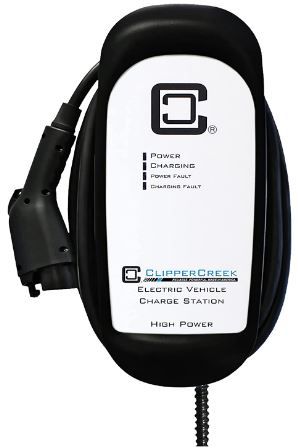
Enphase, previously known as ClipperCreek, is renowned for its award-winning technology found in every EV charger it produces - a testament to its industry-leading durability and reliability. Now, they have even further improved their products by offering a 5-year limited manufacturer warranty along with round-the-clock customer support. The HCS-40 hardwired home electric car charging station, which comes fully assembled, is designed for swift installation to a dedicated 40 Amp circuit by any licensed electrician.
The Enphase Level 2 EV chargers aren't just about reliability, but also safety. They are certified by ETL, an Independent Nationally Recognized Testing Laboratory, in compliance with the UL 2594 standards and have earned the ENERGY STAR certification. Originating from California, these commercial car charging stations are engineered to endure high-traffic use and a broad range of temperatures. They also feature fully sealed outdoor-ready NEMA 4 enclosures, protecting the internal components from weather elements.
When it comes to charging speed, the HCS-40 hardwired 240V 32 Amp Level 2 charger offers up to seven times faster charging than the standard Level 1 electric vehicle charger that comes with your EV. With a power capacity of 7.7kW, or up to 31 miles per hour of charging, you can rest assured that your EV or plug-in hybrid will be ready to hit the road after an overnight charge. Note that the HCS-40 requires a minimum 40 Amp dedicated circuit, and the miles per hour charge rate may vary based on your EV's make and model.
The HCS-40 isn't just a universal charger; it's specially designed for compatibility with all plug-in EVs sold in the USA. However, it performs best with vehicles having acceptance rates up to 7.7kW, such as the Tesla Model 3, Jeep Wrangler 4xe, Kia Soul, and Hyundai Kona. Additionally, Enphase chargers qualify for state and federal rebates, offering you the chance to earn money back by charging your electric car at home.
Enphase has also ensured that the HCS-40 comes with all the essentials you need. It includes a robust and flexible 25-foot-long cable with a J1772 connector, allowing you to charge your plug-in even from the opposite side of the garage or in the driveway. The package also comes with a physical manual for easy pre- or post-install reference. An integrated cable wrap and wall-mounted holster are also provided to help you neatly stow away your charger after use.

The price is a bit steep for what one gets. It doesn't work properly with the VW eGolf's delayed charging feature. The power cord should be longer.
Our Thoughts - With this product, plan the installation carefully.

Very Good
Product information
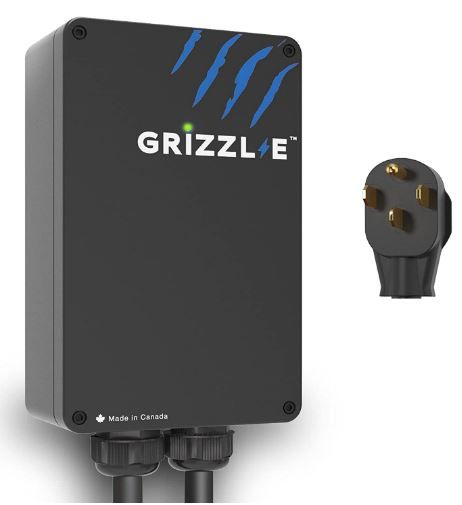
The Grizzl-E Classic NEMA 14-50 Plug with a 24-foot Premium Cable is more than just an Electric Vehicle Charging Station. It's a versatile, robust, and mobile solution designed to meet all your EV charging needs. Perfectly suited for both regular and chilly weather conditions, it's compatible with every type of Electric Vehicle (EV) and Plug-in Hybrid Electric Vehicle (PHEV) available in North America. Its simplicity and power set it apart, making it an essential tool for any EV owner.
What makes the Grizzl-E Classic stand out is its commitment to safety and quality. It has undergone thorough testing and has received full certification from Underwriters Laboratories (UL), a globally recognized safety testing organization. Moreover, it's eligible for the Federal rebate program, adding an extra layer of financial benefit. The charging station boasts an impressive IP67 rating, making it water-resistant. Plus, it's fire-resistant and comes equipped with multiple protection features, such as Over Current, Over Voltage, Under Voltage, Missing Diode, Ground Fault, and Over Temperature Protections. It also incorporates self-monitoring and recovery mechanisms, along with Power Outage Recovery.
The Grizzl-E Classic doesn't compromise on speed either. It provides fast charging and adjustable amperage options: 40A, 32A, 24A, 16A. The maximum current output varies depending on the circuit breaker, offering 40 Amps for a 50A circuit breaker, 32 Amps for a 40A breaker, 24 Amps for a 30A breaker, or 16 Amps for a 20A breaker. This adjustability ensures efficient charging tailored to your specific needs. The charge rate ranges from 10-12 miles per hour at 16A to an impressive 28-30 miles per hour at 40A.
Ease of installation and use are other notable features of the Grizzl-E Classic. It allows you to save significantly on installation costs—all you need to do is install a simple 14-50R outlet, and your Grizzl-E is ready to go. Its design makes it easily transportable, and it can be swiftly removed from the mounting bracket for transportation between different locations. To top it all, it comes in a NEMA-4 water and air-tight metal enclosure, guaranteeing durability. With its exceptional power and varied output configurations, the Grizzl-E Classic offers unrivaled value for your money, making it a standout choice among charging stations.

Can be easily installed without much electrical know-how.

Product support needs improvement. A customer reported that mounting hardware was missing and is waiting for a replacement.
Our Thoughts - A very good charger with many protection features.

Very Good
Product information
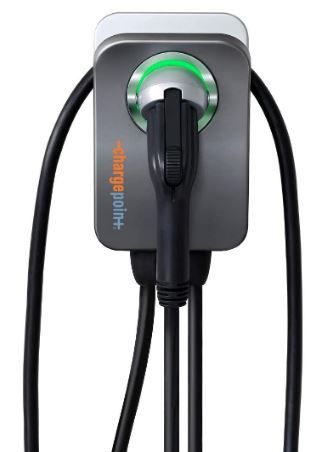
The Level 2, 240-volt outlet electric vehicle (EV) charging station revolutionizes the EV charging experience by offering charging speeds up to nine times faster than a standard wall outlet. Its versatility is showcased in its flexible amperage settings, ranging from 16 amps to 50 amps. Whether you prefer plug-in or hardwired installation, this charging station caters to your needs and preferences, making EV charging more accessible and efficient.
One of the standout features of this charging station is its universal compatibility. It works seamlessly with all-electric cars and has been rigorously tested on a wide range of leading EV models. Whether you drive a Chevrolet Volt, Hyundai Kona, Nissan LEAF, Tesla Model, or any other electric vehicle, this charging station guarantees fast and reliable charging.
Enhance your EV charging with the ChargePoint home app's intelligent features. This smart app allows you to schedule your charging sessions during times when electricity rates are lowest, helping to save on energy costs. It also provides reminders to plug in your EV and offers Alexa voice control for a hands-free experience. Moreover, it consolidates all your ChargePoint Home Flex charging data in one convenient location, keeping you informed about your charging habits and patterns.
This charging station isn't just about speed and smart features; it's equally committed to safety and reliability. Backed by a 3-year warranty and round-the-clock customer support from a company with over a decade of experience in EV charging, you can charge your EV with peace of mind. The charging station is
UL-listed for electrical safety and has earned the ENERGY STAR certification for its energy efficiency, further testifying to its quality.
Installation of this charging station is a breeze for any electrician, indoors or out. If you opt for plug-in installation with a NEMA 6-50 or 14-50 outlet, you'll need circuits rated 40A or 50A. For circuit ratings outside of this range, including 60A-80A for 48A-50A charging, the plug can be easily removed for hardwired installation. This flexibility allows you to select the amperage that best suits your home, potentially saving you from costly electrical upgrades.

Customer support seems to be good. The app is really great for the information it gives.

Some chronic issues with Audi & VW charge ports. The cord should be longer.
Our Thoughts - This product seems to have some niggly issues, but overall is a good charger. With ChargePoint Home Flex, you can adjust the current you want going into your EV.

Best Value
Product information
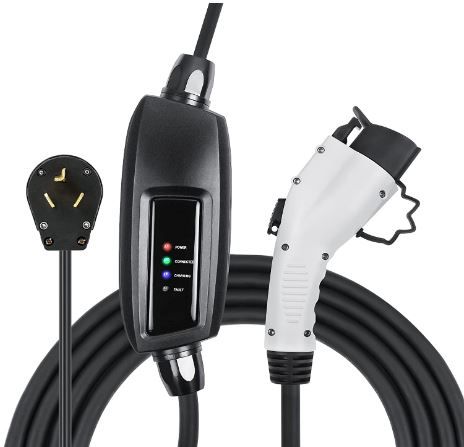
Experience the future of EV charging with our fast-charging solution designed to make the process as swift and effortless as possible. Our charging cable is built to be compact and resilient, making it an ideal choice for home use. The 21-foot cable length caters to most driveways or garages, ensuring easy access for charging. It uses the industry-standard J1772 charging protocol, enabling compatibility with all-electric cars and plug-in hybrids.
Our Level 2 charger takes your car charging experience up a notch by offering three times the charging speed of your car's original charger. Operating at 240V with up to 16A, it delivers a robust charging rate of 3.86kw/hour. This means you can expect approximately 11 miles of charge per hour, significantly reducing your vehicle's charging time and getting you back on the road quicker.
Quality is at the heart of our charging station. We've engineered it to be rugged and sturdy, capable of withstanding daily use. It's equipped with overvoltage, overheating, and overcurrent protection to ensure safe and efficient charging every time. The integrated indicating light provides visual cues about the different stages of charging and alerts you to any potential errors, keeping you informed throughout the charging process.
In terms of technical specifications, our charger has an input power of 240V AC and a voltage range from 185V AC to 264V AC. It operates at a frequency of 60Hz and a maximum current of 16A. The charger features a NEMA 10-30 plug and a cable length of 21ft (6.4m). It weighs in at 3.3kg (7.3lbs) and can operate in temperatures ranging from -30C (-22F) to 50C (+122F), making it a versatile addition to your EV charging setup.
We stand behind our products with the Electron 1-year warranty. If our product doesn't meet your expectations, we encourage you to contact us. We will strive to resolve the issue, and if we are unable to do so to your satisfaction, we guarantee a full refund or replacement - no questions asked. We value your trust in our products and aim to deliver the highest level of customer satisfaction.

It has safety precautions for overheating and overcharging. Good cord length.

The charging coupler is tight and difficult to plug in and unplug.
Our Thoughts - For the price, this is a good charger that has many features.

Very Good
Product information
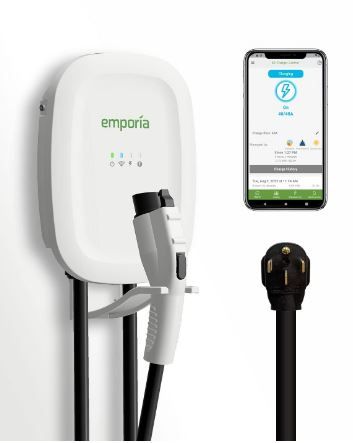
Introducing our Level 2 EV Charger, certified by UL and ENERGY STAR. This charger comes with a default charge rate of 40A, providing an efficient charging solution for your electric vehicle. However, to adjust the charge rate, a WiFi internet connection is required. The charger can be paired with an Emporia Vue Smart Home Energy Monitor, allowing you to optimize your energy use by charging only with surplus solar power and curbing charging during periods of peak demand.
Safety is central to our charger's design. It's been manufactured in line with the safety standards set out by NEC 625, SAE J1772, UL 817, UL 991, UL 2231, UL 2251, and UL 2594. Whether you choose to install it indoors or outdoors, this charger stands up to the elements with its rugged, watertight NEMA Type 4 enclosure. We recommend checking for any incentives or rebates available in your area from your local company or state. Furthermore, our charger comes with a 3-year warranty, offering you peace of mind.
Our EV charger offers installation flexibility. You can either opt for a hardwired installation or use a plug. It supports various power configurations: 11.5kW (240V/48A), 9.6kW (240V/40A), 10kW (208V/48A), or 8.3kW (208V/40A). If you're going for a hardwired installation or installing a NEMA Plug, we recommend hiring a professional electrician. For a 48A charge, a dual-pole, dedicated breaker at 60A+ is required, and for a 40A charge, a 50A+ breaker is needed.
Compatibility won't be an issue with our charger. It works with any EV thanks to the included SAE J1772 connector. Please note that an adapter is required for Tesla EVs. The charger also comes with a 24-foot cable that features integrated cable management, making it convenient to use and store.
Our charger offers real-time energy data, providing you with insights into your energy consumption and charging sessions. To access this feature, a 2.4 GHz WiFi connection with internet access is required. You can monitor your energy usage and schedule charging sessions through the iPhone/Android/Web Browser app. This feature enables you to manage parameters effectively to cope with variable utility rate charges.

The Emporia unit works flawlessly and is a pleasure to use. The WIFI is great to have.

A customer reported that it doesn't charge his Chevy Bolt as the charging port doesn't engage properly.
Our Thoughts - A simple system that will power your vehicle very well. It's a great product for the money.

Good
Product information
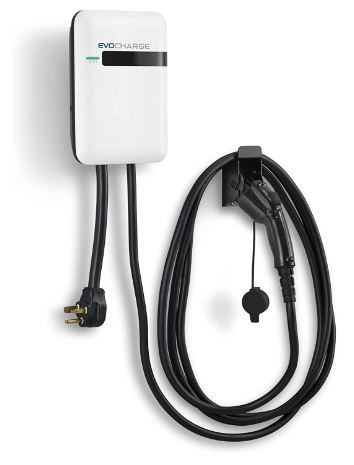
Our charger is designed to be a one-stop solution for all your EV and PHEV charging needs. It's fully compatible with every Electric Vehicle and Plug-in Hybrid Electric Vehicle sold in the United States and Canada. This includes popular models like the Chevy Bolt, Nissan Leaf, Ford Fusion, BMW i3, Chevy Volt, Toyota Prius, and even Tesla vehicles when used with an adapter.
Experience the speed of super-fast charging with our charger. It charges up to eight times faster than standard AC Level 1 EV chargers, adding an estimated 25-35 miles of range per hour. Beyond its impressive charging speed, our charger also boasts easy installation. It comes with a standard NEMA 6-50 plug and a universal mounting bracket, making the setup process straightforward and hassle-free.
Safety is paramount in our design and manufacturing process. Our charger has been meticulously designed and tested to meet the nationally recognized UL standards for safety in the USA and CUL standards in Canada. These certifications are crucial for any electrical product installed in your home. Moreover, our charger has a NEMA 4 rating, indicating its suitability for both indoor and outdoor use in any weather conditions.
With its adjustable amperage and sleek, compact design, our charger unit fits seamlessly into various settings. You can adjust the unit's maximum current output to either 32A, 24A, or 16A to support circuit ratings of 40A, 30A, or 20A. The charger's slim, modern design allows for installation in multiple locations without intruding on your space.
Our goal is to provide you with everything you need in one package, eliminating the need for additional purchases. The package includes the charging unit with an 18-foot cable for extended reach, a NEMA 6-50 plug, a universal wall mounting bracket for easy installation, a plug holster for safekeeping, and a user manual to guide you through the setup and operation. All these come at one affordable price, offering exceptional value for your investment.

Easy installation and a very good charging system.

Customer support needs to be better. Some missing parts in the kit. The cord should be a bit longer.
Our Thoughts - A good product that will give fast charging.

FAQs: Home EV Chargers
What is the best amperage for a home EV charger?
48 amps is the best choice for most homeowners. It provides the fastest Level 2 charging speed available on a standard residential circuit (60-amp breaker) and is compatible with current and future vehicles. If electrical capacity is limited, 32 amps on a 40-amp breaker is a solid alternative.
Can I install a home EV charger myself?
The EVSE unit itself is often plug-and-play (for plug-in models). However, the 240V circuit installation requires a licensed electrician in most jurisdictions. Electrical work without proper permits can violate building codes, void insurance, and create safety hazards.
How much does it cost to charge an EV at home?
The national average electricity rate is approximately $0.16/kWh (2026). Charging a 60 kWh battery from empty to full costs roughly $9.60 at the national average. With off-peak TOU rates, the cost can drop to $5 to $7. Compare this to $30 to $50+ for a tank of gas in a comparable ICE vehicle.
Do I need to upgrade my electrical panel?
Not always. If your panel has enough available amperage (60 amps for a 48-amp charger), no upgrade is needed. If your panel is at or near capacity, you may need an upgrade ($1,500 to $3,000) or a load management device that shares capacity between circuits.
Can I use my EV charger in the rain?
Yes, if the unit is rated for outdoor use (NEMA 3R or higher). NEMA 4-rated chargers are designed to withstand rain, snow, and splashing water. The charging connector itself is also weatherproof when properly connected to the vehicle.
How long does a home EV charger last?
Quality Level 2 chargers are designed to last 10 to 15+ years with minimal maintenance. There are no consumable parts. The main risk factors are power surges (use a whole-home surge protector) and physical damage to the cable or connector.
Is a smart charger worth the extra cost?
Yes, if your utility offers time-of-use rates. Scheduled charging during off-peak hours can save $500 to $1,000+ per year. Energy monitoring and app control add convenience. The $50 to $150 premium for smart features pays for itself within months.
Can I charge two EVs on one charger?
One EVSE charges one vehicle at a time. If you have two EVs, you can either install a second EVSE on a separate circuit or use a load-sharing device that splits one circuit between two chargers (each charges at reduced speed). Some smart chargers support sequential scheduling: one car charges first, then the other starts automatically.
What happens if the power goes out while charging?
The EVSE and the vehicle both detect the power loss and stop the charging session safely. When power is restored, most chargers resume automatically. There is no risk of damage to the vehicle or the charger.
Check out these other interesting articles!
 Save With Reviews
 Save With Reviews
 Save With Reviews