
Your Stock Horn Is a Joke. Here Is How to Pick the Right Air Horn for Your Truck.
You already know your factory horn is useless. You have hit it in traffic, watched the car next to you not even flinch, and thought, "That's it?" Maybe someone drifted into your lane while you were towing, and the best your truck could manage was a sound that belongs on a golf cart. That moment sticks with you.
So you started looking. And that is where the second frustration kicked in. Amazon gave you 400 listings that all look the same. The local parts store had two cheap electric horns covered in dust. You watched a few YouTube videos and got three different recommendations. You asked in a truck forum and got ten opinions, zero consensus. Half the horns you actually liked were out of stock or discontinued. The other half had specs that might as well have been written in another language.
This article is the shortcut through all of that. No filler, no upsell. Just a clear breakdown of what types of horns exist, how they actually work, what specs matter for your truck, and how to avoid the most common mistakes guys make when buying their first air horn kit.
Five Types of Truck Horns and What Each One Actually Does
Not all horns are built for the same job. Before you spend a dollar, you need to understand what separates a $40 electric swap from a $350 train horn kit. The differences are not just about volume. They affect installation complexity, space requirements, and whether you even need a compressor.
| Horn Type | Decibel Range | Compressor Required | Price Range | Best For | Install Difficulty |
|---|---|---|---|---|---|
Electric | 100 to 115 dB | No | $20 to $60 | Direct stock replacement, daily driving | Easy, bolt-on swap |
Single-trumpet air horn | 120 to 135 dB | Yes | $80 to $180 | Noticeable upgrade, moderate volume | Moderate |
Dual-tone air horn | 118 to 130 dB | Yes | $100 to $200 | Fuller, layered sound that carries well | Moderate |
Train horn (2 to 4 trumpets) | 130 to 152 dB | Yes, with larger tank | $150 to $400+ | Maximum volume, towing, highway safety | Moderate to advanced |
Musical horn | Varies | Yes | $100 to $250 | Novelty, parades, personal expression | Moderate |
A few things worth noting here. Electric horns are the simplest upgrade. You pull the old one off, wire the new one in, and you are done in under an hour. They are louder than stock, but they will not turn heads on the highway.
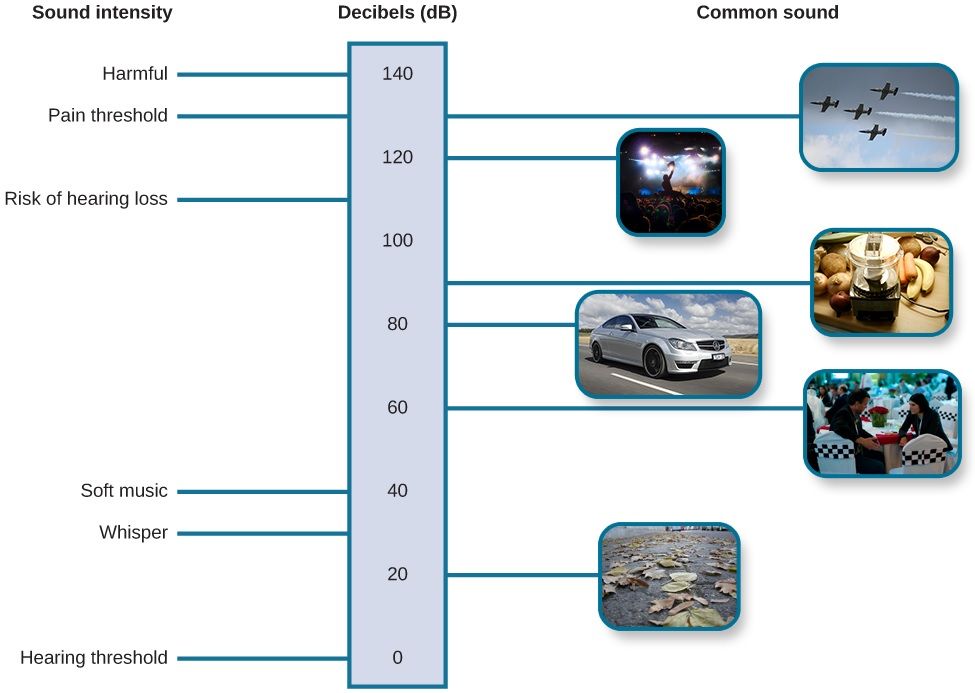
Air horns and train horns are where the real jump happens. A single-trumpet air horn running off a small compressor and a 1-gallon tank will get you into the 120 to 135 dB range, which is a serious step up from stock. Train horns with multiple trumpets and a larger tank push into the 140 to 152 dB territory, which is loud enough to be heard over diesel engines, road noise, and the distracted driver with their windows up.
Dual-tone horns use two separate chambers tuned to different frequencies. The result is a layered, harmonized blast that carries farther than a single-note horn at the same decibel level. If you want something that sounds authoritative without going full locomotive, dual-tone is a solid middle ground.
Musical horns exist, and they are fun, but they are a novelty purchase. If you are here because you need people to hear you on the highway, skip them.
How an Air Horn System Actually Works
The concept is simple, even if the result is anything but quiet. Compressed air is stored in a tank. When you press the horn button, a solenoid valve opens and releases that air through the horn's bell, where it passes over a flexible metal diaphragm. That diaphragm vibrates rapidly, and those vibrations create the sound waves you hear (and feel) from a distance.
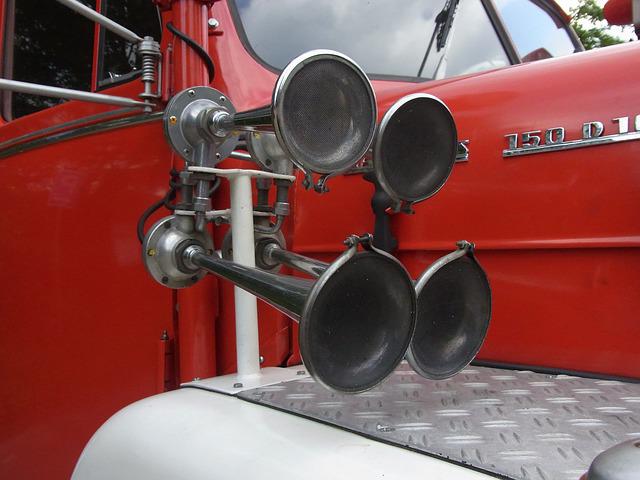
The size of the diaphragm and the length of the trumpet bell determine the pitch. A short bell with a small diaphragm produces a higher, sharper tone. A long bell with a large diaphragm produces the deep, chest-thumping blast you hear from locomotives. This is why a quad-trumpet train horn sounds completely different from a compact single-trumpet air horn, even if both run on compressed air.
The compressor's job is to refill the tank after each use. A typical 12V compressor paired with a 1-gallon tank takes roughly 3 to 6 minutes to refill from empty to operating pressure (usually 110 to 150 PSI, depending on the system). Larger tanks (2 to 5 gallons) give you longer, sustained blasts before the compressor needs to catch up, but they also take up more space and weigh more.
One question that comes up constantly is whether an air horn system will drain your battery. The short answer is no, not during normal use. The compressor draws power only while refilling the tank, and a typical cycle pulls around 15 to 30 amps for a few minutes. That is well within what your truck's alternator can handle while the engine is running. If you are honking so frequently that the compressor runs nonstop, the horn is not your problem.
What Is Inside a Complete Air Horn Kit
Before you buy anything, you need to know what a complete kit includes versus what you might need to source separately. A quality kit should come with everything on this list.
- Horn assembly. The trumpet or trumpets themselves. Can be single, dual, or quad. Material matters here. Stainless steel or chrome-plated brass resists corrosion. Chrome-plated zinc or plastic will not last through a harsh winter.
- Air tank. Stores compressed air. Sizes range from 0.5 gallons (compact, short blasts) to 5 gallons (sustained blasts, better for train horns). A 1-gallon tank is the sweet spot for most single or dual-trumpet setups on half-ton trucks.
- Compressor. Refills the tank. Look for a duty cycle rating. A compressor rated at 100% duty cycle can run continuously without overheating. Cheaper units with a 30% to 50% duty cycle need rest periods.
- Pressure switch. Automatically turns the compressor on when tank pressure drops below a set point and off when it reaches operating pressure. This protects the compressor from overwork.
- Solenoid valve. The electrically controlled valve opens when you press the horn button, releasing air from the tank to the horn. This is the "trigger" of the system.
- Pressure relief valve. A safety component that vents excess air if the system exceeds its rated PSI. This prevents tank over-pressurization. Non-negotiable for safety.
- Airline, fittings, and wiring harness. The connectors that tie everything together. Check that the kit includes the correct air line diameter and electrical connectors for your truck.
If a kit does not include a pressure relief valve or a pressure switch, that is a red flag. These are not optional accessories. They are safety components.
What to Check Before You Buy
This is where most guys either overthink it or skip the homework entirely. Neither works. Here are the five factors that actually determine whether you end up happy with your purchase or returning a box of regret.
- Fitment for your truck. "Universal fit" does not mean it fits your truck. It means the manufacturer did not bother making vehicle-specific brackets. Before you order, measure the space where you plan to mount the tank and compressor. Common locations are under the chassis, behind the rear bumper, in the bed, or behind the cab. An F-150 has different frame rail spacing than a Ram 1500, and a Tacoma has significantly less underbody clearance than either. Check the kit's tank dimensions and compressor footprint against your available space.
- Decibel claims versus reality. Budget brands love to slap "150 dB" on the box. Be skeptical. Legitimate decibel ratings are measured at a specific distance, usually 3 feet or 1 meter. A horn rated at 150 dB at 1 inch is not the same as 150 dB at 3 feet. Reputable manufacturers publish their testing methodology. If the listing does not mention testing distance, assume the number is inflated.
- Your state's laws. Installing an aftermarket air horn or train horn is not illegal in most states. Using it inappropriately can be. Most state vehicle codes require a horn that is audible from at least 200 feet, but also prohibit "unreasonably loud or harsh" sound. Some states and municipalities have specific restrictions on train horn use in residential areas or for non-emergency purposes. "Legal to install" and "legal to blast in a parking lot at midnight" are two very different things. Look up your state's vehicle code before you buy, not after.
- Installation reality. A basic air horn kit on a full-size truck is a 2 to 4 hour job for someone comfortable with hand tools, basic wiring, and drilling mounting holes. You will need to mount the tank, mount the compressor, run an air line between them, wire the compressor to your battery (with an inline fuse), and connect the horn trigger to your steering wheel button or a separate switch. It is not brain surgery, but it is not a 20-minute bolt-on either. If wiring makes you nervous, budget an extra $100 to $200 for a shop to handle the install.
- Build quality and materials. Your horn lives under your truck, exposed to road salt, mud, rain, and temperature swings. Stainless steel trumpets and a powder-coated or stainless tank will hold up for years. Chrome-plated zinc trumpets and a bare steel tank will start corroding within one season. Spend the extra $50 to $100 on better materials. Replacing a rusted-out horn after eight months costs more than buying the right one the first time.
Three Misconceptions That Cost Guys Money
"Louder is always better." It is not. A 152 dB train horn designed for a Peterbilt might be physically too large for your half-ton pickup, and running it in a residential neighborhood will get you a noise complaint or a citation. Match the horn to your actual use case. If you tow on highways, a 140 to 150 dB train horn makes sense. If you mostly drive around town, a 125 to 135 dB air horn gives you a massive upgrade over stock without the legal headaches.
"All air horns sound the same." They absolutely do not. A single-trumpet air horn produces a sharp, high-pitched blast. A quad-trumpet train horn produces a deep, resonant chord that sounds like an actual locomotive. The difference is dramatic, and it comes down to the number of trumpets, their length, and the diaphragm size. If you can, listen to sound clips before buying. Most reputable sellers post audio or video demos.
"If it says universal fit, it fits my truck." Universal fitment means the horn itself is not vehicle-specific. It does not mean the mounting hardware, air line routing, or electrical connections will work without modification on your particular truck. Always check tank dimensions against your available mounting space, confirm that the wiring harness reaches your battery and horn button, and verify that the compressor will physically fit where you plan to put it.
How to Install an Air Horn Kit on Your Truck
Every kit is slightly different, but the general process follows the same sequence. Read your kit's instructions first, but this gives you a realistic picture of what the job involves.
- Choose your mounting locations for the tank and compressor. Measure twice. Common spots are the frame rail, behind the rear bumper, or inside the bed with a toolbox cover.
- Mount the air tank using the included brackets and hardware. Make sure it is secure and will not shift under vibration.
- Mount the compressor near the tank to keep the air line short. The compressor needs to be accessible for maintenance and positioned where it will not sit in standing water.
- Connect the air line from the compressor to the tank, and from the tank to the horn assembly. Use thread sealant tape on all fittings to prevent air leaks.
- Mount the horn trumpets. Most guys mount them under the truck, pointing forward or downward. Make sure they are clear of exhaust components and moving parts.
- Wire the compressor to your battery through an inline fuse (typically 30 to 40 amp) and a relay. Connect the pressure switch inline so the compressor cycles automatically.
- Connect the solenoid valve to your horn button or a separate dash-mounted switch. Test the system, check for air leaks at every fitting, and adjust the pressure switch if needed.
The whole job takes most guys a Saturday afternoon. If you have a buddy to help hold things in place while you drill and bolt, it goes faster.
Matching the Right Setup to Your Truck
There is no single "best horn" because the right answer depends on your truck, your budget, and what you actually need it for. But here is a practical starting point.
If you drive a mid-size truck like a Tacoma or Colorado and want a meaningful upgrade without a complex install, a compact single-trumpet air horn with a 0.5 to 1 gallon tank fits well and delivers 120 to 130 dB. You can't tuck the tank and compressor behind the rear seat or under the bed.
If you drive a full-size truck like an F-150, Silverado, or Ram 1500 and want serious volume for highway driving or towing, a dual or triple-trumpet train horn with a 1 to 3 gallon tank is the sweet spot. You have the frame space to mount everything cleanly, and you will get 135 to 150 dB depending on the setup.
If you haul heavy loads regularly or drive a three-quarter-ton or one-ton truck, a full quad-trumpet train horn with a 3 to 5 gallon tank gives you the sustained blast power and volume to cut through anything. These setups are louder, heavier, and take up more space, but your truck can handle it.
Whatever you choose, buy the complete kit from one manufacturer rather than piecing together components from different brands. Mismatched fittings, incompatible pressure ratings, and air leaks from poorly matched parts are the number one source of installation headaches. A $250 complete kit that works out of the box beats a $180 collection of parts that takes three weekends to troubleshoot.
Your Truck Deserves to Sound Like Your Truck
Your rig is not a commuter sedan. It should not sound like one. The right air horn setup gives you the volume to be heard when it matters, the presence to match the truck you have built, and the confidence that comes from knowing the system is solid, legal, and built to last. Pick the setup that fits your truck, your state, and your budget. Install it once, install it right, and stop settling for a horn that nobody can hear.
Last Honk: Wrapping It Up
If you’re serious about giving your truck a voice—whether it’s a polite honk or a full-on sonic boom—invest in the right air horn system. Think quality over gimmick. Match it to your vehicle, your local laws, and your level of dramatic flair.
In a world where being heard can literally save lives (and sometimes feels good), don’t settle for stock sounds. Upgrade. Customize. Express yourself... loudly.
Because sometimes, the road doesn't just need drivers—it needs characters.
Can we help? We've done the research for you and found the Best Air Horns for Trucks on Amazon. Every day, we read hundreds of reviews and try the highest-rated products we have on our list.
Air Horns For Trucks - Reviews
The Best
About these air horns
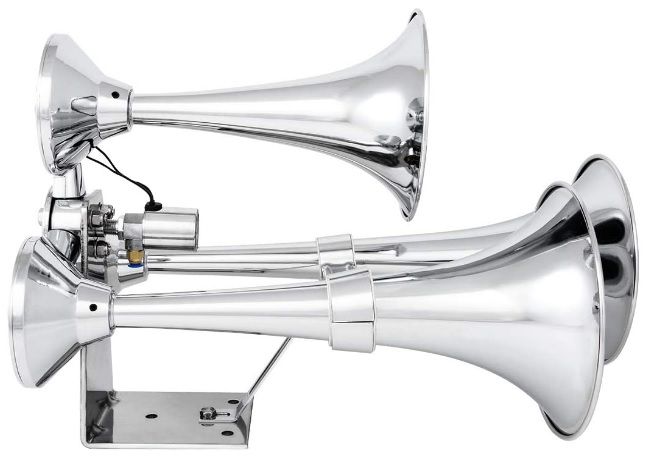
Looking for a train horn system that packs a serious punch? Look no further than this heavy-duty train horn system, which features a sleek chrome finish and a true train horn sound that can reach over 140 decibels. The system includes chromed brass trumpets and stainless steel brackets, and it can operate within a wide range of pressure levels, from 70 PSI to 140 PSI and beyond.
Please note that to install this powerful system, you'll need to provide your air tank and 1/4-inch inner diameter hose - these items are not included. However, you can customize your experience with a variety of optional accessories, including train horn floor mount stands and air valve lever sets in 4-inch, 7-inch, and 11-inch sizes (GG 69977, GG 69979, and GG 69982, respectively). For even more power, consider adding the heavy-duty electric solenoid valve (GG 69993) to your setup (sold separately). With this train horn system, you'll be sure to turn heads - and maybe even make some ears ring!

You will be heard! Nice tones with deep sound. Chrome-coated for environmental protection.

Compressor, air tank, and mounting accessories are not included.
Our thoughts: Top-class with great sound and quality. Once you hear about these beauties, you don't want any others.

Best Value
About this air horn
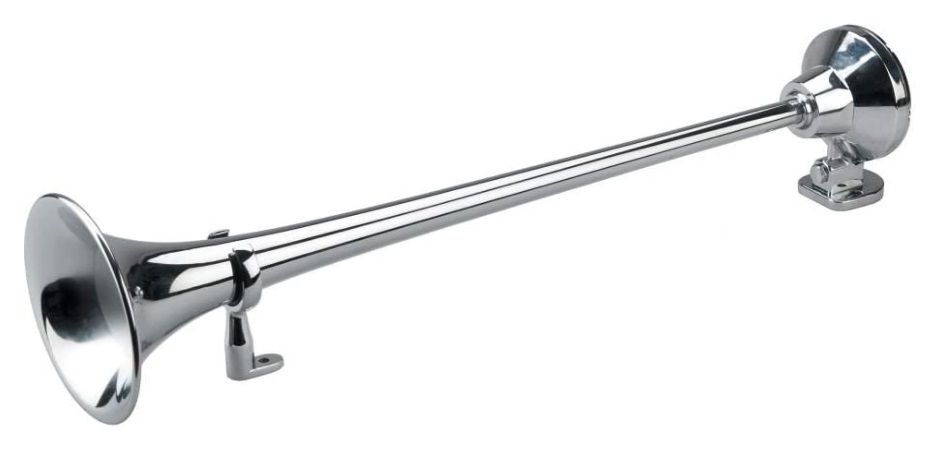
Looking for an attention-grabbing horn that commands authority? Look no further than this emergency vehicle and fire truck horn, specifically engineered to produce the powerful and commanding "Sputtering Sound." Made with all-metal construction and coated in a layer of durable chrome plating, this horn can endure extreme weather conditions and deliver reliable performance for years to come.
For added versatility, this horn comes with a sturdy metal pedestal support that is also coated in a sleek chrome finish. Whether you're outfitting an emergency vehicle or a train, this horn's all-metal construction and commanding sound make it perfect for any application. Don't settle for a weak or ineffective horn - upgrade to this commanding and reliable option today.

Loud, single trumpet-like sound. Well protected with chrome coating.

What you see is what you get. Compressor, air tank, and mounting accessories are not included.
Our thoughts: Good enough to let vehicles and people know that you are coming.

Almost Took Best Place
About these air horns
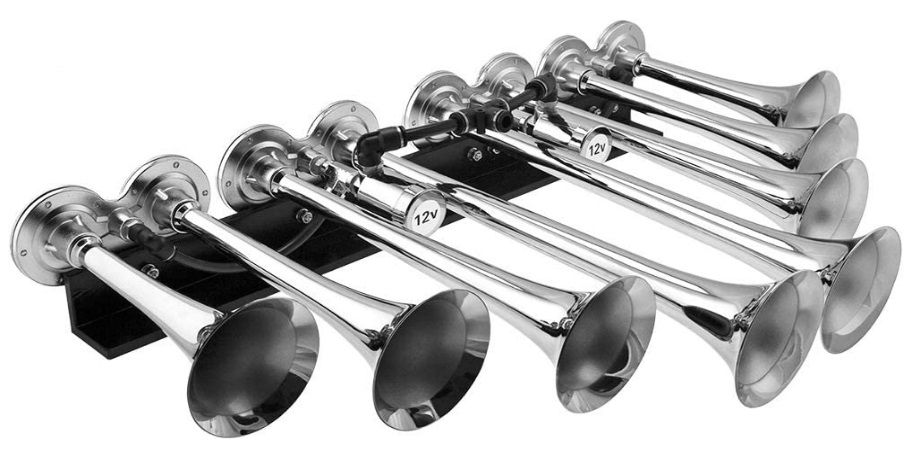
Looking for a train horn that truly stands out from the rest? Look no further than the OCTOPOD™ - a revolutionary, patented design (U.S. Design Patent No. D937,344 S) featuring eight air horns, dual 12V heavy-duty solenoids, and a larger air orifice for a loud and attention-grabbing blast. Don't just take our word for it - check out the sound sample video and hear the massive, deep tone for yourself.
Capable of producing an incredibly powerful and deep train horn sound, the OCTOPOD™ features a unique structure that's sure to turn heads. Customize your setup with the ability to move the trumpets around and convert their style between convex (default) and optional concave (see images). The kit comes with detailed instructions and heavy-duty mounting hardware for a secure and long-lasting installation. Crafted with high-quality materials and a durable coating, the OCTOPOD™ is built to last and withstand harsh weather conditions.
With years of testing and development behind it, we're confident that the OCTOPOD™ is the best value for your money. Pair it with one of our matching onboard air systems to unleash the beast and make your presence known on the road or rail. Check out our comprehensive line of kits and parts to complete your installation and experience the power of the OCTOPOD™ for yourself.

Beautiful, loud sound from the eight trumpets. Protected with a chrome coating.

Compressor, air tank, and mounting accessories are not included.
Our Thoughts: A great set of air horns.

Very Good Air Horns
About these air horns
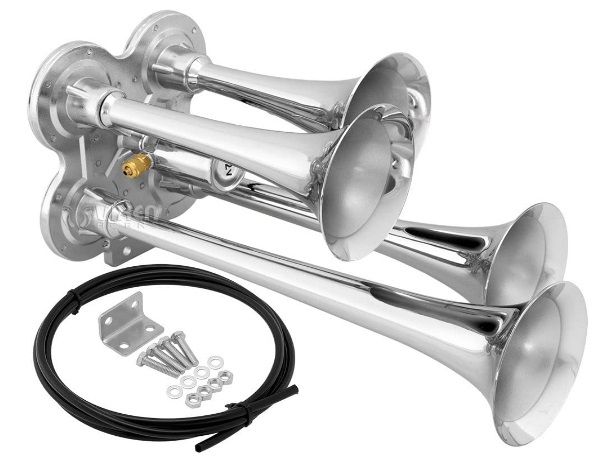
Looking for a powerful addition to your vehicle that demands attention on the road or rail? Look no further than the Triple Trumpet Train Air Horn. This system boasts a 1.5-gallon (6-liter) tank capacity and a 12-volt 150 PSI compressor that delivers an impressive performance. With thermal overload protection, the compressor remains safe and reliable even under heavy usage, ensuring long-lasting functionality.
Rest assured that mounting the horn on your vehicle is a breeze - all necessary mounting hardware is included. With its commanding presence and reliable functionality, the Triple Trumpet Train Air Horn is sure to turn heads and make a lasting impression. Upgrade your ride with this powerful addition today and experience the difference for yourself.

It deserves this coveted position. Great sound and depth.

Not quite like the big brother with eight horns. Compressor, air tank, and mounting accessories are not included.
Our Thoughts: Four-horn system with a very good, deep sound, great for clearing the way.

Good Air Horns
About these horns
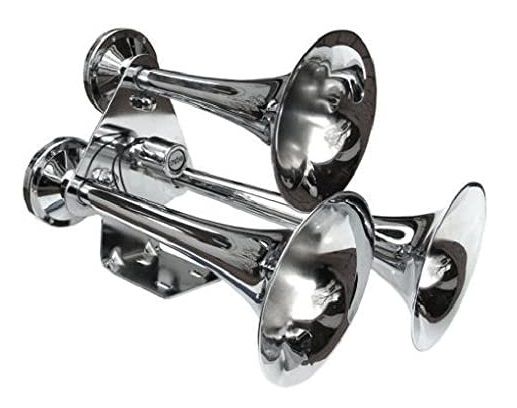
Get ready to turn heads and make a bold statement with this powerful train horn system. Boasting an impressive sound output of 152db at 150 Hz, this horn is guaranteed to make an impact that won't go unnoticed. The all-metal construction features chrome trumpets that not only add a touch of style to your vehicle but also ensure durability and long-lasting performance.
Each chrome bell has a front diameter of 6 1/4", and the horn itself measures L 16 1/4" x W 15" x H 11". To make installation a breeze, this train horn system comes complete with an electric valve solenoid and air hose. With everything you need in one convenient package, you'll be ready to make a bold and powerful statement on the road or rail. Upgrade your vehicle with this powerful and stylish train horn system today and experience the difference for yourself.

A good set of air horns. We also liked the deep sound they produce.

Compressor, air tank, and mounting accessories are not included.
Our Thoughts: This one may not be like our top contender, but it is a great set for your needs.

Great Kit
About these air horns
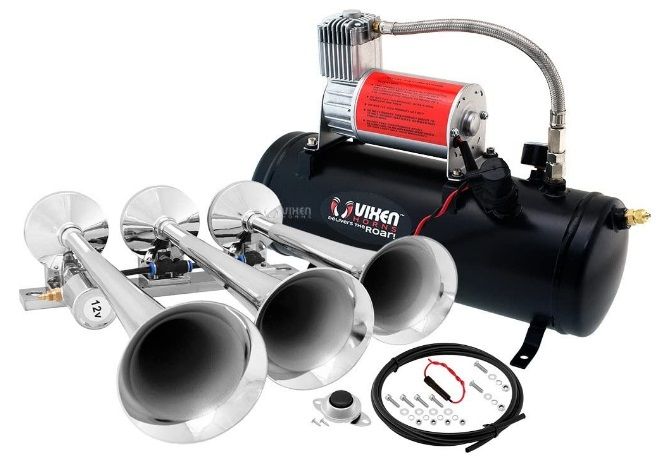
Looking to add a commanding presence to your vehicle? The Triple Trumpet Train Air Horn is a powerful addition that's sure to turn heads. With a 1.5-gallon (6-liter) tank capacity and a 12-volt 150 PSI compressor, this system delivers impressive performance. Thermal overload protection ensures that the compressor remains safe and reliable even under heavy usage.
You won't have to worry about mounting the horn on your vehicle - all necessary mounting hardware is included. Upgrade your ride with the Triple Trumpet Train Air Horn and make a statement on the road or rail. With its powerful sound and reliable functionality, this horn is a must-have for any vehicle owner looking to stand out in a crowd.

Made by Vixen, this is a good kit of air horns. All are included in one pack. Coming sixth, it's no disgrace.

When empty, the air tank may take up to three minutes to fill up with air.
Our Thoughts: The three-horncan't system with a very good, deep sound will do a good job when you need it.

FAQs
Why do trucks have air horns?
The 100 to 110-decibel gadgets are installed by manufacturers to abide by the majority of the state's Department of vehicle safety standards, which require a horn to be in good working order and with the ability to release a sound that is audible under normal circumstances from a range of not less than 200 feet.
What's Better: A Metal Or Plastic Air Horn?
Metal types are normally far better for deeper notes, whereas plastic can be excellent for mid-range notes. It's up to you whether you go with plastic or metal; the important point is to have a resilient, weather-resistant air horn construction. However, if you decide to go for plastic, make sure it is made out of high-quality Polypropylene (PP), as this is the best plastic for the horns.
What's the best installation for truck air horns?
A vital element to take into consideration is whether the layout is compatible with your truck. For obvious reasons, they may have to be placed under the vehicle, while in other circumstances, they can be installed somewhere much more noticeable, like on the cabin's roof or by the cabin's side. It also depends on the number of horns you may have; a single horn may be easier to install than numerous trumpets in an assembly.